

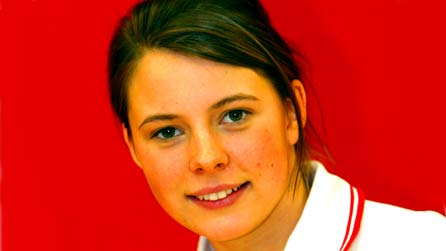
The Paralympic gold medallist discusses the importance of education and her determination to be the best.
Raise Your Game: How important has education been for you?
Liz Johnson: I think education is important because it helps to keep your feet on the ground. Whilst swimming gives you a lot of opportunities, you can't swim forever. It's such a physically demanding sport that you can't keep it up. It's good to keep education in the back of your mind with an idea of what you'd like to do after sport.
I'd swim from six until eight o'clock in the morning, before I went to school. Then I'd go to school and then I'd swim again in the evening - half past five until half past seven or six until eight o'clock. Had I not been going to school, there wouldn't have been any time to socialise.
School helped me socialise. You meet different kinds of people and I think it makes you a more rounded person. Not that there's anything wrong with just going to school or just swimming but you meet so many different types of people. As a disabled person, I think the more opportunities you can have to practise fitting in, the better. You can feel a little overwhelmed or uncomfortable going to new places.
At school you're always meeting new people. You're always being challenged and you learn that your disability isn't that much of a problem and you get the confidence to try new things. I don't know if I would've had that confidence if I hadn't had all those opportunities. I learnt a lot from education that I apply to my sport. I also learnt a lot from my sport that helped me in my education.
RYG: How do you balance your sporting career with your educational commitments?
Profile
Name:
Elizabeth 'Lizard' Johnson
Born:
3 December 1985
From:
Newport, Wales
Height:
1.64m / 5' 5"
Sport:
Swimming
Events:
50m, 100m & 200m breaststroke
4x50m freestyle relay
Achievements:
- Gold (new world record) - 100m breaststroke, IPC World Short Course Championships (2009)
- Silver - 100m breaststroke, IPC Swimming European Championships, Reykjavik (2009)
- Gold - 100m breaststroke, Beijing Paralympic Games (2008)
- Gold - 100m breaststroke, IPC World Championships (2006)
- Gold - 4x50m freestyle relay, IPC World Championships (2006)
- Silver - 100m breaststroke, Athens Paralympic Games (2004)
LJ: People always ask me 'Which is more important to you, your education or swimming?' I could never really find the answer. I think I've answered myself by the actions and the decisions I've made. They were mutual. I developed a good routine whereby I didn't sacrifice my education or my swimming. Instead I sacrificed my life outside of both (laughs).
I only saw my friends at school and I hardly saw my parents because I'd swim for two hours before school and two hours after. That was my routine and it was what I needed to do to get the A levels I needed to progress to the next stage of my education, and to get the results I wanted in Athens. My parents were always there for me.
RYG: Has it helped you to set yourself goals along the way?
LJ: Definitely. Once you get into a routine you can just go with the flow. You just do it. I wanted to get my A levels and to achieve my goals in Athens because that was driving me to swim. You have to want to do it. If you don't want to do it it's hard. I didn't think of it as a sacrifice. For me it was completely worth it and, if I was in the same situation, I'd do it all over again.
RYG: How important is it for you to manage your time effectively?
LJ: It's fundamental. Without good time management the plan fails and you end up not getting anything done. You have to know what you want to do, how much time you've got to do it and then sit down and work out the best way to do it. It's all about sacrifice. Once you have the routine it's pretty easy to stick to it. As long as you take the time to plan how things are going to work it's all good. Without that planning you'll be in a mess.
With good time management there's no need to get stressed. You know where you're at, you know where you're going and things just seem to flow. If you don't know then everything goes wrong and you end up having a breakdown (laughs). The more you've got going on, the more you learn to prioritise things. Involving yourself with a sport definitely helps you to hone your time management skills.
RYG: What skills have you learnt from swimming that have helped you in other areas of your life?
LJ: I'm very lucky because I'm at the top of my sport so I get all the benefits. I'm currently filling in job applications for next year and every skill they're looking for from a previous job, I've learnt through swimming. I have to talk to new people and perform under the pressure of the big stage. I've experienced different foods and different cultures. I know how to manage my time, I know how to make sacrifices and I've shown commitment. I've got all of those things. I've also learned how to focus myself on a goal and see it through. I'm hoping that will stand me in good stead and someone will give me a job (laughs).
RYG: How does maths help you when you're swimming?
LJ: I've enjoyed maths since I was a child. When I did my degree in business management and finance I used maths a lot then. I am fortunate that swimming is based on times. You can break it all down to a decimal point with regard to what time you want to go for in the race. I get great comfort from that.
We use a lot of averages when we're doing test sets. We get our best average and we'll compare that with our past averages. Times play a big part in our training preparation. You can do a set and then go back and see if you've moved on or if you've gone backwards.
Our trainers use different mathematical formulas for the physiology - looking at blood lactate levels and things like that. I do like to use indisputable times in my training sessions and the only way to do that is through maths. It lets me see exactly where I'm at in my training and allows me to plot where I want to go.
RYG: How much do you use IT in your training sessions?
LJ: In our sport IT is very important. We have a monitoring form that we send in every week. We record our sessions on them and our statistics are entered into a central database. That data is then accessible to everyone - your coach, your performance director, UK sport, the Welsh institute of sport. All the people that are involved in helping you can access your statistics. IT is a good way of sharing information and minimising the chances of it getting lost. That's happened in the past.
Our performance director is blind so it's a lot easier for him to have documentation on a computer because his software can then read it to him rather than him having to have someone read it for him. Using IT is a great way of keeping everything catalogued. We can go and look back four years and compare what we're doing now with what we were doing then. My times and results show that I always tend to swim well towards the end of the year. We tabulate a lot of our results and we plot graphs with our big test set times on. That way there's no hiding from how you're doing. Computers are everywhere now and all sports depend on them.
RYG: How has your sport allowed you to handle difficult situations more effectively?
LJ: It's taught me that nothing's guaranteed. You can control what you do but you can't affect what anybody else does. You might go into a race thinking you haven't got a chance, but you might swim out of your skin and win. Similarly you can swim the best you ever have but if the person next to you swims faster then you can't help that. You've done your best but they've beaten you.
I'm so passionate about it that when things don't go my way it really does affect me. In the same way you work so hard for things that when they do go your way you get a lot of value from it.
When I was 14 I qualified for Sydney and then got reclassified. I went up a classification so I couldn't go because the times were different for the class above. At the time I thought it was the end of the world. I cried my eyes out and I didn't get back in the swimming pool until the team returned from Sydney. I needed that break and I needed to feel that disappointment because that made me more determined. That is what drives my determination more than anything.
After that I got a silver medal in Athens. The set back in Sydney taught me that everything has its purpose and happens for a reason. If you can draw a positive from any situation then it wasn't a bad thing. If you make a mistake, as long as you learn from it, then the mistake was worth making.
It's very easy when things are going well. You enjoy it and everything comes easily. When things don't go your way you're reminded that you're not invincible and that you have to earn the right to stand on top of the podium. You don't get given a gold ticket to be there, you have to work for it. Nothing is as important as your first major medal and your first world record but you get a special feeling every time you repeat that feat.
RYG: When you're in the middle of a long training session and every fibre in your body is telling you to stop, how do you motivate yourself to keep going?
LJ: It's hard. Some days you're in the zone whereas on other days you just want to go home. On those days I'll work out exactly how many lengths I've got left to swim and work out how much I've got left to do in percentages and fractions. I'll tell myself 'Right I've got 75% left to do, that's three quarters,' and so on. It helps to occupy my mind.
Sometimes I thrive on the pain. It depends what mood you're in on that day. When you're feeling really lost you've got to think of the big picture. Think back to the disappointments you've had and use them as your stimulus because you never want to be in that situation again. Sometimes you feel like your muscles are going to tear and you're going to pass out. When you're feeling down focus on where you want to be and where you definitely don't want to be. If you feel that passionately about it that should be enough to drive you on.
See also
Elsewhere on the web
Latest
All you need is the right attitude and to have the determination to be successful.
Former Leeds United and Leicester City midfielder
Training ground

Work hard
Colin Jackson reveals more top tips on making exercise part of your lifestyle.