

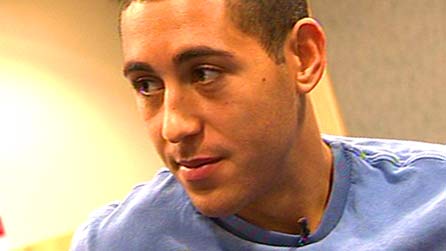
Matt Jones: Were you always the one to be picked first in school games?
Lewin Nyatanga: I wasn't always the star player. I like to think I was a first pick but I'm not a very skilful player that could pull out tricks. In the playground that's what it's all about really so there were a few players in front of me.
MJ: What sort of encouragement would you give players who wish that they were picked first or second?
LN: Prove people wrong. Luckily for me I've never been picked last. Just keep working hard and everyone will be wanting you on their team. If you're the best at 15-years-old and you stop training and stop working hard you may not be the best at 18. It's not always the best player at 15 that makes it. So if you are picked last at school don't worry.
MJ: How did you find the progression through the ranks of the Welsh camp?
LN: I think playing in front of a big audience and on TV was a big step up for me. You feel the pressure much more and how you deal with that affects how you play. I think playing for Wales as a schoolboy was a great experience for me because it got me used to playing in front of people and under the pressure of the cameras.
MJ: You broke the record of being the youngest ever Welsh senior player. How did that feel?
Profile
Name:
Lewin Nyatanga
Born:
18 August 1988
Sport:
Football
Clubs:
- Bristol City (2009-present)
- Derby County (2005-2009)
- Barnsley (on loan 2007-2008)
- Sunderland (on loan 2006-2007)
- Wales (2006 - present)
Achievements:
Voted Welsh Football Writer's Young Player of the Year in 2006
LN: It kind of hit me 'Ok, I'm going to play for Wales now and I'm going to break a record.' I had a little panic on the Monday but the game was on the Wednesday. By then I'd gotten over it and come to the conclusion 'This is what you've been working for your whole life, don't let your nerves get the better of you and waste all those years of hard work, just go and perform.' You're either going to sink or swim. Luckily I swam.
MJ: What was it like putting on the Welsh kit?
LN: Looking around the changing room and seeing the players sitting next to you, that was definitely weird. Looking across and seeing Ryan Giggs you think 'Hang on a minute, I've been watching him on Match of the Day for the last 10 years, and now I'm lining up with him and he's passing me the ball,' and you're talking to him. So it is strange.
You've got to be confident. They've put you in that situation for a reason. You must be good enough. Now you've got to prove to everyone that it was the right decision.
MJ: You must have had some stick about the Welsh anthem because you can't sing it can you?
LN: Welsh isn't my strongest language put it that way. I think it's the same for a few other players, but it wasn't too bad. In my second game I got a bit of stick for that. My argument is that if I had my mum's maiden name it would be Owen-Thomas, so you can't really get more Welsh than that.
MJ: It must be very emotional for you to stand in the line up for the anthem before the game?
LN: Definitely. You've got all those people singing it at the top of their voices. When you get 20,000 people doing that you really can hear it. I try not to look at my parents because I get a bit overwhelmed. I just try and concentrate on my game, but I do feel a bit of a chill when that Gwlad! goes high. I really do feel that.
MJ: Are you very disciplined when you train?
LN: Yes. You've got to change your training as you're coming into a first team environment. We used to be in the gym at 9 o'clock whacking balls around. Then you'd train at 10.30am, come back and have a second training session in the afternoon. If you did that with the first team, with the matches being so intense, you'd find it hard. Now it's less intense near a game. It's more work on quality and tactics - things like that.
MJ: How do you get the best out of your game?
LN: I still stay with the basics because that's my game really. I heard a comment once - simplicity is genius. Don't over complicate it, just pass it, tackle, give it to a midfielder, it's his job to be fancy. Sometimes it is hard when you see players on TV, like Ronaldinho, pulling out these tricks but, if it's not you, play to your strengths. Play your game and don't be too influenced by what other people are doing.
MJ: What are your strengths?
LN: Passing I'd say. I read the game quite well. I'm quite good on the ball, quite composed and give simple passes. I keep the game moving. I think that's what I'm about.
MJ: You talk about discipline during training but you need it off the pitch as well don't you?
LN: Definitely. There were times when I was younger that I did a whole day at school, came home, got changed and headed straight off for a two hour training session. Some days you didn't want to do it, but if you want to get to the top and become a professional footballer that's what you've got to do. You've got to eat right and you've got to rest. You realise as you get older that it's really important.
MJ: Have you made many sacrifices to be a professional footballer?
LN: There's been a lot of parties missed, but when you look back you wouldn't change that as it would mean not being able to play internationals and professional football. You have to sacrifice to succeed. It might contradict your lifestyle at the time, but you've got to change it to suit the lifestyle of what you want to achieve.
MJ: What motivates you as a player?
LN: I think the respect of other people. When you get awards like the Young Player you get the respect of other people as a good player.
MJ: What do you thrive on: gentle encouragement or the hairdryer treatment?
LN: At this stage of my career I don't respond well to being shouted at. I don't know if that was my upbringing, my dad's not a shouter really. If anything was wrong he'd just talk to me in a bit of a stern voice. I'm used to that so shouting doesn't really get through to me. I suppose everyone's different. Maybe when I'm older I'll become used to it.
I can hear you if you just talk to me. I take it in. You find with a lot of people if you scream at them they just switch off. As soon as you start screaming you think 'I'm being told off, it's negative,' so you tend to switch off a bit.
MJ: What's it been like playing under John Toshack?
LN: John Toshack has been great for me. I mean his people management skills are second to none. I think he knows what different players need and how to get the best out of them. For me that's definitely been the case. I owe a lot to him for giving me my chance, giving me the confidence to go out there and perform.
MJ: You're young and you've already achieved on a club and international level, how do you steer clear of the many distractions out there?
LN: By not thinking I'm successful. I think that's how I look at it. I haven't really achieved yet, so I still want to get better. Hopefully when I retire I can look back on all the years and think 'That match was nice,' or 'I was a player in that game.'
If I do that now I think I'll stop trying as hard because I'll think I've made it, which definitely isn't the case. I've got to just keep on trying to better myself as a player and keep improving on what I've got already.
MJ: What sort of support have you had from your parents?
LN: They've helped me with everything really. Things that stick in my mind are training every night. It's not easy. They've found time out of their work to come and help me and take me to where I need to go.
My dad and I used to go to the local park virtually every night and must have spent 1-2 hours playing little games. That's really helped me in my development and with my game. I can look back and I think that's where I got the basics from.
MJ: How difficult has it been moving away from home and starting out on your own?
LN: It 's hard but I've got to become an adult. You can't stay at home forever and this is when it's going to happen for me. This is my time. I've started adjusting to the real world and taking it in my stride.
MJ: Do you think you're the type of player that thrives in big games?
LN: I don't know. I've never seen myself like that. When I look at the big games I always seem to perform. When I was younger I never thought I was a big game player. Maybe when I was younger I wasn't, but I've become more used to a big stage and I prefer that.
MJ: Do you think being consistent is the most important part of being a professional footballer?
LN: Definitely. That's massive. I think that's what you learn when you're older. When you're younger you have two good games, one terrible game and that's just the way it is.
If you keep going and learn to be consistent you'll do well. I wasn't the best player, there were players better than me out there, but they used to play well about one in five games and that's just not good enough.
See also
Elsewhere on the BBC
Elsewhere on the web
Latest
'I can't do it,' is not acceptable. You can do anything you want to.
Personal trainer to the stars.
Training ground

Work hard
Colin Jackson reveals more top tips on making exercise part of your lifestyle.