

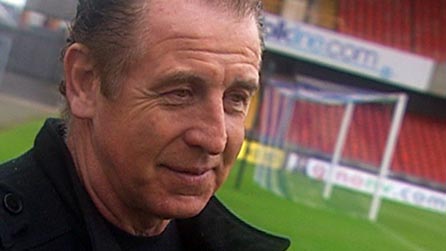
The former Northern Ireland and Tottenham Hotspur footballer believes that "When your confidence is high it gives you the belief to go on and do it."
Colin Jackson: How did you get into football?
Gerry Armstrong: By mistake as I never actually played soccer until I was 17-years-old. All my young days were as a Gaelic footballer. I played Gaelic football and hurling here in Northern Ireland. I think it was a plus because they were tough games and the pitch was bigger so I was quite hard, robust and tough.
In Gaelic football, in the 1970s, when things went off on the pitch everybody started fighting and I got suspended for several months for being involved in one of the fights. Because I was not playing or training, I played soccer in the street and I had the opportunity to play for one of the amateur teams here, Cromac Albion in Belfast.
I was then invited to play for Bangor Football Club for three and a half years and was transferred to Tottenham Hotspur in 1975.
CJ: What was sport like in school for you?
Profile
Name:
Gerard Joseph Armstrong
Born:
23rd May 1954
From:
Belfast, Northern Ireland
Former position:
Forward
Teams:
Tottenham Hotspur, Watford, Real Mallorca, Northern Ireland (63 caps)
Achievements:
- Highest scoring British player at 1982 World Cup
- Promotion to Division 1 with Tottenham and Watford
GA: I loved sport and loved competitions. I wanted to compete in everything. I just loved to take part in sport.
CJ: You did a lot in school on the sporting side of things what about the education side? Did you get any O levels/A levels?
GA: Yes I got my O levels and A levels. I actually wanted to become an architect. I got A levels in engineering drawing, woodwork and woodwork theory. I moved into a quite an exclusive area in the Malone Road in Belfast and worked for an architect there, but after about six months I didn't feel I liked it so I moved into local government. Education is very important - healthy body, health mind - and I think it helped me with my sports. They worked hand in hand.
CJ: What was it like when you signed up to play in England? Were you expecting to be signed up by Tottenham?
GA: I only had a one year (contract). Several clubs had watched me play, but the day I signed, at a hotel just outside Belfast, I was expecting to sign for Arsenal because they were making most of the inroads. I'd been on trial to Tottenham four weeks earlier but thought they had lost interest. When I turned up at the hotel it was the Tottenham Hotspur Manager, Terry Neil, who was there and he signed me. I was quite happy to sign for Spurs at the time.
CJ: What was it like to settle in the UK coming from Northern Ireland? Was there a massive difference?
GA: It was massive. I was staying in a hotel near central London for several months before I actually found a house. Training on a daily basis was something new and unique to me and after four or five months I realised how important it was, because physically I got fitter. I always loved going into the gymnasium. You start to learn and the more you practice the better you become. Practice makes perfect. I was in the gym working on my skills, my control, my touch, and within about six or seven months I was in the first team.
CJ: We're here on quite sacred ground at Windsor Park in Belfast. This place was like a fortress in your day.
GA: It was. We got a lot of spankings when we were playing in the late 1970s as the team was just evolving, but once we got eight to 10 international games under our belts you start to find out what it's all about. We went six years almost without defeat. We beat Germany here and I scored the winning goal against Portugal here in our campaign to qualify for the 1982 World Cup. We beat Israel in the last game of the campaign here at Windsor Park and qualified. We beat them 1-0 and I scored a left foot volley into that goal. This is a sacred ground for a lot of the Ulstermen and the Northern Irish fans.
CJ: Looking around I can just about imagine what the atmosphere was like. When you scored the goal did you feel the crowd or were you just absorbed with the team and it's sheer excitement just to qualify and get to the World Championships?
GA: The goal is only part of it. There was no real outstanding talent in the 11 players that played for Northern Ireland. We were a very good team and that was our strength. The fact that we all worked hard for each other. We fancied ourselves against anybody. When your confidence is high it gives you the belief to go on and do it. The fans then get behind you and with the noise they used to make, their belief transferred onto the pitch and then we started to believe. You can achieve so much then.
CJ: Your wealth of experience is not lost because you still have an involvement in the sport of football, as I do with athletics. We're both pundits and we're both commentators as well. What is that like?
GA: It's good because it keeps you involved in the sport you love, but it's not the same because you don't get the adrenaline rush and you don't get that feeling. The feeling when you walk out onto the park in front of 100,000 and the hairs at the back of your head start standing up. But you still get the feeling that you're still involved which is probably the next best thing.
CJ: You're back in Northern Ireland now, but you've also spent a bit of time in Spain. So I want to know, do you speak Spanish?
GA: ¿Hablo Espagnol? (Do I speak Spanish?) Yes I do speak Spanish. It was a necessity for me. In 1983 I didn't really want to leave Watford but as a result of what I'd done in the 1982 World Cup, a lot of Spanish clubs were following me. Real Majorca came in and made me an offer I couldn't refuse so I moved to Spain. I quickly realised within five to six weeks that I had to learn the language. You need to communicate with your team mates and no-one in the team spoke English so I had to learn Spanish and I had to learn it fast.
I worked at it for about six months until I cracked it. The sense of achievement that you can actually speak their language, and the way they respond to you because you've actually put the effort in to try and learn the language, they look at you totally differently.
CJ: Many of our big English stars have gone over to play in Spain. Have you been able to advise any of them?
GA: It's great the number of players who have come from the UK, including David Beckham and before him Steve McManaman. I spoke to Steve before he went and I tried to advise him. I said "Listen you have to learn the language," and I told David Beckham the same. You have to learn the language, that's the most important thing. Learning the language and communicating with your team mates makes all the difference. They've done really well and both of them speak good Spanish. When Gary Lineker joined Barcelona he also learned the language. It's a great asset to have.
CJ: Outside of football what's been the greatest sporting achievement/moment that you've witnessed, either live or on the TV?
GA: Oh I've so many. I love all my sports. I love my golf and I love my athletics. I think the first time I really got into the football was 1978 when Argentina won the World Cup Final in Argentina. That was a massive achievement.
Also I had a great feeling when I watched Daley Thompson win his gold medal as a decathlete. That was one of the moments that sort of caught me, but there's been so many now. You look at Usain Bolt and what he does on 100m and 200m and my jaw drops open because I used to think I was quick (laughs).
CJ: What advice would you give young people about sport as a way of life?
GA: Sport is a fantastic life. If you've got a talent, you have to use that talent. I think sport helps you to become a better person. It keeps you fit, it keeps you healthy. The fact that someone was paying me to actually do what I loved doing was a bonus. I used to love training anyway and I still do, but I think playing sport is an asset for everyone.
CJ: What do you spend most of your time doing?
GA: When I'm not working I play tennis with my wife, I cycle and I have a gym in my house, so I'll train two to three times a week in the gym. I've always tried to be active and do things.
CJ: Is time management important because obviously you're in demand for TV and you still want to do things personally?
GA: You've got to get the balance right. I don't mind doing 3-4 days a week work as long as I get the wind down time, and winding down for me is training.
CJ: How big is football as a game in Northern Ireland?
GA: Definitely football is the top sport here. There's golf too. You've got people like Graeme McDowell, Rory Mcllroy and Darren Clarke, who are 3 of the best golfers in the world all coming from a little place with a 1.6 - 1.8 million population. It just shows you that if you put your mind to it, you can achieve it.
CJ: Do you have any sporting heroes then?
GA: I've got lots of sporting heroes. George Best from a football point of view was my hero. I used to watch a lot of other sports as well, like boxing. Mohammed Ali was just amazing. I watched Mohammed Ali tell everybody what he was going to do and then he'd go and do it. To be able to have that confidence, belief and ability was something special.
CJ: Who is the most famous person you've ever met?
GA: Goodness you're putting me on the spot now! Well I've met Maradona and a lot of big football stars, but some of the people I'd love to meet I haven't had the chance, like Nelson Mandela, Mohammed Ali and Cassius Clay. Those are two people from history that I'd love the opportunity to meet.
See also
Elsewhere on the BBC
Elsewhere on the web
Latest
Whatever it is you want to do, follow your dream.
Welsh distance runner
Training ground

Work hard
Colin Jackson reveals more top tips on making exercise part of your lifestyle.