

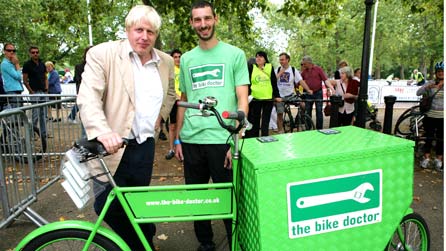
Raise Your Game: How did you first get involved in the cycle industry?
Sean Lally: I've always ridden bikes for as long as I can remember. I've always pulled them apart and fixed them, so when my wife Julia and I set up our own company we decided to do it in the cycle industry.
We wanted to approach a commercial industry from a social standpoint, so we're a full profit, limited company, but everything we do has a green or a social impetus behind it. For example, we're a car free company and we have green policies that we've put into place. We're showing that you can do it with an ethical, green ethos behind you.
RYG: Could you tell us a bit your cycling academy and its aims?
SL: We run an academy which offers professional City and Guilds training for people who are looking to get into the cycle trade or for people who are very enthusiastic about bikes. We work with people from young offenders to various disadvantaged youth groups and they can come to us and get a place on a professional training course.
We also run a service salon and that includes professional cycle repair for the emergency services, work places and we're about to launch a cycle training scheme so that people can feel safe cycling on the roads.
RYG: How can students benefit from a cycle mechanics based qualification?
SL: We're offering a professional qualification that's internationally recognised, so if a young person is passionate about cycling, as many are, and they are looking to do a gap year, they can get a job easily in Australia, America, Canada and Europe. They'll have the skills to be able to go out into the trade.
The Australian government was recently advertising for bike mechanics on their website. They were paying mechanics to go out there and they were arranging work along with six weeks paid travel time in Australia.
Cycling is now moving into a different world. In the past it's had a 'Steptoe and son' approach, but now it needs skilled people. They can prove themselves to employers and they can learn more, so the idea really is, as well as an introduction into the cycling world, it's an education too.
RYG: The popularity of cycling has increased greatly in recent years. What are some of the benefits of taking up cycling?
SL: It's certainly the best way to get to work as we've seen with the huge increase in cycle commuting all across the country. I think a lot of people are inspired by cycle sport now as we're one of the leading countries in the world for cycling with our dominant track cycling team and incredible performances in the Tour de France.
What you find with cycling is that it is its own culture. It tends to be very friendly, very positive and full of interesting people. It's a sport, it's a pastime and in terms of transport planning it really is the way forward. It doesn't rely on petrochemicals, it doesn't rely on a huge amount of natural resources to provide the bicycles and it is the most efficient way of getting around in terms of the energy you put in to what you get out.
RYG: If people are looking to commute or use a bicycle for local travel, how much money do they need to be spending?
SL: It's one of those areas where the cheapest equipment be it clothing, bikes or locks, is not going to work very well. In terms of commuting bikes we tend to think that £200 is the minimum you should be paying.
If we look at bus passes, the several thousand pounds that people spend each year on train tickets and the cost of running a private motor car, cycling is a tremendously cost effective way to travel. You'll certainly save money on gym fees as well!
RYG: In order to stay roadworthy, how frequently should people be looking to get their bikes serviced?
SL: This is a very important point because if your bike isn't working properly then it's going to be very unpleasant to ride. The bike should have a major or general service once a year and it should also have care and attention to it on a regular basis.
You should be able to do some basic things yourself such as changing an inner tube and repairing a puncture. You should be able to inflate your tyres because they'll need inflating at least once a week and you need to keep your chain lubricated.
We find that the most common fault on bikes is that the brakes don't work properly. If your brakes don't work properly then you are in danger, but we see all sorts of things from wheel nuts that are tightened by hand to forks that are on backwards!
What we say to people is to either learn the skills yourself, so you can fix your own bike, or get a relationship with a high quality independent bicycle retailer in your area and they will look after you.
RYG: For anybody who may be apprehensive about cycling, how can they get started?
SL: I don't think I need to say much because the amount of people taking up cycling is incredible and I'm continually blown away by it! For anyone who doesn't yet ride a bike, the best thing to do is to go to your local independent bike shop and discuss your cycling needs with the experienced and skilled staff there.
For people who can't currently ride a bike or feel uncomfortable in an urban or a rural environment, there is a lot of subsidised cycle training available where people can be trained to a national standard.
The three main things are: get the right kit, get yourself trained and get riding!
See also
Elsewhere on the BBC
Elsewhere on the web
Latest
Making sure your body and your bike are ready for the challenge really gives you confidence.
Triple Olympic Gold medal winning cyclist
Training ground

Work hard
Colin Jackson reveals more top tips on making exercise part of your lifestyle.