


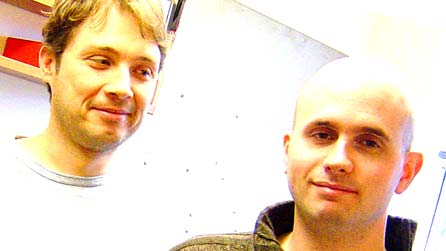
Henry Stott and Alex Morton, the statisticians behind the Fink Tank explain how they beat the bookies.
Raise Your Game: Are you both sports fans?
Alex Morton: I'm a big sports fan. I've loved football for years and I like athletics, cycling, rugby, tennis - everything! So after doing a PhD in statistics, it's kind of a dream for me to combine the two.
Henry Stott: On the other hand, I don't have any interest in sports at all really. I'm more interested in two separate parts of it; firstly, looking at whether you could predict these things and what the application of statistics in something as chaotic as football looks like.
It's just a fascinating scientific issue. And then I was just interested in whether bookmakers could be beaten, with the suspicion that they could.
RYG: Is that how the Fink Tank came about?
HS: What happened was that we started working on the World Cup (France 1998) from the angle of could we beat the bookmakers. It was actually part of an office pool that didn't take place. On the back of that we ended up on Five Live, Danny heard us and it went from there.
RYG: So do you beat the bookmakers?
HS: We gamble together, we have a joint portfolio.
AM: I've just developed a new model which we've put in place this year, and has been used to generate the forecast for The Times and it's done extremely well.
The model in the literature just uses goals, but now we are using goals and shots and combining the two, and from that we've found a big boost in the prediction power of the model.
How bookies make their money:
In the above race, where each horse's real chances are 3/1, the bookies would offer you shorter odds of maybe 2/1.
So if you were to bet £1 on all 4 horses at 2/1 in this race it would still cost £4 but you'd get just £3 back for the winner (2 x £1 + a £1 stake back).
For every race like this the bookie would only need to pay out £3 in winnings for every £4 taken in bets and that's how they'd make a profit.
HS: Out of four tournaments this season, we're ahead on all four.
RYG: What kind of sums are we talking about?
HS: It used to be tens and hundreds [of pounds], but now we are talking thousands.
RYG: A nice little earner then?
HS: Well yes, but the sums involved ensure we focus on the model to make sure it is working.
RYG: How did you originally get involved in statistics?
AM: I did a maths degree and then fell into a statistics PhD. I continued to work in academia until I met Henry and he got me involved in this.
RYG: Is this where you see your careers developing?
HS: Oh yes definitely. What is at the bottom of this is wherever you look you can see things going on in the world that could be better served, or you see people that could make better decisions if they were assisted by statistics that have been distilled by computers. I think football is a classic example of that.
You could imagine what a typical coach's reaction is to the usefulness of computers in terms of helping him choose a team or select a player. Clearly they are going to be very resistant, because it's so antithetical to everything they think about with regard to 'the beautiful game'. But the reality is no human being can distil the amount of information there is in all the different games that are happening all the time into a single place.
You need calculations to do that, and there is this happy medium, whereby on the one hand computers will do the calculations for you and distil and clarify the message from the recent performance of different teams and different players, and, on the other hand, human judgement can come in and make the calls on what is done.
So why do people gamble?
Because we think we know more than the bookies!
Using our sporting knowledge we can assess the real probabilities and spot where the bookies have offered odds which we believe are too generous.
At least gamblers would like to think their expertise will help them win! But be aware that bookmakers are experts too at assessing probabilities and getting their odds right.
Remember you rarely see a poor bookie!
There is a really interesting paradigm here which is played out, across all different kinds of fields too, and that is why this is interesting to us.
RYG: Do you have much 'banter' with Daniel with regard to how your teams are doing?
AM: Funnily enough, no. I don't really support a club. I used to like Liverpool when I was young, but then I went to university in Manchester and started mixing with people from Manchester and ended up following Manchester United so it's a bit of a mess.
RYG: How would you encourage people to take an interest in statistics?
HS: Good question. I would encourage them to look at the application of statistics or maths within something that they are already interested in. That's one of the great thing about looking at football and sport from that perspective because it can genuinely give you an edge over other people. It can genuinely make your team go better if you look at the stats and study the form. There's no point studying something you don't care about, which is the big problem with a lot of stats teaching.
I would just encourage people to look at the kind of modelling we've been doing and to maybe take inspiration from the fact that there is something genuinely interesting being done with numbers here, and that you really can use computers to get insight that you really couldn't get by doing it on the fly by yourself.
RYG: How much of your work is done using computers?
HS: 100%
RYG: Nothing is done using a pen and paper any more?
HS: Sorry. It's not fair because Alex does quite a lot of Algebra.
Why not try Decision Technology Research group's The Predictor?
See also
Elsewhere on the BBC
Latest
You are in charge - that's the beauty and that's the challenge.
Former UK Athletics performance director
Training ground

Work hard
Colin Jackson reveals more top tips on making exercise part of your lifestyle.



How odds work:
If 4 horses of exactly equal ability race each other 4 times, the most predictable outcome is that each horse will win 1 race and lose 3.
This makes their real odds 3/1.
Placing a £1 bet at 3/1 on all 4 horses in the race would cost you £4, and you'd get £4 back for the winner (3 x £1 + one of your £1 stakes back).
But then everyone, including the bookie would come out even. Nothing gained, nothing lost.