
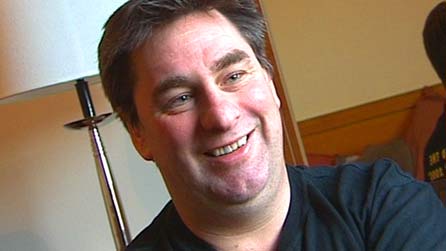
The sports journalist talks about the skills needed to be successful.
Raise Your Game: What's life like as a sports journalist?
Brendan Gallagher: I'll talk you through today as an example. I'm in Dublin the day before the big game between Wales and Ireland. We had to be at Croke Park for 10 o'clock. Warren Gatland and the Wales team came down to do 10 minutes with the media.
It was a beautiful morning and we were escorted into Croke Park, through the tunnel. The Wales team ran out, Stephen Jones and the kickers had some practice, and then Warren came over to talk to us. He sat there in the sun with ten journalists asking him one question each. By the time it got to me every question I wanted to ask had already been asked, which was really frustrating.
At the end of the session the Welsh Press Officer said "Ok guys that's enough," and an old colleague of mine at The Times did what he always does and said "Just one more."
He caught Warren slightly off guard, and he came out with the best quotes of the day - about how this match was nothing to do with any personal feud between Warren Gatland and Eddie O'Sullivan, it was all about the Welsh and Irish players. He came out with the line 'They're all hurting very bad, there was a lot of hurt in this camp, this is what this match is about,' which is what we wanted.
Then we all trooped off to a hotel right next to Croke Park, where Ireland were having their Friday press conference at 12 o'clock. We got there for half past 10, sat down and started our previews.
When you're a journalist on the road, you're not always sitting in an office. You work wherever you can plug your computer in. The Irish boys came in at about quarter past 12. One of the good things about a Friday morning press conference is you get a taste of what the mental feeling is in the camp. That helps you when you're doing your preview.
When I get back to the hotel room, the real work begins. I write 750 words for the preview, plus the team details. By that time it's about four o'clock, but you can't relax until about seven. There might be a late injury or illness in one of the camps. Then you're in Dublin and the night's yours.
RYG: What have you written by the time you leave the press conference?
Profile
Name:
Brendan Gallagher
Born:
16 October 1958
From:
Sussex, England
Position:
Sports Journalist
Paper:
The Daily Telegraph
Previous papers:
South Wales Echo
Achievements:
- Sports Council Best Story Award (2000)
- Had reports printed from 48 countries around the world.
BG: I didn't start anything until I got back from the first press conference this morning. I went back to the hotel, had a cup of coffee, and decided that I was going to start my preview with Wales.
You have an option when you do a preview. You either go in on one team or the other. I thought 'Wales are the story this season with what Warren Gatland's been doing, can they win the Triple Crown?' The quotes from Warren were good on Friday morning. Out of 750 words, 500 were about Wales - what they hope to achieve, how they turned a losing sequence around, all that sort of stuff.
I was also trying to put the personal clash between Eddie O'Sullivan and Warren Gatland into perspective. Some people were making a lot out of it, whereas I didn't think it mattered that much. The last 250 words were about what the match meant to Ireland, just to give balance to the piece.
RYG: What skills do you need to do this job well?
BG: Before skills you need stamina. You've got to have the energy and the staying power. When I was a bit younger, I got glandular fever. I was a journalist on the South Wales Echo, and I was unwell for nine months. I physically couldn't do the job because I had no energy. You need lots of energy to get out of bed and go to a press conference at 8 o'clock, then race back to the office to wade through your notes or transcript.
Just when you think you're done the phone goes and you find out that someone's broken their leg in training. If you haven't got the energy you can't do it. At the rugby World Cup in Australia we didn't get to bed until four o'clock in the morning, because that's only six o'clock at night at home, and our sports desk were only really getting going at that time.
You need energy and good health, and if you don't have it, you've got to step back until you feel well again.
You've also got to be passionate about sport. It doesn't matter what sport you're passionate about, just be passionate about sport. Half of the job is about talking, interviewing, listening and interacting, so you've got to enjoy meeting people. If you don't enjoy that then you're going to struggle.
You've got to do your homework. If I'm going to interview somebody I spend three to four hours reading up on them the night before. You might only use two or three facts that you've deducted from that, but they'll be interesting.
I was in Wales interviewing Shaun Edwards ahead of the Ireland game. I know Shaun quite well and I know lots about him, but I just thought 'What else is there about him?' I found an image of him playing rugby league for Ireland 10 years ago.
At the end of his career, he played a match for Ireland Rugby League. I dropped that into the conversation and he talked for 10 minutes about his one and only appearance for the land of his grandfathers. It was new stuff which we hadn't done before and appeared in the paper the next day.
RYG: What advice would you give to somebody that wants a job like this?
BG: Go for it! It's not just going to fall into your lap. There are tens of thousands of similarly minded people wanting to do this job. You have to start at the bottom at a local newspaper.
Write to them, phone them up, and send them examples of your work. Don't worry if they're not that good, just keep sending them. Volunteer to report on your local football and rugby teams. Just keep going. Eventually they'll say 'Can you do this for us?' 'Can you do that for us?' Then you've got a foot on the rung. Once you're there you'll be mesmerised by it.
There's a well-worn path - local newspaper, regional newspaper, agencies. Some people then go off towards radio or TV and others work for national papers. If you want to work at World Cups and Olympics just keep going.
See also
Latest
Don't let what you can't do interfere with what you can do.
National Fitness Director WRU
Training ground
Work hard
Colin Jackson reveals more top tips on making exercise part of your lifestyle.