


Prof. Dianne Edwards
Last updated: 27 March 2012
Adam Walton meets Cardiff University paleobotanist Prof. Dianne Edwards whose work on fossils in Wales and around the world has revealed how early plants colonised the planet.
Broadcast Tuesday 27th March at 7pm
Listen to the latest programme online
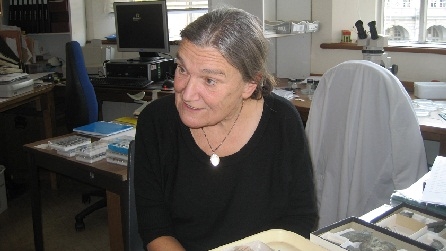
This week Adam's at Cardiff University's School of Earth and Ocean Sciences to meet a botanist whose research has significantly advanced our understanding of how, nearly half a billion years ago, plants first made the move from sea to land and colonised planet Earth, ultimately paving the way for all other life to follow.
Dianne Edwards was born in Swansea and but spent much of her time on Gower, where her parents had a bungalow. Her research has taken her all over the world, although many of the fossils which have played a key part in her discoveries are actually right here in Wales. As well as her work on the structure of early land plants she's also found firm evidence of wildfires some 420 million years ago and even discovered the earliest known animal droppings from around the same time.
Dianne is a Fellow of the Royal Society and she's recently been elected President of the Linnean Society, the world's oldest scientific organisation devoted to the study of biology. She's a founding trustee of the National Botanic Garden of Wales and, in recognition of her work there, she was awarded the CBE. And she's currently one of thirteen figures - from the early nineteenth century to the present day - being celebrated in an exhibition at the National Botanic Garden called 'Inspirational Botanists - Women of Wales'.
In this week's programme Adam meets Dianne in her laboratory at Cardiff University to discuss the childhood inspirations which ignited her interest in botany, the difficulties of fieldwork in remote areas of China and Patagonia and the scientific significance of fossilised millipede poo!
Links
BBC News: Fossils Reveal Oldest Wildfire
New website

Listen online
A new look for BBC Radio online: listen live on your computer - and now on your smartphone.


