


Spiders
Last updated: 25 October 2011
This week Adam explores the spider collection at the National Museum Cardiff. He also discovers how insect mating signals can become a dinner gong for hungry spiders and he meets a therapist who can cure arachnophobia.
Broadcast Tuesday 25th October at 7pm
Listen to the latest programme online
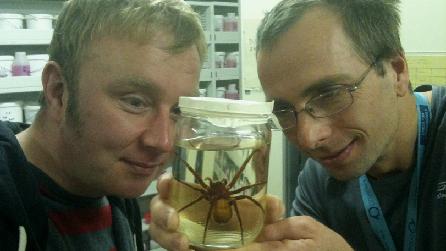
Adam's host at the National Museum Cardiff is Zoological Conservation Officer, Julian Carter. In the basement he introduces us to some of the Museum's ten thousand spider specimens, all kept in jars and pickled in preserving fluid. The collection includes around two thirds of Britain's 700 spider species.
Adam takes a closer look at some of the spiders we share our homes with, including Tegenaria, the house spider that you're most likely to find in the bath or scuttling across the living room floor. Then there's Pholcus, the spindly 'daddy long legs' spiderthat hangs around in the corner of rooms and which, despite looking so delicate, preys on big house spiders. We also meet Julian's particular favourite, Scytodes, which hunts by spitting loads of sticky silk at its prey until it's immobile and helpless.
Julian clearly loves his spiders but many of us, of course, are less keen on them. And some people become panic-stricken at the mere sight of one. In its severest forms arachnophobia can be pretty debilitating. But help is at hand. Joyce Dallimore is a counsellor and psychotherapist based in Caldicot in Monmouthshire and Adam meets her to talk about the causes and the cure for arachnophobia.
Science Cafe reporter Jeremy Grange finds himself in a field near Wenvoe on the outskirts of Cardiff where Dr. Victoria San Andres Aura from Cardiff University is studying its complex web of predator-prey relationships. Using DNA analysis she's discovered that as well as eating insects, the local money spiders are also eating each other.
Meanwhile back in the lab at the University, Adam meets Victoria's colleagues Prof. Bill Symondson and Dr. Meta Virant-Doberlet who are studying how spiders exploit the mating signals of leafhoppers to prey on them. To attract the opposite sex leafhoppers create vibrations through the stem of the plant they're sitting on but hungry spiders home in on these vibrations, turning the insect's invitation to "meet me" into one to "eat me"!
Links
Zoology at the National Museum Cardiff
New website

Listen online
A new look for BBC Radio online: listen live on your computer - and now on your smartphone.


