


Antimatter
Last updated: 08 February 2011
In this week's Science Cafe Adam Walton visits Swansea University to investigate the mysterious world of antimatter.
Listen to the latest programme online
In Star Trek, antimatter powers the engines of the Starship Enterprise. And in Dan Brown's book Angels and Demons a sinister secret society called the Illuminati plant an antimatter bomb underneath the Vatican. But if you thought that antimatter was pure science fiction you'd be wrong. It exists, it's a increasingly important area of scientific research - and they make it in Swansea!
Antimatter is the mirror-image of matter. If matter and antimatter are brought together they instantly annihilate each other - and that's what happened at the beginning of the universe when nearly equal amounts of matter and antimatter were created straight after the Big Bang. It's only because there was slightly more matter than antimatter in this great annihilation that our universe exists at all.
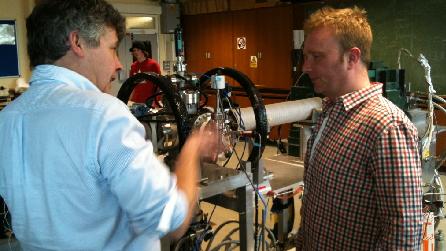
But it is possible to make antimatter. Radioactive decay produces positrons, the antimatter version of electrons, and in the Department of Physics at Swansea University Prof. Mike Charlton shows Adam how he creates a beam of positrons in his laboratory. He also talks about his work at CERN in Switzerland (home of the Large Hadron Collider) where he and his team have managed to produce atoms of anti-hydrogen.
In this week's programme Mike Charlton helps Adam separate the antimatter facts from the science fiction. The programme also visits the PET scanner at the University Hospital in Cardiff where we discover how antimatter is being used to diagnose cancer and save lives
Links
New website

Listen online
A new look for BBC Radio online: listen live on your computer - and now on your smartphone.


