


Cardiff School of Physics & Astronomy
Last updated: 24 October 2010
In this week's Science Cafe Adam Walton visits Cardiff University School of Physics & Astronomy to discover the work being done on the Planck and Herschel space observatories that were launched last year.
Broadcast Sunday 24 October, 5 PM
Listen to the latest programme online
Adam meets Peter Coles, Professor of Theoretical Astrophysics, who discusses the Big Bang, and even plays us the sound that it made billions of years ago. He explains how Planck will help to probe the conditions in the early Universe.
Adam also meets Professor Peter Ade, who has worked on the planning of the Planck mission for many years, and hears how the cosmic microwave background radiation came about.
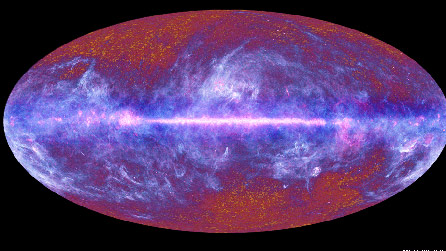
Dr Chris North guides Adam through the striking image (reproduced at the top of this page), the first "all sky" image from Planck, explaining what the colourful picture can tell us. We also hear about the Herschel observatory, which has the largest mirror ever launched into space to give unprecedented high quality images of nearby galaxies.
Principal investigator for SPIRE (the Spectral & Photometric Imaging Receiver) Professor Matt Griffin explains how SPIRE will play a key role aboard Herschel. Sarah Harry outlines how Herschel is providing incredible detail in the images of star formation, and Steve Eales who is leading the survey of one-eightieth of the sky with Herschel.
Links
All sky image from Planck (Cardiff University news page)
New website

Listen online
A new look for BBC Radio online: listen live on your computer - and now on your smartphone.


