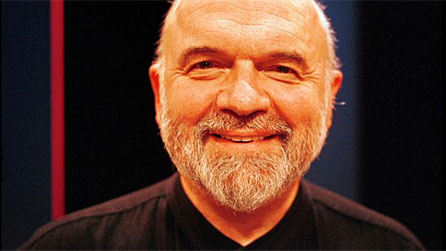
The Barry boy who became one of the most successful of a particularly English-style school of tenors.
Many professional singers from Wales can trace the progress of their early interest in music and performing through the route of chapel and the eisteddfod - but this was not the case for Robert ("Bob") Tear. His first singing took place in a church choir rather than in chapel, and the combination of this and his education at Barry Grammar School put him in a comfortable position when he went to King's College, Cambridge as a choral scholar.
King's College Choir has produced many notable lyric tenors, including Mark Padmore and James Gilchrist as well as Bob - as well-known for their considered, intelligent approach to music-making as for their fine voices. All of them excel on the concert as well as the opera stage, and in a wide range of styles of music from Monteverdi to modern, and Bob in particular was one of the most versatile of singers.
His early career featured many performances of religious repertoire, notably as soloist in Handel's Messiah and in the part of the Evangelist in Bach's Passions, and he took part in many recordings of pieces such as these.
It would not be long before Bob's career took him into the opera house, firstly in 1963 with the English Opera Group, with which he performed many operas by Britten and other British composers. There were resonances between his sound and that of Britten's partner Peter Pears, for whom all his tenor parts were written, and Bob was much associated with Britten's work with the group, at the Royal Opera House, Covent Garden and elsewhere. Notable successes in Britten's work include the title role in Peter Grimes, Peter Quint in The Turn Of The Screw, Aschenbach in Death in Venice and Captain Vere in Billy Budd, and in Les Illuminations and Serenade for Tenor, Horn and Strings on the concert stage.
Bob's long association with the Royal Opera House since 1970 showed his great versatility, performing across the gamut of the repertoire. Parts included Jupiter in Handel's Semele, Admetus in Alceste by Gluck, Monostatos in Mozart's Die Zauberflöte, Froh/Loge in Wagner's Ring cyclw and Lensky in Tchaikovsky's Eugene Onegin as well as creating roles such as Dov in Tippett's The Knot Garden and the Deserter in Henze's We Come to the River. He sang at the Royal Opera House for the last time in 2009, as Altuom in Puccini's Turandot.
He performed in opera houses throughout the world, including Munich, Los Angeles, Brussels, Salzburg and Bayreuth, and appeared in several productions with Welsh National Opera, including Billy Budd, Salome and Eugene Onegin.
Bob's versatility showed itself in many ways. He excelled in recital, particularly of English song; another passion is for Victorian ballads, which he recorded with Benjamin Luxon and André Previn; and as he started to wind down his singing appearances he embarked on new careers on the conductor's podium and as a speaker and narrator.
His final singing performance was in 2009 as Altuom in Turandot at the Royal Opera House, Covent Garden.
Bob was in increasing demand as a speaker/narrator, including appearances at Kings Place, where he read a selection of Mozart's letters accompanied by music, and at the Wigmore Hall in Stravinsky's A Soldier's Tale with members of the London Philharmonic Orchestra.
He was visiting professor of opera at the Royal Academy of Music in London, where he lived. In his spare time, he wrote, painted, illustrated and played the piano.
In 1984, he was awarded the CBE.
He died in March 2011.