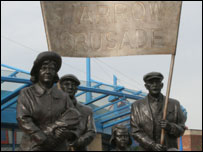
In the economic depression of the 1930s, North East ship builders and steel workers suffered unemployment and poverty. Birth of the CrusadeOn 05 October 1936, 200 men walked from Jarrow to lobby Parliament for paid work. | "There is no political aspect to this march. It is simply the town of Jarrow saying 'Send us work'." | | The Guardian, Tuesday October 13 1936 |
The Jarrow march did not come about overnight; it was the result of years of industrial collapse never before known on Tyneside. After WWI, as government policy hit hard, the ship building industry faced collapse and Jarrow's workers were cast out of the shipyards in droves. The Palmer's shipyard at Jarrow was a major employer. Its closure, in 1935, compounded the problems of poverty, mortality and early death. As the depression wore on, the town council and workers felt something had to be done. 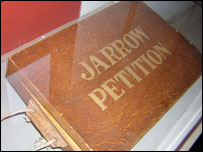 | | Marchers carried petition to UK Parliament |
So a small group of 200 workers hit the road on a trek to London supported by North Easterners, 90,000 of whom signed a petition addressed to Parliament. A second-hand bus was bought to carry cooking equipment, and ground sheets were provided for outside rests. An advance guard was sent out to arrange overnight stops and public meetings. The marchers covered 280.5 miles in 22 stages as set out below:Jarrow to Chester le Street – (12 miles)
Chester le Street to Ferry Hill – (12 miles)
Ferryhill to Darlington – (12 miles)
Darlington to Northallerton – (16 miles)
Northallerton to Ripon – (17 miles)
Ripon to Harrogate – (11½ miles)
Harrogate to Leeds – (15½ miles)
Leeds to Wakefield – (9 miles)
Wakefield to Barnsley – (9¾ miles)
Barnsley to Sheffield – (13½ miles)
Sheffield to Chesterfield – (11¾ miles)
Chesterfield to Mansfield – (12 miles)
Mansfield to Nottingham – (14½ miles)
Nottingham to Loughborough – (15 miles)
Loughborough to Leicester – (11¼ miles)
Leicester to Market Harborough – (14½ miles)
Market Harborough to Northampton – (14½ miles)
Northampton to Bedford – (21 miles)
Bedford to Luton – (19 miles)
Luton to St Albans – (10¼ miles)
St Albans to Edmonton – (11 miles)
Edmonton to Marble Arch, London (8½ miles) Government unmovedThe Jarrow marchers successfully reached London, but despite considerable public sympathy the crusade made little real impact. In Jarrow, a ship-breaking yard and engineering works were established in 1938. However the depression continued until WWII, when industry prospered because of Britain's need for rearmament. The BBC would appreciate your family memories, comments and anecdotes surrounding this remarkable North East protest. Martin Kosmalski replied to BBC Tyne: My auntie who is now deceased lived in Potten End near Berkhampstead, Hertfordshire. Towards the end of her years she gave me a lapel type badge, of a brass miners lamp attached to a pin. She told me that it had been warn by one of the Jarrow marchers, can someone confirm that this was in fact some kind of badge warn by the marchers or were they purchased by the public/workforce in order to support the marchers. Richard Smith replied to BBCMy Grandmother always told us that grandfathers brother Surname Howard was the one that led the workers out. Apparently he was quite a firebrand and the two brothers used to have heated arguments about how the poor should be given money. They had both served their time as blacksmiths but my grandfather wanted to be a fruiterer and became very successful Kathleen Haigh replied to BBC:My uncle, Jimmy McCauley was the second last of the marchers to die.He said he wore out many pairs of shoes on the march and that all of the marchers looked forward to being fed by the people in whichever town they arrived! In retrospect, he believed that the march was in vain because nothing happened afterwards to bring jobs to the town. The legacy which does remain is that Jarrow has found its place in History thanks to their brave efforts. Mick Grieves wrote:My nana Beattie said that those who marched were those who wouldn't work. She should know she was in Jarrow at the time. Mind you my grandas brother went so she might have been referring to him! |