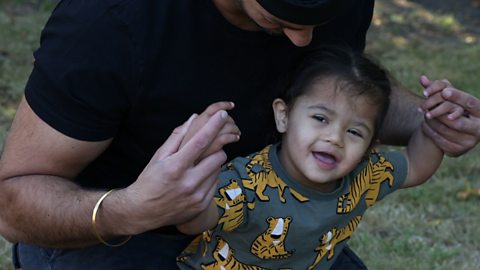
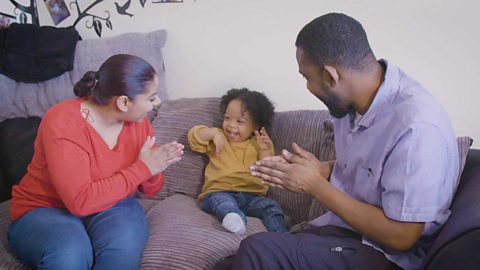
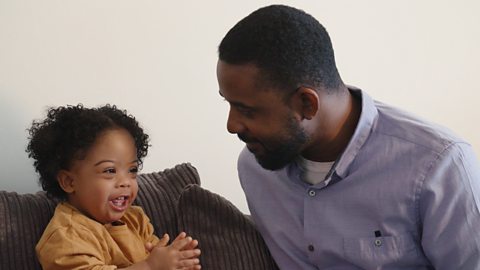
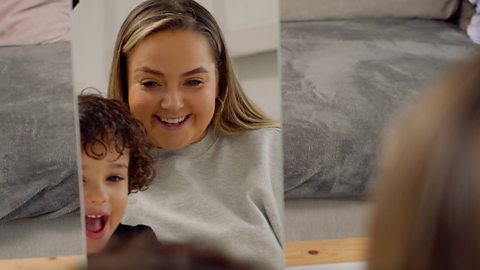
Simone and her partner Ryan have a 2-year-old son called Dantae, who has Down syndrome and sickle cell anaemia.
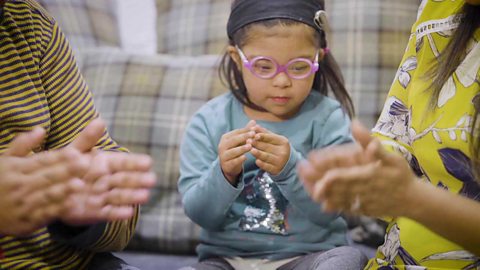
They’ve been learning Makaton to help with Dantae’s communication.
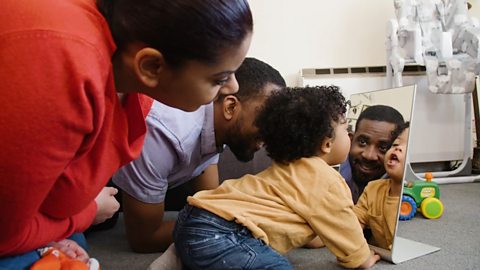
Tell us about Dantae
Well, Dantae… he’s so cheeky, he’s very active and he loves music. He likes all kinds of music, whether it’s on TV or on YouTube. He even likes creating his own. We’ve made little instruments for him, like putting pasta and rice in bottles and he shakes them.
He loves nursery rhymes too – Head, Shoulders, Knees and Toes and Wind the Bobbin Up are his favourites. And once you start singing the nursery rhyme, he wants it over and over again.
He actually likes Ed Sheeran and Lewis Capaldi at the moment. He tries to sing along to their slow songs and gets all emotional in his face.
He just had his second birthday and he loved it, because we decorated the front room in banners and balloons, had bubbles and ate chocolate cake!
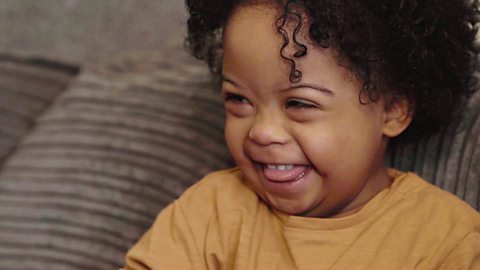
Getting started with Makaton
When I was 14 weeks pregnant, we had a CVS test which gave us the diagnosis that Dantae has Down syndrome. Then when he was born, our doctors did the test again and confirmed it.
Straight away after he was born, the paediatrician referred us to an early intervention support team in the community. They helped us with lots of things including physio, speech and language, feeding and a specialist teacher visited us.
She recommended that we go to a group session at a local school. It was for children with Down Syndrome and Dantae made a few friends there. They also held workshops, where we learned about different ways to help his communication and social skills. This is where we first did Makaton, when Dantae was about 6 months old.
We started by learning the simpler signs, like the more frequently used ones. The first ones we learned were ‘hello’, ‘more’, ‘finished’, ‘toilet’… I’m doing them as I’m saying it!
Learning a new language
When we came home after that workshop, we were so excited that we taught ourselves more signs online. We watched quite a few YouTube videos and then also joined some Facebook Makaton groups.
Then, when we mentioned it to his speech and language therapist, she gave us a little booklet with some more of the basic signs in. That was really helpful.
We said 'oh wow this is amazing and it’s so simple'
When you know it, the signs make sense. It was quite difficult at the start though, because my memory’s so bad! Dantae was still a baby at the time so it took him a while to pick it up.
But it’s opened up a whole new world for him now. As we’ve learned it, a lot of our family members have also picked up the basics, which is really nice.
Dantae sometimes uses his own gestures too. He’s made up signs for ‘more’, ‘finish’ and even ‘toilet’. So, sometimes only me and his dad know what he’s talking about.
I wouldn’t say I’m fluent in Makaton now, we’ve still got a bit more practice to do.
But the words that Dantae uses the most are the ones we know really well. He still gets frustrated sometimes. He’s great at telling us when he wants something, or when he doesn’t like something but he gets upset when he can’t express his feelings.
We’ll definitely keep using Makaton. His speech and language therapist even says that we should try using the symbols, as well as the signs, as that will give him more ways to communicate.
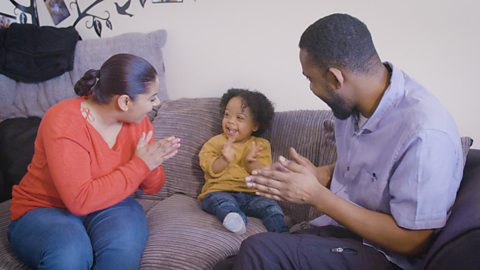
I’d say the best thing about learning Makaton is finding a new way to communicate with Dantae. It feels really exciting to use it with him.
Makaton has opened up a whole world of communication for us.
It’s helped us most around mealtimes and toilet training, because he gets more involved now. For example, I can use the signs to ask whether he needs the toilet and then, when he’s on the toilet, whether he wants more or if he’s finished.
I think he gets a little bit confused sometimes, because he’ll say ‘more’ when he’s really finished or vice versa. Then other times, he’ll be sitting there on the toilet, just singing and doing signs for the sake of it.
Advice for other parents
If there are any parents out there who are thinking about learning Makaton, I’d just say do it.
It’s exciting and fun, especially when you see your child doing the signs back. You’re constantly shocked and amazed that they actually understand you.
It takes a bit of time and obviously patience but once you get there and keep going consistently, your child will get the hang of it and so will you!
For more information or advice about Down syndrome visit The Down's Syndrome Association.
The Makaton charity shares online lessons, as well as signs of the day and loads more information and fun stuff on their website.