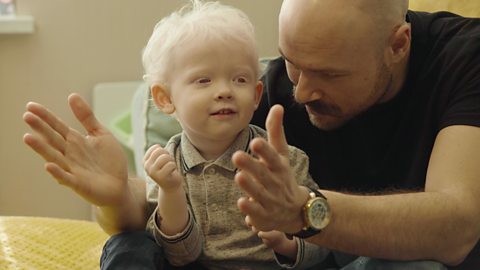
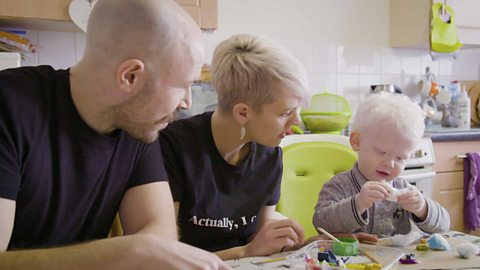
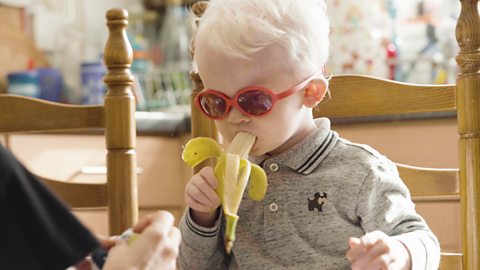
Layla and Torrian are parents to Milo, 2, who has oculocutaneous albinism (OCA). Milo is registered as visually impaired: he is severely short sighted and although he can see around a metre, this is mainly limited to shapes and colours, rather than small details.
Tell us about Milo...
He’s so full of beans! He’s energetic and has a real sense of humour. He knows when he’s being funny and he really likes to make people laugh. Milo is also mad about animals – especially elephants – and is obsessed with the emergency services. He can recognise the sound of a police car or ambulance, even if he can’t see it. Another thing Milo loves is imaginary play. When he’s not dressing up as a fireman, he’s getting us to make a police station out of a tent and blankets.
The diagnosis
We had no idea Milo had albinism until he was born. I knew the instant he was put on my chest. He looked completely different to my 12-year-old daughter, Alice, when she was a baby. To begin with, the doctors insisted he was fine, just very blond. But after 3 days, we saw a new doctor who said he was concerned about Milo’s pale complexion. He also hadn’t opened his eyes. We now know the lack of melanin in his eyes means they are more sensitive to light. When Milo was 5 days old we saw an eye specialist who diagnosed him with albinism. He was very blunt and said, ‘He’s likely to be blind. We’ll see you in our clinic in 3 months.’
It was an awful moment, and it was left to us to find out more about the condition. Luckily, Torrian found the Albinism Fellowship, who have been amazing and given us lots of information and support. We’re still waiting for genetic tests to find out which type of albinism Milo has. Because of his silvery white hair, pale skin and little to no pigmentation in his eyes, doctors think he has type OCA1 or OCA1B.
A different way of seeing the world
Milo was around 6 months old when we realised he could see. I still remember the first time he saw my face. We were lying in bed so I was probably only about 20cm away from his face. He looked at me, smiled and touched my face. His face just lit up!
And that meant from the moment he was born, Torrian and I have been Milo’s eyes to the world. Even when he was a tiny baby, we’d describe everything we could see. On walks I’d talk to him about big red buses and made sure I was always giving him a running commentary, using descriptive words.
Working on Milo's communication
My background is in childcare and before I had Milo I specialised in working with children with special needs. Because of this, I assumed Milo would have speech and language issues as he got older. A big part of how we communicate – including knowing how to have a conversation – is looking and seeing.
Lots of people think communication is just the spoken word. But there’s more to it than that.
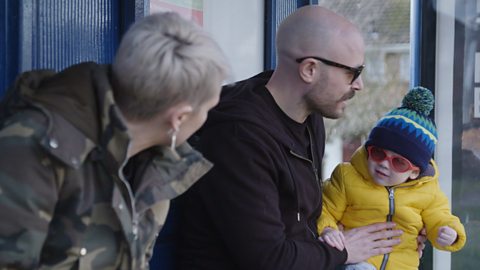
It’s about reading body language, facial expressions, the intonation in your voice, the tone you speak in. We make sure we think about all of that when we’re talking to Milo. Because his sight is so limited, we also use touch a lot like holding his hand. He’s very sensitive to touch and noise so it’s reassuring for him.
We know he can see bold colours so we use these to describe things. When he started getting fascinated by animals, we told him that elephants are grey. He wanted to eat elephant food and find things that elephants like, so we set him the challenge to find other grey things. We then taught him about the colour yellow, based on the fact that lions are yellow. When he understood the colours, we used them to teach him about the world around him.
Because his communication skills developed later, it was harder to know if he understood what we said.
We used shorter sentences with descriptive words. In the pram, noises would scare him so when we were out for a walk I’d say, ‘big bus coming’. At the time you feel like it’s pointless because you get nothing back.
Now he’s started talking, we know he took it all in. He’s so descriptive for a child of his age and that’s our input! He’ll say, ‘look, a big green tree’.
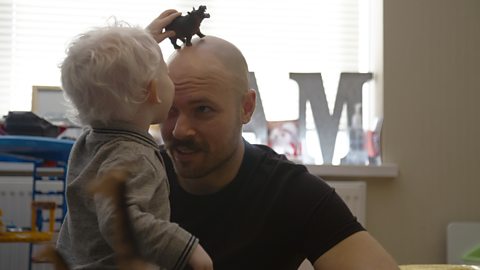
"Access all the help you're entitled to"
My advice to parents in a similar situation would be to access all the help you’re entitled to. Often it can be quite lonely. Milo’s disability isn’t severe but he is different, so it can be difficult to know where you fit. When he was younger I used to say, ‘we don’t need extra help.’ As soon as I stopped thinking like that and started going along to different support groups, I could see the benefit for both of us.
Milo has never his let his eyesight stop him in any way.
His dad and uncles all look and sound quite similar and when he was smaller, Milo couldn’t tell which one was his dad. So he’d go to each one in turn and they’d pick him up. When he got close enough to their faces, he’d say ‘no’, and he’d go to the next person until he found Torrian. We used to call the uncles ‘not-the-daddies’!
Milo is doing so well and he loves it when we celebrate his successes. It’s reinforcement for him of a job well done, and we’re so proud of him.
For more information and advice about albinism, visit The Albinism Fellowship.