The man who sought a ‘theory of everything’
Stephen Hawking was the most recognisable scientist of modern times. His life fascinated people for decades, culminating in an Oscar-winning portrayal of him in the film 'The Theory of Everything'.
The film's title was a nod to his scientific life. Hawking spent years looking for a single theory that describes our Universe. And despite debilitating illness, he was one of science's great popularisers, conveying his ideas to millions.
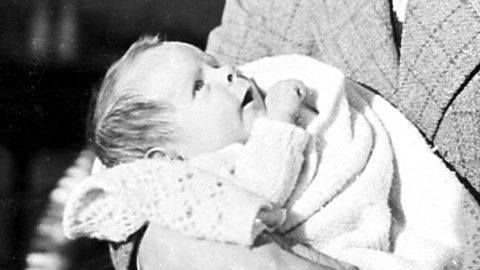
8 Jan 1942
A very normal young man
Hawking was born on 8 January 1942 and grew up in St Albans, the eldest of four siblings.
His father was a research biologist and his mother a medical research secretary, so it was not surprising that he was interested in science. As a student he was drawn to physics and maths as he believed they offered the most fundamental insights into the world. But nothing marked him out as special from his classmates or in his first term at Oxford University.
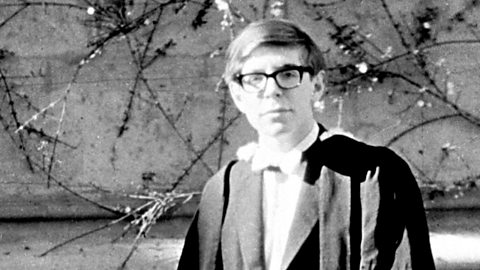
1965
Stephen marries Jane Wilde
Stephen got a first in Physics from Oxford, and started a PhD at Cambridge. His own private universe expanded when he proposed to his future wife.
Jane was also from St Albans, and was a modern languages undergraduate. She had met Hawking at a New Year’s party, before his diagnosis. The couple decided to marry quickly, because they did not know how long Stephen had to live. As Stephen's health deteriorated, he took to walking with a stick. Jane, who was two years younger than her fiancé, had to seek a special exemption from her college as students were not normally allowed to wed.
1966
A new way of thinking about the world
Hawking escaped the limits of his disability by training his mind to work in a new way.
As he started to lose the use of his limbs, he developed a way of visualising problems in his mind to reach a solution instead of by writing equations. Some of his colleagues have suggested that this way of thinking has led to his greatest discoveries. Hawking was now working on one of science's most bizarre ideas – black holes. An extreme prediction of Einstein's general theory of relativity, they are created when huge stars collapse to zero size and infinite density – known as a 'singularity'.
Hawking's disease gave him a unique perspective on the world
Narrator:
At the age of 22 Hawking's was diagnosed with ALS, a type of motor neuron disease. His doctors gave him 2 years to live. It was a prediction Hawking chose to ignore.
Kip Thorne:
Stephens ALS has progressed much more slowly than with almost anybody else. we don't know for sure why, but it has been much more slow.
Narrator:
By the 1970's Hawking's had lost the power of his limbs and his speech was slurred. All this might have destroyed his career, instead astonishingly he turned it to his advantage.
Kip Thorne:
He had to develop a whole new way, different from the rest of us, for working with the mathematics of Einstein's relativity. He learned to do it entirely in his brain without the benefit of writing things down.
He developed a way of doing it that involved manipulating images of the shapes of objects. The shapes of curves, the shapes of surfaces. Not in three-dimensional space but in four-dimensional space plus time.
John Preskill:
It's a kind of intuition he has about spatial relationships, he has the ability to visualise things that's very uncommon, and that's one of the things that makes him so effective at what he does.
Kip Thorne:
It has made him unique amongst all physicists, in his ability to do a wide range of calculations far better than he would ever have been able to do if he had not had ALS.
Narrator:
This unique way that Hawking was forced to work and think about the world would now allow him to understand the black hole better than anyone else.
1970
Could black holes provide clues to how the Universe began?
Hawking's work on black holes helped prove the idea of a 'Big Bang' at the birth of the Universe.
Developed in the 1940s, Big Bang theory was still not accepted by all cosmologists. Working with mathematician Roger Penrose, Hawking realised that black holes were like the Big Bang in reverse – and that meant the maths he'd used to describe black holes also described the Big Bang. It was a key moment in showing the Big Bang really happened. As his body deteriorated, Hawking's career was taking off.
Stephen's work reveals clues to the nature of time. (Clip from 'Profile', BBC Four)
Narrator:
One of the for most experts on black holes is mathematician Roger Penrose, who Hawking began to work with. Penrose predicted that at the heart of black hole is so called singularity, a point of infinite density and zero size.
Roger Penrose:
The question of singularities inside a black hole was something that I addressed by kinds of methods that people hadn't used before in this subject.
Peter Coles:
Hawking had an insight into this problem with regard to cosmology because he took the idea of a black hole collapsing to point and realised that it was really like a backwards version of the Big Bang. the Big Bang was everything expanding from a point to form the whole universe.
Narrator:
Hawking's masterstroke was to realise that both space and time were created in the Big Bang.
Stephen Hawking:
I think my achievement has been to help to show that time as we know it has a beginning in the Big Bang, and within black holes, and to investigate what happens in these places.
Peter Coles:
As soon as Stephen Hawking had done his work on the Big Bang singularity it was obvious that he was a major talent in this area and was capable of producing great work. It was obvious that he was an original thinker and potentially a very versatile one.
1974
In search of fundamental laws of physics
Hawking realised black holes could be a way to explore physics' holy grail: a unified theory that combined general relativity with quantum mechanics.
These two powerful but incompatible theories describe the universe at the cosmic scale and subatomic scale respectively. Hawking's attempts to combine them produced a surprising result – that black holes should shine. This effect is now known as 'Hawking radiation'. The work cemented his reputation as a key thinker of his generation. In 1974 he was elected as a fellow of the Royal Society, aged 32, and one of the youngest people to achieve this honour.
Find out more about Hawking's remarkable discovery about black holes. (Clip from 'Horizon', BBC Two)
Narrator:
In 1973 Stephen started a new line of research that was eventually to make him famous, with the discovery of Hawking radiation. Up until then, his work on black holes was concerned only with large ones with the mass of the Sun or bigger. But then he began to think that there might also be very small black holes. Stephen realise that in order to understand them Einstein's general relativity would not be enough. He needed to use a completely different brach of physics called quantum mechanics.
Quantum mechanics was formulating by Werner Heisenberg and Erwin Schrödinger in the mid-1920's. There's is a theory of very small things like atoms. Quantum mechanics is the greatest achievements in physics this century, even greater than Einstein's theory of relativity. It implies that what we think of as empty space is really empty at all but is filled with pairs of particles and anti-particles. these appear together at some point in space, move apart and then come together again, annihilating each other.
They're called virtual particles because you can't directly measure them with a particle detector. you can detect them however, by their indirect effects.
According to Hawking, if there's a small black hole present one of the members of these pairs might fall into it. Of course, the other on might fall in too, but it's also possible for one of them to escape and in that case, it would appear to be a particle emitted from a black hole.
In fact, to an observer a long way away, it appears that the black hole is emitting particles and radiation as if it was a hot body. very small back holes aren't black at all; they shine with Hawking radiation.
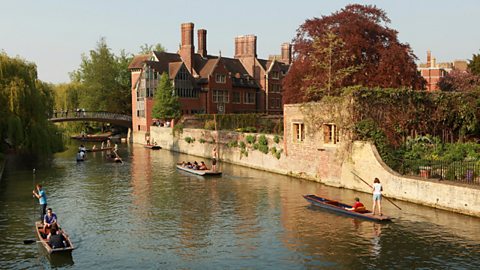
1979
Hawking chosen as the heir to Isaac Newton
Aged 35, Hawking became Lucasian Professor of Mathematics at Cambridge – a post held by some of Britain’s most important physicists including Newton.
He had reached a pinnacle of intellectual achievement despite the facts motor neurone disease had ravaged his body, he could no longer walk or feed himself, used an electric wheelchair to get around, and slurred his speech so much that many struggled to understand him. Yet he had already outlived the predictions of his doctors by more than ten years.
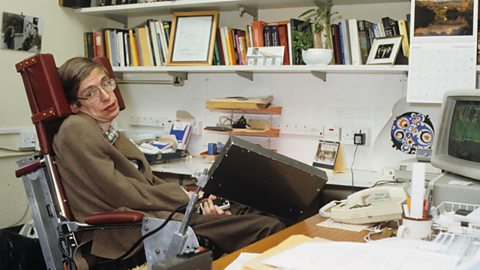
1985
Stephen loses his voice but finds a new one
While in Geneva, Hawking was admitted to hospital with a life-threatening bout of pneumonia. His life was in the balance.
Doctors could only save Stephen by performing an operation that robbed him of his ability to speak. Now he could only communicate by raising his eyebrows. Stephen was distraught, but once again he refused to be beaten. His friends helped him use a cutting-edge speech synthesizer which gave him a distinctive new voice. One of his first requests once he’d mastered the system was that someone should help him complete a new book he had been working on.
1988
A Brief History of Time
Hawking's introduction to cosmology is one of the best-selling books of all time.
Hawking wanted to explain his work to the public, and to make some money to provide for his family as his health declined. A Brief History of Time was a best-seller for four years. Hawking believes its success is down to giving people access to great philosophical questions, but acknowledges human interest boosted sales. The book went on to sell over nine million copies. It turned Hawking into a celebrity and transformed his life.
Hawking's popular account of modern Physics proved an instant bestseller. (Clip from 'Profile', BBC Four)
Narrator:
Short of money, Hawking needed to secure his families future. He came up with what turned out to be a masterplan, a book that would become a major money-spinner.
Roger Penrose:
I was thinking or writing a popular book and he told me he was doing this, and so I said to him "Oh are you writing this with the Cambridge University Press?" and he said "Good heavens no and doing this to make money". So I think he was clearly writing this book because he needed money and in his case it was something that was important, and he certainly had his eye on making a big impression.
Narrator:
Hawking spent 4 years writing a book. In 1985, he took the manuscript with him on a scientific trip to China. Former student Bernard Carr was one of the first people to read it.
Bernard Carr:
I remember I was on a train and I remember at that stage Stephen had the first draft of the book, and I remember reading it on the train.
Narrator:
The book had two parts, first; the usual introduction to physics and astronomy, second; his own ideas on the nature of time and black holes. But before Hawking could finish his book events took a turn for the worse. Within weeks of his return from China he was taken to hospital in Geneva with pneumonia.
Bernard Carr:
I received a phone call so I flew out to join them. It wasn't at all clear that Stephen was going to survive and eventually he was put on the life-support machine for a while and then they flew him back from Geneva to Cambridge and he was in Cambridge also on the life-support machine for quite a while.
Jane Hawking:
He was extremely upset and he was also angry with the world at that point. I went to see him, his doctor was there and I said to the doctor "He's a bonny fighter isn't he?" he is. The doctor agreed, he was not in anyway wanting to die at that point he wanted to go on living and did.
Bernard Carr:
Of course one of the consequences of this was he lost the use of his voice. He had to have a tracheotomy and lost the use of his voice, and so that changed his life in a big way.
Jane Hawking:
He had no voice, he had a very bad temper, and he was dealing with a frame in which you spelt things out letter by letter. And a lot of the conversations were done with his eyebrows which luckily are very expressive but he was extremely frustrated and he was in intensive care for a fortnight and in hospital for two months.
Narrator:
Hawking now required 24 hour nursing care but if he was to hold the family together, he needed to summon the energy to finish the book.
Unidentified male:
The book meant a great deal to him, I'm sure it meant a great deal to him, and he could see no way probably of completing it. And then slowly he found the mechanism with the computer and the scanning and the voice synthesizer and so on. But of course, that took quite a while to get all that to a point of development that he could use it efficiently and effectively.
Narrator:
The computer and mouse was specially designed by the husband of one of his nurses. It meant he could begin to communicate again. By moving one finger Hawking could construct whole sentences. And, at last, he could complete the book.
In 1988 'A Brief History of Time' was published. By the end of the eighties, it was a publishing sensation. It has been translated into 30 languages and has sold over 9 million copies. It remains the most popular science book of all time.
1995
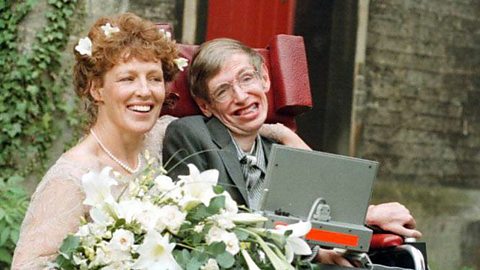
Stephen marries for a second time
After 25 years of marriage and three children, Stephen and Jane Hawking separated and divorced. Stephen married his nurse, Elaine Mason.
As Hawking had become a household name, his home life had suffered. Fame and illness proved too much of a strain. Hawking described his new relationship with Elaine Mason as 'passionate and tempestuous'. His second marriage lasted eleven years. He cited the pressure of his illness for its eventual breakdown.
1999
An icon of popular culture
In 1999, Stephen achieved what many regard as the ultimate accolade: his first guest appearance on the Simpsons.
By now he was an iconic figure, as famous for his public writings and cameos as for his scientific papers. He had presented a documentary series, 'Stephen Hawking's Universe', guest starred on ‘Star Trek: The Next Generation’ and lent his distinctive voice to Pink Floyd’s album ‘The Division Bell’. And he continued to publish popular science books.
Watch Stephen Hawking’s appearance in the Simpsons episode They Saved Lisa’s Brain. (Clip from The Culture Show, BBC Two.)
Lauren Laverne:
Anyone who's anyone from the world of politics and showbusiness has been in it, and they're not afraid to aim high.
The Simpsons clip:
Everyone: Stephen Hawking!
Principle Skinner: The worlds smartest man!
Lisa: What are you doing here?
Stephen Hawking:
My daughter Lucy new one of the scriptwriters from 'The Simpsons'. She said he would like to write an episode involving me accepted immediately because it would be fun and because 'The Simpsons' is the best thing on american television.
The Simpsons clip:
Principle Skinner: I'm sure what Dr Hawking means…
Stephen Hawking: Silence. I don't need anyone to talk for me.
Stephen Hawking:
The episode was very funny. Now almost as amny people know me through 'The Simpsons' as through my science.
2004
The black hole information paradox
Hawking's work on black holes continued. In 2004, he came up with a bold new idea, over the question of whether black holes break the laws of physics.
One of the ideas underpinning quantum theory is that physical properties of subatomic particles (or 'information') cannot be destroyed. For years, Hawking argued that black holes don't destroy information, but never shown how. At a conference, everyone expected a defiant defence of his ideas. Instead Hawking made a startling U-turn. His controversial new theory – that the information is transmitted into other universes – demonstrated he was still rethinking his image of the Universe.
What was Hawking's bold new theory about black holes? (Clip from 'Horizon', BBC Two)
Christophe Galfard:
Soon after Stephen came back from hospital he asked me to work with double-speed. We spent hours and hours writing at night, late night, weekends, day, night all the time.
Narrator:
Then Hawking made a dramatic announcement. He wanted to address the scientific community at one of the most prestigious conferences in physics.
Gary Horowitz:
Shortly before the meeting we got word from Hawking that he wanted to speak, sure when someone of Stevens stature asks to speak you try and accommodate him.
Narrator:
Hawking's paper was a late entry. The schedule was cleared and he was found a slot. The conference got underway, but what everyone was waiting for was hawking's new idea. many in the audience were expecting another defiant performance, a proof that Hawking was right and that information was lost in a black hole. But Hawking had a surprise, he wasn't here to defend the information paradox, he was here to bury it.
Stephen Hawking:
Can you hear me? I want to report that I think I have solved a major problem in theoretical physics that has been around since 30 years ago.
Narrator:
Hawking's speech turned out to be one of the great u-turn’s of science. For information, he now admitted, was not lost in black holes after all. The idea he had defended for 30 years had been wrong but after the shock there was a twist in the tail. Hawkin claimed Sussking wasn't right either and instead he now had his own solution, one that was to leave his audience largely bemused.
It was based on a familiar theory, that the universe we live in might be only on of an infinite number of universes, each with its own different history. in some, a black hole would exist, in other universes it would not. To understand the real effect of a black hole you had to combine all of the parallel universes together.
Stephen Hawking:
One therefore has alternate histories with and without a black hole. information is lost in the black hole of histories but information is preserved in histories without a black hole.
Narrator:
In effect those universes were black holes existed would be cancelled out by those that didn't. And that meant information didn't disappear because there would be no black hole for it to become trapped in, in the first place.
Stephen Hawking:
If one waits long enough only the histories without a black hole will be significant. So in the end information is preserved.
Christophe Galfard:
If there is no black hole, then there is no problem basically.
Narrator:
The man who'd spent most of his career trying to understand black holes had now come up with a proof that made them disappear, and in the process effectively admitted he'd been wrong.
2009
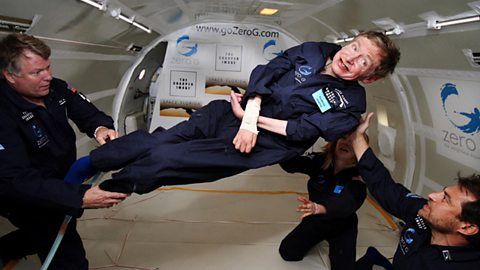
Stephen declares ‘I’m not retiring’
As required by Cambridge University regulations, Hawking stepped down from the post of Lucasian Professor of Mathematics when he turned 67.
By now, he could no longer use his hand to operate his wheelchair, and could only communicate by moving his cheek muscles to control his speech synthesizer. However, he announced that he intended to continue working. Unable to take on the administrative responsibilities of most senior scientists, he was able to continue what he did best - thinking. He took up a new post at Cambridge and continued publishing in leading journals.
2010
The Grand Design
In his best-selling book The Grand Design, Hawking made more bold claims about the hunt for a theory of everything.
Hawking backed a radical new idea: M-theory. It predicts that there are many universes, and that there is no theory of everything to describe our particular Universe. Instead the laws of physics are different in different universes; ours happens to one in which the conditions are right for life. M-theory's conclusions were unpalatable to many who had spent their lives searching for a theory of everything, and some physicists dismiss M-theory as little more than speculation.
Brian Cox asks whether our Universe is one of many in a larger multiverse. (Clip from Human Universe, BBC Two)
Brian Cox:
The reason that we appear to live in a perfect universe with the perfect numbers, the perfect constants of nature, the perfect laws, is because there are in fact countless millions, perhaps an infinite numbers universes each with different physical laws. Different numbers, different constants of nature. then we shouldn't be so surprised to live in the perfect universe. It's like the lottery, somebodies got to get the right ticket, somebodies got to win it.
Just as a lottery has many tickets, each bearing different numbers, so there maybe many universes each with different values for the constants of nature. Universes with stronger or weaker gravity, slower light or faster light.
2014
Hawking celebrated on the silver screen
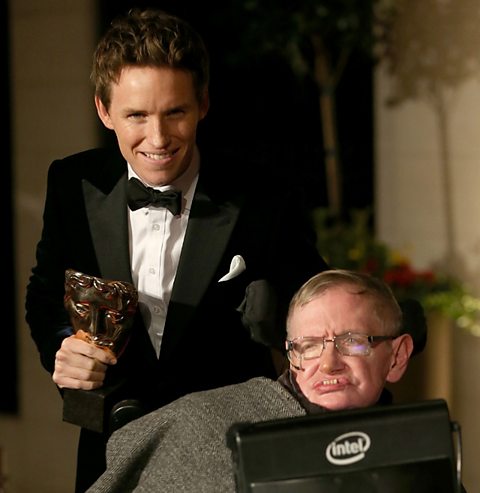
In ‘The Theory of Everything’, Eddie Redmayne gave an Oscar-winning portrayal of Hawking.
The film was based on the book ‘Travelling to Infinity: My Life with Stephen’, by Stephen’s first wife Jane. Jane and Stephen collaborated with the production team, and he allowed his voice to be used on the soundtrack. Hawking himself praised the film and claimed he had trouble distinguishing photographs of his early life from photographs of Redmayne. The film became a lasting testament to Stephen's ability to inspire scientists and the public alike.
2018
An astounding life
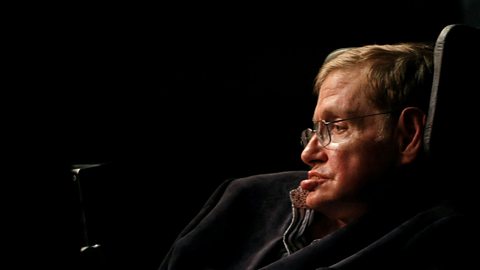
In March, Professor Stephen Hawking died. For fifty-five years, he defied a disease that should have killed him in five.
The time spent since his diagnosis was not just about survival – he produced all of his world-changing work. His brilliant theories advanced the ideas of Einstein and ushered Hawking into the pantheon of important modern physicists. His surprise top-selling book and iconic appearance may have introduced and endeared him to the general public, but his ideas on gravity, black holes and the Big Bang will be his greatest legacy.
