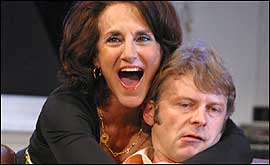
When Neil Simon first chose to trial this work in Boston in 1970 it received many disconcerting reviews, which in turn almost led to its instant demise. However Simon's faith to persevere saw the play become critically acclaimed on Broadway and it's still clear to see why even after thirty four years. This piece deals with some dark issues but still offers Simon's excellent one liners, reminiscent from his days as the key writer on Sergeant Bilko. Lesley Joseph swept into the role of a former nightclub singer, Evy Meara, fresh out of rehab for alcoholism and back into her tatty apartment in New York. Her long suffering friends, Toby and Jimmy, were on hand to assist her at first, but it was the arrival of her teenage daughter that brought the play to life. The individual character introduction was brief but skillful, we instantly knew that Evy was tender but the true depths of her despair were yet to come. Jonathan Guy Lewis, as Jimmy, seemed to roam the stage with a camp swagger that further endeared you to his plight to ensure that Evy remained safe and dry. However, we were also invited to understand that he too was suffering with a personal crisis of confidence and his dreams of acting stardom where not materialising. 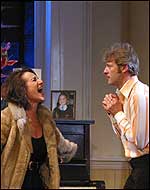 Life long friend Toby played by Miranda Foster, also had self identity issues, which saw her beautifully dressed with perfect make up but left her eager to hide the sign of aging. Her problems along with Jimmy's and Evy's at first made for quick witted banter but in time brought the issues of addiction, failure and denial to the fore front. Life long friend Toby played by Miranda Foster, also had self identity issues, which saw her beautifully dressed with perfect make up but left her eager to hide the sign of aging. Her problems along with Jimmy's and Evy's at first made for quick witted banter but in time brought the issues of addiction, failure and denial to the fore front.
Sinead Keenan acted the role of Evy's seventeen year old daughter Polly with typical teen angst mixed with genuine concern for her mothers well being. Lesley Joseph, while showing glimpse of her previous incarnation as Dorian from Birds of a Feather, was still powerful in her attempt to dissuade her daughter's help. While it was clear Polly's intentions were honourable, you were still left feeling as though the initial bubble of hope was all about to burst. With the second act came the opportunity Joseph to demonstrate her fine skills as Evy descended into grasp of her addiction. You could feel the tension in the audience rise as Joseph lurched towards the wine bottle with a satanic stare. She hit the bottle as those around her also voiced their woeful tales of failure, all except Polly who's sparing attempts to ease the rooms problems led to her own failure. This eventually left her alone while her mother revisited her miserable past with the help of her inner demons. There is always one person who by the interval the entire audience wishes would seek the attentions of a cough specialist. When the curtain dropped for the interval I realised that shameful accolade belonged to me. I had managed to asthmatically wheeze throughout the most tense of theatrical stand offs, partly through the intensity of the production but also caused by the on set of Man flu. This is possibly the most serious of the flu like illnesses to affect the theatre, mainly due to man's inability to cough quickly or quietly. In the final short act we were shown the aftermath of the previous night, revealing some dark home truths. As Evy unveiled a corking shiner, her hangover wisdom provides Toby with a genuine solution to her problem. But the reappearance of Polly reignited the tense atmosphere on stage and also in the auditorium. There were times where I began to feel the dark underbelly of the play effected my interpretation of the work. I wondered whether to feel guilt or sorrow for the extreme level of addiction that Joseph's character portrayed. But the true power of Neil Simon's play led me to question my own addictions and therefore I believe to unveil its real power. In coming weeks we will be treated to another Neil Simon classic as London Suite arrives at Milton Keynes. If this production can offer the same level of competency as The Gingerbread Lady, then we can expect another brilliant night out.
Read our interview with Lesley Joseph>>
|