| 13 November 2014 |

| |
| BBC Homepage | | |
| |||
| Contact Us | | |
Myths and LegendsYou are in: Beds Herts and Bucks > History > Myths and Legends > What’s the Robber Dunne?! 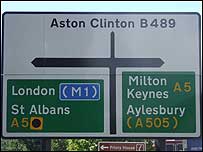 The famous crossroads in Dunstable What’s the Robber Dunne?!Katy Lewis Find out more about one of the stories behind Dunstable's name! There are always stories of how towns have got their names. Some are linked to royalty or famous figures, while for others it’s to do with location or unusual happenings. Dunstable, built around the busy crossroads where the Icknield Way crosses the A5 Watling Street, may have been named after ancient words which meant "the market place on the hillside.", but there may also be a far more romantic and exciting reason. It may have taken its name from - the legend of the Robber Dunne. Local historian Vivian Evans tells us more! “There had been a gang of robbers around this crossroads” she explained, “and the leader was a man called Dunne. He terrorised travellers and they appealed to King Henry I that he should try and get rid of these robbers. 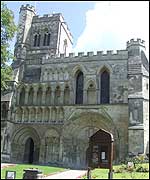 Priory Church, Dunstable “So he [Henry] came here [to Dunstable] and gave them a post, or a stake, which they stuck in the ground. He then gave the soldiers his ring, and told them to staple it onto the post. They were to keep watch all night because they thought he’d never miss the chance of stealing this ring. “Henry went off somewhere for the night” she continued, “and the soldiers kept watch but in the morning, the ring had gone and the soldiers hadn’t seen a thing. So the King said that the only thing he could do was to clear all the rough ground around the crossroads and put a town there - and that is the story as to why it is called Dunne-staple!” “Well, then of course the story gets more and more complicated” she added. SimilarYes, like all good legends, the story of the Robber Dunne has been added to over the years. Between the 13th and 19th century the story cropped up a number of times. In 1290 it was mentioned in the introduction to the Treaties of Dunstable, a book which explained how the Priory came to be such a large landowner. In the early 1600s, a version of the story appeared in the Parish Register and in 1821, a painter and decorator called William Nicholls published a whole series of stories called Dunnos originals and went into GREAT detail about Dunne. But in all these versions it was a similar story that was told, with a similar ending. Then in 1898, Arthur Mooring, the then editor of the Dunstable Borough Gazette, published his romantic and exciting Legend of Dunne the Robber! This was quite a different story where Dunne was a wealthy Saxon landowner who was forced off his land by an overbearing Norman knight. Dunne then became the leader of about 50 more men, all discontented landowners. It is now that the Dunne story grows into a full-length romance and adventure story! RomanceVivian takes up the tale again! “One day, they captured a party of Norman knights escorting a lady to St Albans Abbey and took the lady to chalk caves at nearby Totternhoe” she revealed. “Dunne was seriously wounded but the captive lady Alicia nursed him back to health and they became great friends.” Alicia’s story is that when her mother died, her father sent her to the Abbot of St Albans for protection, so that he could look after her and her money until she was suitably married. But it turned out that the Abbot had an eye on his own wealth and he was going to turn Alicia into a nun and take her money. “The story goes on that Dunne returned Alicia to her father” continued Vivian, “but then her father’s house was burned down and Dunne and his friends rescued her from the fire and took her back to the caves again. Everyone blamed Dunne and the outlaws for the fire when it wasn’t really them at all. They also thought that Alicia had died in the fire but she was really safe in the caves with Dunne. “Henry I had been away all this time but when he came back, Dunne and his friends returned Alicia to the king for her safety. Then it turned out that the love story was not between her and Dunne, but she had another man who she was very much in love with. “Then the story rambles on” continued Vivian, “and then finally, we get to the bit about the post and the ring etc! Eventually, Alicia is prepared for her wedding to her sweetheart Wilfred. “The story ends with a town being founded here by King Henry, “a place for mercers and buyers of wool, a market where country folk shall bring their produce and barter if for money”. And Alicia and Wilfred, we hope, lived happily ever after.” Existed?So, the story of how Dunstable got its name is one that has been passed down through generations and ended up as a romantic adventure story. Sadly, it would seem that the crossroads was known as Dunne Staple long before tales of any robbers – as Vivian explained! “Yes, the crossroads was called “Dun staple” before the town was founded” she said.
“Dun” refers to the down land and staple with a “p” was a sort of boundary / marker post. So over the centuries at this crossroads, there would have been some sort of marker post for the change of the county etc. So the real story isn’t very exciting! But Dunne the robber story got more and more exciting.” So story of Dunne has been embellished over the years but does Vivian think that he actually existed? “Undoubtedly there were robbers recorded right through history on Dunstable crossroads” she revealed. “In the 1300-1400s, various kings were writing to the Prior saying that they’d had so many complaints about robbers round that bit of the road that what were they going to do about it. “It was a perennial problem so undoubtedly there were robbers and undoubtedly there was one who took his name from the downs, and people from along way away called him Dunne.” Nevertheless, while he is likely to have existed, it’s highly unlikely that the king would have allowed a town to be named after a villain! “I think it’s most unlikely” agreed Vivian! “I prefer my Saxon site name explanation rather than this story – good story that it is!” ReasonBut still there was a good reason for a town to be in the place that is now Dunstable. “Yes” said Vivian, “I hate to kill a good story but when William II died, Henry I took on the fight against Robert, captured him and brought him to England under house arrest and lost all the money his father had got by winning the battle of Hastings. “He needed to build up an export trade and that was the real reason he put a business centre here – I don’t think robbers had a lot to do with it!” It’s a shame that the legend of Robber Dunne is only a tale, but it’s nice to still tell it. Let’s go back to 1821 and the words of William Nicholls to remind ourselves of our country’s tradition for telling a great story! King Henry said tis wonderful The Staple and the Ring they found, last updated: 21/08/2008 at 16:57 You are in: Beds Herts and Bucks > History > Myths and Legends > What’s the Robber Dunne?! |
| | About the BBC | Help | Terms of Use | Privacy & Cookies Policy |