 | 27 November 2014 |

| |
| BBC Homepage | | |
| |||
| Contact Us | | |
AbolitionYou are in: Beds Herts and Bucks > Abolition > Sankofa March of the Abolitionists 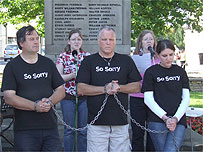 Sankofa March of the AbolitionistsIan Pearce Marching to say sorry for Britain's involvement in the slave trade, the Sankofa March of Reconciliation has recreated a journey through this area, made by Thomas Clarkson in 1787, who tried to tell people about the horrors of slavery. Back in March I caught up with the Lifeline March of the Abolitionists as they walked down the Meridian Way between Hull and London linking Parliament with the home of William Wilberforce. Now they are back with a second walk. Called the Sankofa March of Reconciliation, this walk recreates an epic journey by one of the leaders of the Abolition Movement. Britain was involved late in the slave trade not starting until 1676 . Once it was involved however, it used the Royal Navy's supremacy to totally dominate the triangular passage. The goods being returned to England from the Indies and America and the goods being shipped out to Africa led to a great economic explosion throughout the eighteenth century. This is when the great cities and the great homes were built as well as the mills and factories all fuelled by the holocaust of African Slavery - the middle passage of the traders : out of sight and out of mind for the merchant venturers who were becoming the great benefactors of cities like Bristol and Liverpool..  From June 1787 until 1788 Abolitionist Thomas Clarkson rode 1151 miles between the slave ports of London, Bristol and Liverpool returning through the industrial Midlands where the weapons and shackles used in slavery were forged. He carried African produced goods. Similar to what can be found in Fair Trade shops today, Clarkson was demonstrating there was another way of trading in Africa. The marchers this time have not walked every inch but instead are making entrances into towns and are taking school assemblies and highlighting places that had a clandestine involvement with the profits of the slave trade. So, for example, they passed Luton's Stockwood Park. The great house, sadly demolished in the sixties, was home to the Crawley family and was built from money earned in the slave trade. Members of my own family worked for the Crawley family - though probably for very little money. 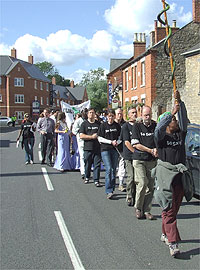 I met the marchers this time in Olney. The march down the High Street was well supported. The marchers led the way yoked and shackled as before. They were followed by drummers , the St John's Ambulance Corps who had made their headquarters available, carnival queens and princesses, cubs and scouts as well as a group of Buddhists from Milton Keynes. We stopped in the market square before visiting the grave of John Newton the former slave ship captain who gave evidence against the trade. Sankofa means going back to go forward… quite apt in Newton's case. The marchers are looking for an apology for Britain's involvement in the Transatlantic Slave Trade especially from the church. A representative from World Vision reminded us of the continuing face of slavery in human trafficking. After resting in Olney the marchers walked through Luton before the final leg to the heart of London's docks at Deptford. last updated: 13/07/07 Have Your SaySEE ALSOYou are in: Beds Herts and Bucks > Abolition > Sankofa March of the Abolitionists [an error occurred while processing this directive] |
| | About the BBC | Help | Terms of Use | Privacy & Cookies Policy |
