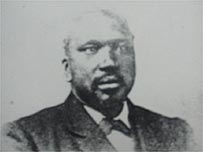
Pavenham, a small village to the north of Bedford, not the sort of place you'd think would be home to a former slave of the Sudanese Dinka tribe. But in 1880 a young Dinka tribesman from Sudan called Hatashil Masha Kathish or Salim, as he became known, came to start a new life in the village. 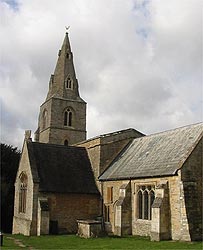 | | Pavenham Church |
While in captivity Salim was treated like an animal. He was sold for six yards of calico, such was the worthlessness of slaves at that time. In his autobiography "The Life Story of Hatashil Masha Kathish" he describes his experience after being sold from one Arab master to another. "'My new master proved to be a creature who might fitly be called a Demon. To make me wretched was his greatest delight, nor cared he what methods he employed to attain his end. At one time he would make me fight boys much bigger than myself, against whom I stood no chance of success. Then, when I had been beaten he would take me off to some lonely place and ask me why I had let the other boy conquer me. "He nearly killed me once. I was carrying his gun, an old fashioned rifle, after him, and had the cartridges in a belt that was buckled round my waist. Our path brought us to a brook and as I leapt into it with the gun upon my shoulder I forgot all about the cartridges, which, of course, were spoilt by the water. When he saw what I had done his face became like a fiend's and he stood and beat me, in spite of my cries for mercy, till I could cry out no more. I could only just pull myself together as a tortured beast would have done, and try to die and escape his brutality." Then in 1880, a missionary called Charles Wilson, whose father was the vicar in Pavenham, brought Salim back to the UK after he was freed by forces serving under British General Charles Gordon. 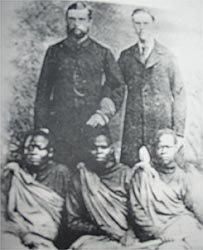 | | Charles Wilson returned home with former slaves |
He lived for a time in the vicarage with the Reverend and his wife and was sent to the local school. Most people in the village welcomed their unusual visitor with open arms but some, as Salim describes, were not so hospitable. "'It was not all smooth sailing with the village boys; some of them went too far with their jokes. One tore my clothes in a scuffle and I felt this to be a greater injury than if he had bruised my face. I went to the village garden to find an iron tool with which to strike him. At that time you must remember, I had not been long under the influence of civilised society. Providentially the village postmaster met me on the road, or there might have been a tragic ending to that quarrel." While at school Salim learnt to speak English with the help of his classmates who would hold up objects for him and ask him to name them. "Sometimes I was wide of the mark", he admits in his autobiography, "and then, amid roars of laughter, I had to try and try again until the difficulty was conquered. I endeavoured to master the alphabet …but I'm afraid the strange noises I made as I grappled with letter after letter, little tended to the quiet of the school. Not even the sight of a cane on the Master's desk sufficed to check the laughter I provoked." Salim stayed in the village for over a year and later accompanied Mrs Wilson to Nottingham after the death of her husband in 1881. He attended a missionary training institute but continued to live in England, much in demand as a preacher and speaker. As well as his autobiography he authored 'The Ethiopia Valley; the story of the people called the Dinkas' (c.1906) edited by William Engledow Harbord. He was baptised in August 1882 and given the name Salim Charles Wilson after his first English friend. He married and later kept a general store in Scunthorpe. ListenPavenham historian Joan Arch reads extracts from Salim's autobiography: |