 | 29 October 2014 |

| |
| BBC Homepage | | |
| |||
| Contact Us | | |
AbolitionYou are in: Beds Herts and Bucks > Abolition > "I was blind but now I see..." "I was blind but now I see..."BBC Three Counties Radio presenter Ian Pearce investigates the life of John Newton, regarded by many as the father of abolition, his involvement in the slave trade and subsequent conversion to evangelical Christianity. 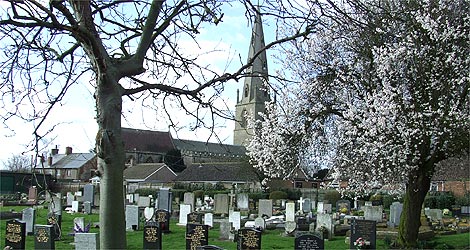 St Peter and St Paul in Olney As the anniversary of the abolition of the slave trade approaches, the hymn 'Amazing Grace' is receiving much attention. The Olney Hymns were written by John Newton and William Cowper. Newton was the curate-in charge at St Peter and St Paul in the market town and the melancholic poet Cowper lived on the market square in what is now the Cowper and Newton Museum. Newton is regarded by many as the father of abolition and it is his involvement in the slave trade and his subsequent conversion to Christianity that gave him the authority to speak from experience against "A commerce so iniquitous, so cruel, so oppressive, so destructive as the African Slave Trade!" 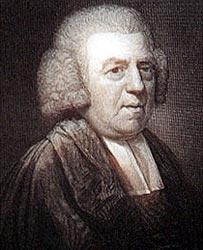 John Newton Newton in fact knew slavery from the other side. He was press ganged on to a navy ship and was captured as a deserter and put in shackles. But it was Newton’s experiences as a slave ship captain that was to become central to the fight against the trade. The main thrust of Britain’s merchant shipping was a triangular route. The ships left British ports carrying manufactured goods to Africa including guns to allow the slave trade to flourish The ships were then packed with kidnapped Africans for transport to the West Indies and America. The final leg saw them carry the products of slavery back to Britain such as cotton, sugar and tobacco. So the slave trade created Britain’s manufacturing industry and fuelled addictions for the workers to waste their money. The 'middle passage' was so far from British shores that the realities of the slave ships and the horrendous conditions were not cause for concern. Until Newton’s "An Authentic Narrative" was published in 1764, about the same time he took up his position in Olney that is. This book described the conditions on the ships in their full horror. The heat and smell of these rooms, when the weather will not admit of the slaves being brought upon deck, and of having their rooms cleaned every day, would be most insupportable to a person not accustomed to them. If the slaves and their rooms can be constantly aired, and they are not detained too long on board, perhaps there are not many die, but the contrary is often their lot. They are kept down, by the weather, to breathe a hot and corrupted air, sometimes for a week: this, added to the galling of their irons, and the despondency which seizes their spirits when thus confined, soon becomes fatal.John Newton: An Authentic NarrativeThe book became a best-seller and highlighted the reality that the trade was keeping quiet for fear that abolition would end the money which was making Britain great. 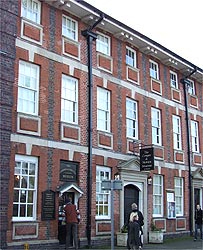 The Cowper and Newton Museum in Olney Newton turned to God during a storm at sea, although he initially continued to work on slave ships. His former debauched lifestyle changed though and he prided himself on the humane conditions of his vessels, even managing to complete one voyage with no loss of life. He then worked as an inspector of tides in Liverpool before turning to the ministry. Sponsored by Lord Dartmouth he moved to Olney. His house and that of Cowper were separated by an orchard and there the two men enjoyed each others intellectual company. Each week they would write a new hymn to illustrate the Sunday sermon. Because of Cowper’s depressions, Newton wrote far more of the hymns including 'Glorious Things of Thee are Spoken', 'How Sweet the Name' and of course 'Amazing Grace' written for the New Year’s Eve sermon in 1773. Newton’s constant evangelical berating of the Olney townspeople meant that the relationship grew stale and he moved to St Mary Woolnoth in London in 1783, the year before William Wilberforce entered Parliament. 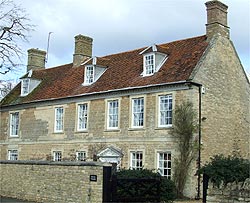 The Old Vicarage in Olney His new church was in Lombard Street right in the heart of a City growing rich on the broken bodies of African slaves and exploited workers and Newton used the pulpit to rail against the Slave Trade. Wilberforce had met Newton as a child. When he was unsure of his direction as an MP he sought Newton’s guidance. Newton told Wilberforce that he would make a difference staying in the political arena. He campaigned against immorality and of course became the political force of the abolitionist movement. The slave trade was abolished on the 25th March 1807 and Newton died in December the same year, by then deaf and blind but relieved to have seen the “iniquitous traffic” abolished. 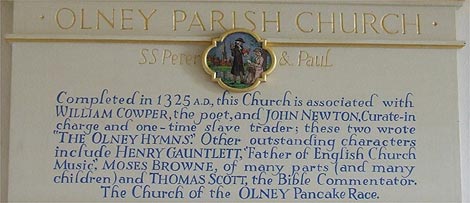 Inscription inside the church Slavery itself was abolished in the Empire in 1833 and Wilberforce learned of this on his death bed, passing away the same year. The two hundredth anniversary of abolition has seen much interest in the life and work of John Newton. It is a story worth telling, especially as millions of people are still in slavery today. The amount of research into Newton’s writings ensures that he will be recognised as more than the man who wrote 'Amazing Grace'. How fitting though that in the bi-centenary of Newton’s death, this song has become the anthem for the commemoration of the anniversary of the achievements of the abolitionists. last updated: 27/06/07 Have Your SayTony Seward Nella Bell Brian Lintern SEE ALSOYou are in: Beds Herts and Bucks > Abolition > "I was blind but now I see..." [an error occurred while processing this directive] |
| | About the BBC | Help | Terms of Use | Privacy & Cookies Policy |
