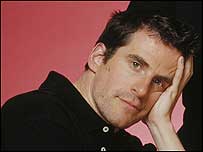
| Jerry Springer - The Opera | Milton Keynes Theatre 18 – 22 April 2006 Mon – Thur eves 7.30pm Fri & Sat 5.30pm & 8.30pm Wed 2.30pm The show is NOT suitable for children. RICHARD THOMAS Prior to Jerry Springer – The Opera, Richard Thomas wrote and produced Kombat Opera’s Tourette’s Diva. Richard’s television and theatre credits include Musical Director on The Frank Skinner Show (Series 3 on BBC1, Series 4, 5 & 6 on ITV1), This Morning With Richard Not Judy (Series 1 & 2 on BBC2), and Harry Hill’s sell-out national tour. He also composed and performed music for Attention Scum (BBC2), which was nominated for The Golden Rose of Montreux 2001. Richard Thomas has been involved in several Edinburgh Fringe Festival shows including Perrier Award nominated The League Against Tedium, Beethoven’s Not Dead, Legends on the Edge of the Millenium, Arthur Smith’s Hamlet, Cluub Zarathustra and The Tom Miles Quartet. |
Jerry Springer - The Opera has to be one of the most talked about and controversial productions to hit the British stage since "The Romans in Britain" in the 1980s. It is also one of the most successful, winning an unprecedented four Olivier awards, including Best Musical and also heralded as Best Musical by the Critics' Circle, the Evening Standard and What's On Stage. The show, created by Stewart Lee (book and lyrics) and Richard Thomas (music, book and lyrics) is a new opera based on America’s most lurid talk show and the US host who brought worldwide television audiences programmes entitled “Pregnant by a Transsexual”, “I Married a Horse”, “Here Come the Hookers", and “I Refuse to Wear Clothes”. It began as a series of public ‘Scratch Night’ workshops in 2001, before opening at the National Theatre to rave reviews and standing ovations in April 2003. It transferred to London's Cambridge Theatre in the November of the same year and soon became an established commercial West End hit. But when the BBC announced that they were going to screen a full length, unedited version of the show in January 2005, there were mass protests from various Christian groups about the decision to put what some called "a filthy piece of blasphemy" on our televisions. 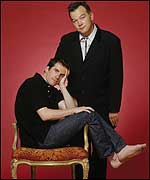 | | Co-creators Richard Thomas and Stewart Lee |
Hundreds of Christian protesters rallied outside BBC buildings before and during the broadcast and thousands of people contacted the BBC about the show, mainly to complain about swearing and religious themes. They claimed that the production mocked God and Jesus Christ and contained 8,000 swear words, a total reached by adding every swear word sung by each member of the 27-strong chorus. Nevertheless, the broadcast went ahead, attracting 2.4 million viewers, a record viewing figure for any musical or opera. Early in 2005, the producers announced a UK wide tour starting in the Autumn but the organisation Christian Voice exerted pressure on all theatres in the UK urging them not to house the planned tour. 30 per cent of venues pull out following the threat of legal action and public protest, and the tour became financially un-viable. An application for funding was made to The Arts Council and refused. In September 2005, 21 theatres, including Milton Keynes, united to save the tour. A move again condemned by Christian Voice. "This tour can only bring the judgment of Almighty God on the United Kingdom" said Stephen Green, their National Director. "To publicly blaspheme the name of Jesus Christ is to bring shame and judgment on those towns where it happens and on the United Kingdom as a whole." Realising that in all this, we hadn't actually heard too much from the show's creators, we grabbed the chance to chat to co-creator Richard Thomas (music, book, lyrics) about why he wanted to turn the TV show into an opera, what it was really about, and what he thought of the protests. Can we take you back about four or five years - before all the awards and before all the protests? Right at the beginning - why did you decide to do this, what was the idea behind it? Richard: Protests? What protests? Has somebody not told me something? I used to watch Jerry Springer, the late night shows that were on ITV, after I had come back from a gig and I got really fascinated by it. It was such a global hit and it was odd that it came out of America because Americans were kind of secretly embarrassed by the show but also secretly very admiring of it because of all the money it made. I found it fascinating and about four or five months into my obsession with it, there was one night there were about eight singers of all shapes and sizes on stage all screaming at each other, being heavily bleeped out, and there was an audience shouting at them and you couldn't really understand a word that was being said! I thought "God this is like opera!" and at that point I knew what I wanted to do. I thought "I'm going to have to do this as an opera"! At the time I'd say to people that I was doing this and they'd say "Why bother? Everyone's taking the p*ss out of Jerry Springer, what is there left to do?" But I said I'm going to explore it a bit more, there's some meat there that's worth exploring. The thing with these things is that you never know until you start getting into them what you're going to come up with but I'm glad I did. In a way I didn't care what happened to it [after I'd written it]. I think that when you get a good idea that you really want to do you just have to do it and hopefully you can sell it or whatever, but the selling of it isn't really the motivating force, the force is "I've got to do this idea". So, as you got into it and started to explore, what were you trying to achieve? Richard: Number one - I wanted to get laughs. I spent ten years in my 20s as a double act so I love comedy but I also wanted to treat the characters with dignity and go somewhere completely different. Basically I just wanted to do a classic two hour show that was really funny but was also a sort of fabulous surreal journey and that's it. I'm quite old school so while I write big chunks of entertainment that can be quite edgy, you've always got comedy there to take the bite. It's a comic opera, but what would you say it's ABOUT? | "The message that comes out of it is about compassion and tolerance and actually "judge lest not you be judged"." | | Richard Thomas |
Richard: You never set out to write about issues. Looking back on it now, I'd say it was about compassion and tolerance but it's also about anger, argument and betrayal and deceit - all those classic kind of operatic themes that you get in a Jerry Springer show. But essentially the message that comes out of it is about compassion and tolerance and actually "judge lest not you be judged"! But it's also really funny!! And that's quite hard to achieve in opera you know! So, it had been around for three years , it won loads of awards, including four Olivier awards in 2004. It was really successful and then suddenly .... Richard: Suddenly I'm the devil. Did that take you by surprise? Richard: Are you kidding?! God yeah - absolutely! I was in Germany at the time doing another show and had people ringing me up saying that there was loads of press about it and that people were burning their [TV] licenses and stuff. So, suddenly I was in this hotel room in Germany watching CNN and the story had gone global! At first I thought it was hilarious and I was really upset that I was missing out, but then when the death threats and stuff came in that got really serious - that was deeply unpleasant. Did you get any? Richard: I didn't get any personally but the heads of the BBC got them so the actual night of the broadcast was a very, very unpleasant experience because I was just in despair thinking that someone might get hurt. And I was very relieved that no one did. It was a deeply unpleasant experience. Then lately, it's been the persistent harassment from various groups and the misrepresentation of the show calling it "a filthy piece of blasphemy" with thousands of swear words in it. It hasn't. One - this got very boring but two - we both got upset and angry because we just had to spend our time defending the show when it had been this huge hit and got all these awards. Normally as an artist you jump through hoops to finally break through and then you relax a bit, pat yourself on the back and chill out! Instead I was doing interviews where people would say "What right do you have to offend people gratuitously or write 8,000 swear words?" And I'd say there aren't 8,000 f**king swear words! They'd say - why write a filthy piece of blasphemy? I'd say I wouldn't write a filthy piece of blasphemy because what's the point? It would be so boring. I can't think of anything more dull and I can't think of anything I'd least like to see. Somebody could write a blasphemous piece with 8,000 swear words in it but NO ONE WOULD WATCH IT! Then they'd say "Oh there's freedom of speech issues and I'd say "Yeah I think people should pretty much write about exactly what they like!" Are you pretty fed up of defending it then? Richard: Yeah I am! One of the great things about theatre is that it can push the boundaries, you can challenge and you can discuss and the great thing about living in this country is that you have the freedom to say it. Richard: Exactly - absolutely. A lot of people have complained about it, and they are perfectly entitled to their opinions, but many of those also haven't seen it. What do you say to them? Richard: Well that was my main beef. That's what became dull about it all as well. The 60,000 who complained before it was broadcast on the BBC hadn't seen it and the show had been around for three years, it was globally acclaimed and there was never a murmur of dissent - just the occasional walk out. 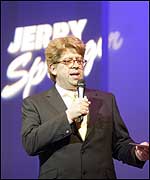 | | Rolf Saxton in the title role |
People bang on about they have a "right not to be offended" but no such right exists - and I don't think the show is that offensive. I've lived in south London for 18 years and there's certainly not a "right not to be offended" in south London! The whole point about theatre and film and stuff is that people should explore contentious subjects otherwise you're going to write propaganda and I don't write for the government, I don't write spin and I'm not a PR individual. I take a risk and I write things - some sell and some don't and that's my whole life and I make absolutely no apologies for that. To be truly offended by it I think you'd have to be very, very sensitive or an idiot. It's also a really funny show and I'm proud of that. It's a funny show and you can understand every word and that takes a lot of writing, a lot of crafting let me tell you! That's what I'm proud of. The fact that someone's offended, I'm sorry, you're talking to the wrong person - I don't care. Well - I do! If somebody's really upset and weepy about how it's offended them I wouldn't like that - I'm quite old school - I like to entertain. The second half is full of symbolism, but that's not a new concept is it? Richard: No, it's not new - it's 2,000 years old! There's a big tradition of using the Christian family, like in the morality plays, they are used all the time like that. My slight beef about that is that the second half is a nightmare and so actually they aren't really portrayals of the Christian story. These are figments in the imagination, in the nightmare of a dying man. It's not even like a morality play. And strange things happen in dreams? Richard: Yes. So I still can't see what the fuss is about and in a way that's been the saving grace for me. The good thing about it going on tour is that for a while I thought maybe it is just a filthy piece of rubbish maybe I am this nasty minded fool? You started to doubt yourself? Richard: Yes - definitely. Then when I saw it in Plymouth again, I really enjoyed the show, I laughed a lot and I found it really moving. That's what a show should do for God's sake. Then I got really angry, I thought I can't see the fuss - what is all the fuss about? I just don't get it. How is the tour doing? Richard: The tour's going well. We lost a third of the theatres so it's a loss making tour. But people have turned down royalties and stuff to do it because I think people thought it was important not to back down in the face of basically what was ignorance and bigotry. That's fine, I respect people's right to be ignorant and bigoted - but it's a slight pain in the ass when you lose a third of your theatres and you lose your royalties but the whole thing's been such an amazing roller coaster that there's no regret in any of this at all. But luckily no one got hurt. You've had a lot of publicity from it as well? Richard: The upside of it is the TV ratings doubled and that's great but the downside is that it has affected sales because I think that now the perceived wisdom is that the show is a filthy piece of blasphemy with thousands of swear words - and who wants to see that? Everybody hears that that's what it's about, but is there positive feedback, what do people like about it? 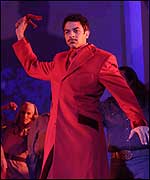 | | Dean Hussain in Jerry Springer |
Richard: I'll tell you what's good about it. It's a really funny, massive award-winning show like nothing you've seen before, with fantastic singing, really great music and in the second half you're slightly pushed and moved by some stuff happening to a man who then dies. But it's a really funny great night out and I promise that you will have never seen anything like it before. So, what do the people who like it say to you? Richard: They are saying what is all the fuss about? They say this is a fantastic night out - it's really funny, it's really special and it's completely original. I sound like a really vain, arrogant man but because we've been on the back foot all the time I have to really remind people it is funny and good. Do you regret the TV appearance? Richard: Oh god no. You can't really regret things because you're not in control of that stuff. There was a lot of nasty fall out but how could you foresee those things. And it's got people talking? Richard: Yes - and if it had any hand in stopping the incitement to religious hatred bill going through, then I'm very proud of that. |