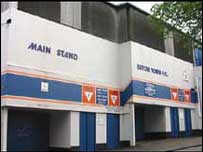
Luton Town's ground opened on 4 September 1905. This Saturday, the club will celebrate 100 years at Kenilworth Road at their home match against Wolverhampton Wanderers. 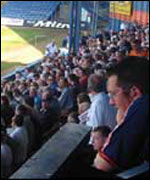 | | In the Main Stand at the Supporters Direct meeting |
John Buttle from the club showed BBC Three Counties' Martyn Coote around the ground, recalling his first visit and many other anecdotes about the place that Luton call home. My first match I started coming here in 1946. Sadly I lost my father and I came over to Luton to stay with an aunt and uncle. On a Saturday in November 1946 my uncle said I'm going to take you down to watch Luton Town play football. I came down and I hung on for grim death on the railings. I was only 10 at the time and there were 23,000 people in the ground. In those days we used to get those sort of gates and people used to queue right down Kenilworth Road to get in the games on most Saturdays. It was about two and sixpence to get in and I think as a youngster it cost me about a shilling. The match was against Newcastle United and it was quite a famous game really because we were losing 3-0 at half time and I thought "What's he brought me to?" But believe it or not, we actually ran out 4-3 winners!! Smoke get in your eyes The old railway which ran from Bute Street station all the way to Dunstable and beyond ran by the "new family stand". I remember on a Saturday afternoon, the engine driver would often stop and have a look at the match because he could stand on the foot plate and see over. On one occasion, the smoke came over so badly that the referee had to halt the game. That's the way football was in those days. And people in the houses opposite, they could go into their back bedrooms and look out and see most of the match. Living at the ground 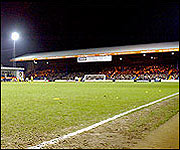 | | Kenilworth Road at night |
On Kenilworth Road, there was a row of terraced houses with a big gap underneath the first floor to go into the ground and players used to lodge in those houses. The groundsman also lived there and the club offices were there too. Out of the back gardens they would look at the Kenilworth Road terrace as it then was. In the middle of that terrace was the half time score board. The Bobbers Club Before the executive boxes were put in in the 1980s, that side of the ground was known as the Bobbers Stand. The Bobbers Club was underneath where you went at half time for a cup of tea. Underneath it now is the executive box holders' lounge. Artificial pitch We were one of the first club's in the country to have an artificial pitch and at the same time, because we'd had problems, the then chairman and his board decided that we were only going to have home fans in the ground. The pitch caused quite a stir but it was good because it meant we could hire the pitch out to teams all over the country and play a lot of games on it. We could play on a Saturday, the youth team might play before the big game and get exposure and then on a Sunday we had as many as four or five games. This was economically beneficial to the club but on the playing side of course, many visiting teams didn't enjoy the experience. Before the artificial pitch there used to be a 12 foot drop corner to corner. Oak Road The Oak Road Stand, now used for away fans, didn't used to go back as far as it does now. It was changed in the 60s to increase its capacity. I used to stand there sometimes. In the 50s you had to get into the ground an hour and a half before the kick off to get a decent spot behind one of the barriers. Record crowd The record attendance was 30,069 and that was in the Sixth Round of the FA Cup in 1959 when we re-played Blackpool after drawing 1-1 away. I think there were more people outside than were actually in the ground. It was quite remarkable. I've never seen scenes like it. Vauxhall nearly closed down and the schools were almost empty during the afternoon. Main stand 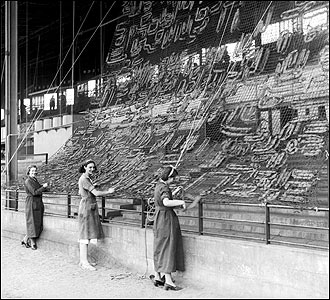 | | Kenilworth Road helps the war effort |
The Main Stand that was there 100 years ago mysteriously burned down in the early 1920s. Rumour has it, and I think it's fairly accurate, that this stand was bought second hand from Kempton Racecourse in 1922 with the help of local business people. Moving It's a lovely ground and it's got a lot of character but of course we've got to move because we cannot, in the modern game, bring enough people in. We need more people and we need a better ground. But the day these doors are finally locked there will be a sadness in my heart. |