 | 13 November 2014 |

| |
| BBC Homepage | | |
| |||
| Contact Us | | |
IndustryYou are in: Tees > Places > Industry > Corus - How it happened. Corus - How it happened.By BBC Tees' Martin Forster At one time more than 100 blast furnaces lined the banks of the River Tees, providing employment for 40,000 people. In 2009 the final blast furnace faces the possibility of closure and the last 2,000 Teesside steelmakers' futures are again uncertain. 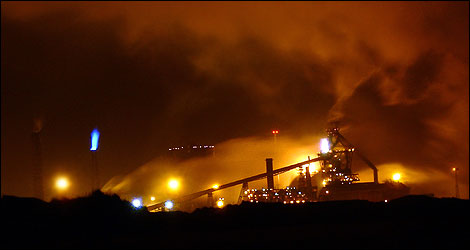 Redcar steelworks by night. You can take the story of Teesside steel back to the 16th Century, when the monks of Rievaux Abbey first began to extract iron from the Cleveland Hills, but the events that led to this latest moment when Teesside was forced to consider its future without steel go back to 2003.In 2003 Corus (formed by a merger of British Steel and Dutch steelmaker Hoogovens after the 80s and 90s saw a steep decline in UK steelmaking) ran into financial difficulties, posting annual losses of £458 million. The Teesside plant faced the threat of closure, amid accusations that the Dutch-dominated company was prepared to sacrifice British plants to protect the ailing aluminium arm of the business in Holland. Breathing SpaceThe plant was only saved when a deal was struck to establish Teesside Cast Products, owned by Corus, but responsible for finding its own buyers for its steel. Essentially, Teesside was left to sink or swim by itself.Alistair Arkley was part of the Steel Task Force on Teesside that brokered the deal. "Corus was losing lots of money and it was very much Dutch controlled and there was a feeling that they would take a view that shutting a British plant wouldn't matter so much. I think that at the time we were pretty pleased to have achieved what we did and were pretty pleased how it went after that." For the next four years, as a surge in demand sent steel prices rising, Teesside Cast Products flourished, signing up a consortium of four companies to buy 80% of its steel, with the remaining 20% going straight to Corus' own plants. But running a blast furnace in Britain is not cheap and Teesside couldn't compete with emerging steelmakers in Asia on price, concentrating instead on producing specialist grades of steel. 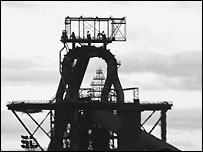 The plant has dominated the skyline for decades. The Tide TurnsThe financial collapse of 2008 hit the steel industry hard and the deal struck to save Teesside in 2003 left it as a small player with little capital to see it through. Teesside was vulnerable. By the end of 2008, shifts had been cut and in January 2009 Teesside Steelworks went up for sale.Chris Houlden, Senior Consultant in Steel at the Commodities Research Unit said, "Demand was particularly strong until the middle of 2008 due to China and other nations as well, like Brazil and India, and that supported both the consumption of finished steel products and also for slab. "But steel is particularly sensitive to macro-economic circumstances, so in the economic downturn, steel consumption has responded particularly drastically." In May 2009, with demand for steel plummeting, the consortium that had signed up to buy Teesside's steel announced it was pulling out of the ten year deal early, prompting Corus to announce that it wanted to mothball the Teesside plant. That statement put around 2,000 staff and 1,000 contractors' jobs in jeopardy and potentially called and end to steelmaking on Teesside for the first time in a century and a half.
last updated: 12/05/2009 at 17:37 SEE ALSOYou are in: Tees > Places > Industry > Corus - How it happened. |
| | About the BBC | Help | Terms of Use | Privacy & Cookies Policy |

