 | 13 November 2014 |

| |
| BBC Homepage | | |
| |||
| Contact Us | | |
Places FeaturesYou are in: Tees > Places > Places Features > Heugh Battery restoration program 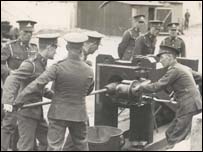 Restoration of the Heugh Battery 2006 Heugh Battery restoration programThe first cannon mounted on Hartlepool’s shore may well have been placed close to the Heugh during the late 16th Century and we know that guns were fired in anger from around here in 1650 when they were used against a frigate attacking a local boat. Hartlepool’s Heugh Battery will be featured in this year’s restoration program this September. They really need your votes in order to restore the battery to its former glory, so let’s all get behind our history and help them win the votes needed to get through to the final. Here is the history of the Battery which is on the Hartlepool headland. Hartlepool’s Heugh Battery was one of many erected in the mid 19th Century to defend British ports from attack and it was not unusual to have served through two World Wars and protected the coast for over a hundred years However Heugh Battery stands apart from all other sites as along with the neighbouring Lighthouse Battery these were the only British coast defence guns to engage enemy warships in battle. The storm of steel that erupted on a winter’s morning in 1914 was the first attack on Britain since 1797. It was here that the first soldiers were killed on home ground during the First World War and it was for this action that the first pair of Military Medals to be struck was awarded. The first cannon mounted on Hartlepool’s shore may well have been placed close to the Heugh during the late 16th Century and we know that guns were fired in anger from around here in 1650 when they were used against a frigate attacking a local boat. By 1740 eight guns were mounted just outside the present battery gates in Soulby’s Point Battery which by the Napoleonic Wars had been renamed East Battery. Abandoned in 1817 East Battery was once again rearmed by the Militia in 1855 as a stopgap measure before their new guns arrived. The Heugh and Lighthouse Battery were built side by side on the East Battery site in 1860 along with a third battery further north at Fairy Cove. Great efforts were made to strengthen the crumbling cliffs but to little avail at Fairy Cove where the battery began to topple into the sea a few years later. Heugh battery mounted four 68pr smooth bore cannon while the Lighthouse Battery held two. These could fire out to about a mile and a half but with no great accuracy. They were replaced during the 1880’s by more powerful and accurate 64pr rifled guns. Being the larger site Heugh Battery held most of the stores, offices and workshops and there was also accommodation for the two permanent gunners who lived here. In war the guns would have been manned by part time local men belonging to the Militia or as the Century drew to a close, the Volunteer Artillery, aided by a sprinkling of regular gunners. During peacetime the permanent gunners acted as caretakers, living quiet lives in the empty battery. Games of billiards were to be had in the nearby barracks and hours could be whiled away tending the batteries vegetable patch. In 1893 new batteries mounting powerful 6 inch breech loading guns on carriages which raised the barrels up over the emplacements to fire made their debut. The cliffs had also been reinforced by a new promenade and the Lighthouse Battery was upgraded for one new gun while two more were placed just north of the town. Heugh battery was overlooked as an ‘old stone work’ of little value and relegated for the Volunteers practice. However the new guns were both complicated and slow and soon rendered obsolete. After much discussion it was decided to completely rebuild the Heugh Battery for a pair of the most modern guns so that in 1900 virtually all the old site was torn down and two concrete emplacements were built with a strong underground magazine between giving the layout that we see at the battery today. The new guns, the famous Vickers 6 inch Mk VII could at this time hurl a hundred pound shell out to seven miles or more. Lighthouse Battery received similar treatment in 1908 and the older defences were swept away leaving Hartlepool armed with just three 6 inch guns. That same year the Volunteers transferred to the Territorial Force swapping their old blues for khaki. The Heugh Battery had entered the 20th Century. The day the First World War broke out the gunners were on their way to summer camp only to be turned around at the railway station and sent back to man the guns. Preparations proceeded apace, barbed wire and barricades were erected in the nearby streets and local houses commandeered. The Coastguard War Station was moved into the lighthouse and the Fortress Commander moved into the battery to be closer to his men. From dawn to dusk the guns were ready for action. It came on a misty morning just before Christmas on the 16th December 1914. The force of the shelling kept putting the Heugh rangefinder out of action, the communication lines were cut and when the lighthouse gun was finally repaired it could not fire as the lighthouse now stood in the way. Only as the German vessels retreated were all battery guns able to fire uninterrupted again, but the range was too great to cause real damage. After the Bombardment Heugh Battery took on a new role as a training ground for Siege Batteries being dispatched to the Western Front and over 2000 men were taught to handle heavy guns here. Yet despite all this Heugh Battery received no upgrades during the war, rather the decision was made, with the support of Winston Churchill, to consolidate the Tees Defences with the construction of a pair of batteries for 9.2 inch guns at Palliser Battery to the North of the Town and Pasley Battery near South Gare. Unfortunately Palliser battery did not last long and shut down in less than a decade after disputes over the lease. After the war the defences were gradually run down and once again the Heugh and Lighthouse Batteries held the only guns allocated to Hartlepool’s defence. These were further reduced in 1936 when the Heugh and Lighthouse Batteries were amalgamated. One Heugh gun was removed and the emplacement abandoned so that the new Heugh Battery incorporating the lighthouse gun remained a two gun site. This pair remained Hartlepool’s only defence at the outbreak of the Second World War. The Second World War began quietly on the home front but once France Fell in May 1940 a desperate scramble to fortify the coast began. Hartlepool received many new guns and Heugh Battery became the core of a whole range of new defences around the Town Moor. The battery received a new cookhouse and huts to cater for the influx of men, a rifle range and trench were constructed for training and many local houses were once again commandeered for accommodation. In preparation for the desperation with which defence would be undertaken, the old parade ground made way for a large gas decontamination block. The Heugh guns never fired in anger during the war, the only recorded incident being the unconfirmed shooting down of an aircraft by a Lewis gun from the abandoned emplacement. The occasional warning shot was fired over uncooperative merchantmen but generally the days were quiet and the guns silent. After 1943 coast defence began to wind down as the men took up new postings in the run up to D-Day and finally in 1944 the battery was mothballed. Check out our photo gallery at the top right of this page.last updated: 25/11/2008 at 15:12 SEE ALSOYou are in: Tees > Places > Places Features > Heugh Battery restoration program 5 DAY FORECAST The latest forecast for your area from BBC Weather [an error occurred while processing this directive] |
| | About the BBC | Help | Terms of Use | Privacy & Cookies Policy |
