In today's lesson we're going to investigate time, and discover whether the clock change has an effect on our alertness and reactions.
We'll develop our investigative skills and gather evidence through doing things, and taking note of what happens. We'll discover if the clock change really does have an effect on us!
Introduction to the Time Investigation
We asked pop star Fleur East to investigate time, and why it's not always the same time everywhere on Earth. Watch this short film to find out what she discovered on a visit to the Greenwich Royal Observatory.
Fleur East investigates time zones at Greenwich Royal Observatory.
Fleur Sax:
Jet-setting round the world, singing and performing, it's very easy to lose track of time. That's because wherever I am in the world, I have to put my watch forward or back.
Fleur Sax:
Los Angeles, America is eight hours behind us in the UK. So when we're waking up for breakfast in London…
Fleur Sax:
… it's bedtime in LA. Sydney, Australia is ten hours ahead of the UK.
Fleur Sax:
So when you're waking up there, it's teatime here.
Fleur Sax:
Travelling across time zones and changing my watch always leaves me feeling a little mixed up and confused. I often feel like going to bed during the day, but at nighttime, I feel like dancing because I'm not used to the new time zone.
Fleur Sax:
But would a small change still affect me?
Fleur Sax:
You don't need to live a global-trotting lifestyle to experience the clocks changing.
Fleur Sax:
In the UK, we change them twice every year, moving them forward by one hour at the beginning of summer and back again when summer's over. It's so we can make the most of the extra daylight at that time of year.
Fleur Sax:
But scientists don't know how this affects the way we sleep. We want you to investigate if changing the clocks changes you.
Fleur Sax:
But, before you get started, we're going to explore one of the oldest scientific questions there is. What is time?
Fleur Sax:
Our understanding of time didn't start with the invention of clocks and watches. It began in a much more natural way, by following the daily rhythm of the sun moving across the sun. From up in space, we can see that as the Earth spins next to the sun, one half of the world moves from darkness into light and then back again into darkness. It takes 24 hours for the Earth tomake one complete spin, giving us our cycle of day and night. It's why time differs, depending on where in the world you are.
Fleur Sax:
When the sun is shining on us in the UK, it's daytime. But at the same time, on the other side of the world, in Australia, they're in darkness. So it's nighttime there.
Fleur Sax:
It doesn't make sense for the time to be the same in each part of the world, which is why I'm always having to change my watch. Just 150 years ago, people even had to change their watch to travel around the same country. Every town in the UK used to have its own local time, which they worked out by the position of the sun in the sky. So when it was midday in Plymouth, itwas 12:17 in London. But then they built the railways and things had to change. Passengers needed to know when the train was going to arrive.
Fleur Sax:
Did they use the time where you were, the time at the place the train was going to, or even the time the train company was using? You'd have to be a mathematical genius to work out when to be at the station and when you'd actually arrive.
Fleur Sax:
Things could not go on like this. Something had to be done. And it was at this building in London that the problem was solved.
Fleur Sax:
This is the Royal Observatory Greenwich. Home of time. In 1884, it was decided that this line would be the point from which we set all of our clocks.
Fleur Sax:
When the sun passes over this line, it's midday here and everywhere else in the UK. We call this Greenwich Mean Time, and the rest of the world sets its time by it. Even astronauts up in space set their clocks by it.
Fleur Sax:
This line is used to divide the world's time zones into east and west. For every time zone going that way, west towards America, you take away an hour. If you go the other way, east towards Europe, you add an hour.
Fleur Sax:
It's made working out the time anywhere in the world much easier.
Fleur Sax:
Back to my jet-setting and our experiment. Every year, the clocks go forward for summer and back again in autumn. We want you to investigate how it affects you.
Fleur Sax:
You'll be testing your reactions to see how alert you are.
Fleur Sax:
But now it's way past my bedtime. Goodnight.
Get ready for the clock change
You'll investigate how changing the clock for daylight saving affects your sleep and alertness, by keeping a sleep diary and conducting some simple tests of your reactions. Over a week, the children will be asked to record the time they go to sleep and the time they wake up. In addition, they will be asked to test their reaction times with a simple test.
You'll be asked to:
• Keep a sleep diary for one week from Tuesday night until the following Tuesday night
• Test your reaction times and record your alertness in the morning and afternoon on Friday
• Test your reaction times and record your alertness in the morning and afternoon on Monday
• Look for patterns in the data you have collected
How to record your sleep
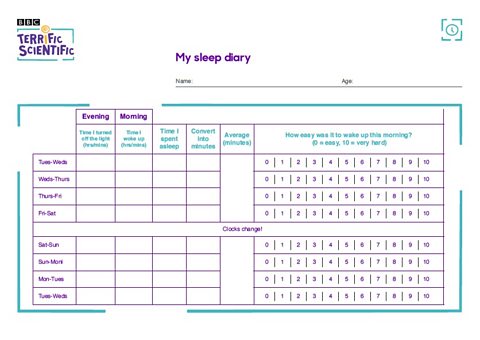
You'll be given a sleep diary to take home with you so that you can record how you sleep before and after the clocks change.
You can ask someone at home to help you with this if you like.
You need to record:
the time when you turn off the light to go to sleep
the time when you wake up in the morning
how easy it was to wake up
Analysing the data
When you get back to school you'll be working out how long you slept in minutes each night, and the average number of minutes you slept. Then you'll be looking for patterns in the data to see if they can show you anything
How to record your reaction times
Working in a pair you will use a simple ruler drop test. Find out how fast your reaction times are by how quickly you can catch a falling ruler!
NB: You need to do this test five times in the morning and five times in the afternoon on Friday, before the clocks change, and do the same again on Monday, after the clocks have changed. Record your results on the chart.
How to do the reaction time ruler drop test