In today's lesson we're going to investigate the water that comes out of our taps, and discover whether warm water can sometimes freeze quicker than cool water.
We'll develop our investigative skills and gather evidence through doing things, and taking note of what happens. We'll discover that all results are valid, even if unexpected!
This investigation links to the Materials and their Properties element of the curriculum.
Introduction to the water investigation
We asked "The BFG" star Ruby Barnhill to investigate water for us, watch this short film to find out what she discovered.
Ruby Barnhill:
Water is amazing stuff. In its frozen form, as huge sheets of ice, it's strong enough to shatter rock and sink ships. Heated into a gas as steam, water powered the machines that changed our world. And as a liquid, water is essential to life on earth.
Ruby Barnhill:
But it's also one of the most complicated substances we know and scientists still don't know everything about it. They've been puzzled by something called the Mpemba Effect, named after the young African boy who found out that warm water sometimes freezes faster than cold.
Ruby Barnhill:
We need your help to put this to the test. We want to know if the differences in our tap water across the UK change how quickly warm or cold water freezes.
Ruby Barnhill:
But why would water from one tap freeze differently to water from another? Before you get started, I think I need to go on a little investigation of my own to find out where our tap water comes from and why it's not all the same.
Ruby Barnhill:
I've come to the hills of Buxton in Derbyshire, a place well known for all its natural water springs, to find out more about where our water comes from. And I've got some expert help from Lauren Hipwell, who knows this area inside out.
Ruby Barnhill:
So this place is famous for its water but where does it actually come from? From streams like this?
Lauren Hipwell:
Well actually, our tap water all starts with rain from the sky. It flows off the hills. Some of it soaks straight in and some of it ends up in streams and rivers.
Ruby Barnhill:
But surely all our rain is the same across the country so why is our tap water different?
Lauren Hipwell:
To find that out, we need to follow this stream a little bit further into the hill.
Ruby Barnhill:
The rocks in this part of Derbyshire are made of limestone, which is full of little holes that let water through. Time to find out where it goes.
Ruby Barnhill:
Wow. So we're actually inside the hill we were just on?
Lauren Hipwell:
Yeah. This cave has been carved underneath the hillside.
Ruby Barnhill:
So is this water that we're standing in the same water that was at the top of the hill?
Lauren Hipwell:
Yeah. It's exactly the same. The rainwater has just seeped in through all the rock and is now flowing straight through this cave.
Ruby Barnhill:
The cave has been formed by the water flowing through cracks in the earth and wearing away the limestone rock below. It's taken about two million years to grow as big as this. It feels like I'm in another world.
Ruby Barnhill:
Why is this kind of alien-like thing hanging from the ceiling?
Lauren Hipwell:
That's called a stalactite and the way it's formed is rainwater, because it's slightly acidic, when it comes in through all this limestone, it picks up minerals such as calcium and it just redeposits it all over the cave and the cave walls.
Ruby Barnhill:
The calcium that the water dissolves from the rock is the same stuff that helps keep our teeth and bones strong. So what does that mean for our tap water?
Lauren Hipwell:
What's interesting is that when water passes through minerals such as calcium, it turns it into hard water, whereas different parts of the country, where the water doesn't pass through the rock, it's soft water.
Ruby Barnhill:
So even though the water we get from our taps all starts as rain, some of it will become hard water by dissolving minerals from rocks in the earth. Water with less minerals is known as soft water. Whether you get hard or soft water from your tap will depend on where the rain near you ends up. Some homes are supplied with water that collects in big, underground caves calledaquifers. Here the water will often stay in the ground for long enough to dissolve minerals and become hard water. But not all our water collects under the ground. Much of it will break out of the earth to form streams, which flow into rivers, lakes and reservoirs. This surface water has not had time to dissolve minerals from the earth, so when it reaches our homes, it's softwater. Here in Buxton, the water travels so deep underground that it actually gets really hot from the heat stored in the earth. As the water heats up, it rises back to the surface and forms a natural hot spring, like this well in the centre of town.
Ruby Barnhill:
People come from all over to fill up their water bottles from this well because of all the dissolved minerals in it.
Ruby Barnhill:
The water actually tastes really warm and is very different from my water at home.
Ruby Barnhill:
Which takes me back to your investigation. If water is different across the country, will it also freeze differently?
Ruby Barnhill:
Remember when I told you about Mpemba, the African schoolboy who found out that sometimes warm water freezes faster than cold? Scientists want you to put this to the test by using the water out of your taps at school. They want to know if the hardness or softness of water has an effect on how quickly it freezes.
Ruby Barnhill:
What you discover will help scientists find out more about one of the most important and amazing substances on earth.
Ruby Barnhill:
Have fun investigating.
Prepare your equipment
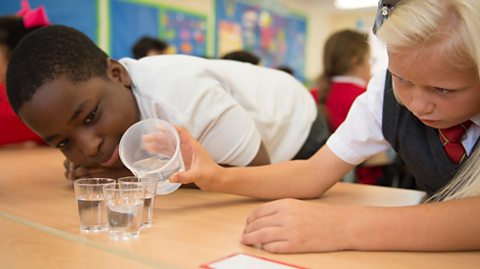
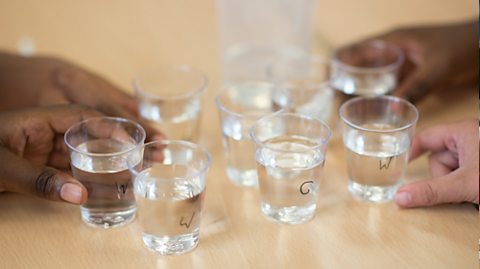
Your teacher will split you into groups for the investigation. Each group will need: two mini cups per person, some plastic trays and a marker pen.
Follow these steps:
Mark a line on your mini cups to show 25ml (your teacher will show you how)
Mark half of your mini cups with a C for cool water and the other half with a W for warm water
Take turns to fill the mini cups marked C with cool water
Your teacher will fill the W cups with warm water for you
Ask your teacher to put all the mini cups in the freezer.
Test your water hardness
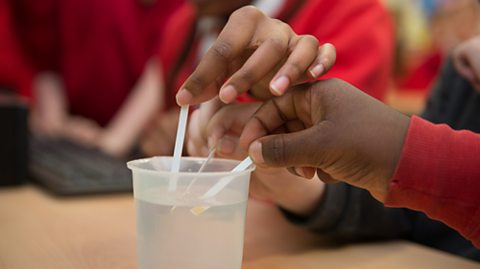
While you are waiting for the water to start to freeze you can test the hardness of the water from your tap. Your teacher will give you a water hardness testing kit which includes some testing strips and a colour chart.
• Place one strip in a mini cup of cool water and keep it there for 2 seconds
• Shake off the water
• Wait for 10 seconds
• Your stick will change colour! Compare the colour to the colour chart and note down the number next to the colour which matches your stick.
What do the colours mean?
The colours on the chart show how hard your water is. 1 is soft water and 5 is hard water.Make sure you note down the hardness of your water.
Start the experiment
Make sure your mini cups of cool and warm water go into the freezer at the same time.
Once all the mini cups are in the freezer, it's time to start.
Method
• Wait for around 80 minutes and then fetch some mini cups from the freezer
• Test a C cup and W cup and mark down how frozen the water is on your worksheet
• If either of them is completely frozen mark down the time on your sheet
• Wait 10 minutes and repeat.
Keep checking!
Keep checking new mini cups from the freezer until water in both the C and W cups is frozen solid. Make sure you write down on your sheet the time at which they froze and which was first. Once they have both frozen, it's time to think about your results.
Discuss the results
Does warm water freeze faster than cool water?
- Has the investigation given you an answer?
- Did you find a difference in freezing times?
- Did all the groups get the same result?
- If there was a difference what could have caused it?
- Are the results valid? Did we control variables well?
- Was our measurement accurate? How could it be improved?
Write a summary
“I used to think that… But now I know that… Because…”