Rhys:
Nǐ hǎo Super Movers!
Open up the ballroom doors
♫ TOGETHER:
Let’s all count in Mandarin ♫
Rhys:
♫ We’ll start with one to four ♫
♫ Ready Super Movers? ♫
♫ We’re going to put you in the know ♫
♫ TOGETHER:
One to four in Mandarin ♫
Nancy:
♫ Are you ready? Here we go! ♫
♫ Oooooh ♫
Nancy:
♫ yYī ♫
Rhys:
♫ yYī ♫
Nancy:
♫ èr Èr ♫
Rhys:
♫ Èr èr ♫
Nancy:
♫ Ssān ♫
Rhys:
♫ sSān ♫
Nancy:
♫ sSì ♫
Rhys:
♫ sSì ♫
Nancy:
Amazing Super Movers!
Rhys:
Thank you.
Nancy:
Are you ready for the second round?
Rhys:
Yeah.
♫ TOGETHER:
Let’s all count in Mandarin ♫
Rhys:
♫ Let’s listen to how that sounds ♫
Nancy:
♫ Brace yourself for action ♫
Rhys:
♫ Now we’re gonna’ go five to ten ♫
♫ TOGETHER:
Let’s all count in Mandarin ♫
♫ Are you ready now let’s begin! ♫
♫ TOGETHER:
Oh!! ♫
Nancy:♫ wWǔ ♫
Rhys:
♫ wWǔ ♫
Nancy:
♫ lLiù ♫
Rhys:
♫ lLiù ♫
Nancy:♫ oQī ♫
Rhys:
♫ oQī ♫
Nancy:
♫ bBā ♫
Rhys:
♫ bBā ♫
Nancy:
♫ jJiǔ ♫
Rhys:
♫ jJiǔ ♫
Nancy:
♫ sShí ♫
Rhys:
♫ sShí ♫
So now we’ve learnt the numbers from one to ten.
Shall we do a recap?
See if you can follow us!
Here we go!
Nancy:
♫ yYī, èr, sān, sì, wǔ ♫
Rhys:
♫ yYī, èr, sān, sì, wǔ ♫
Nancy:
♫ yYī, èr, sān, sì, wǔ ♫
Rhys:
♫ yYī, èr, sān, sì, wǔ ♫
Nancy:
♫ lLiù, qī, bā, jiǔ, shí ♫
Rhys:
♫ lLiù, qī, bā, jiǔ, shí ♫
Nancy:
♫ lLiù, qī, bā, jiǔ, shí ♫
Rhys:
♫ Lliù, qī, bā, jiǔ, shí ♫
Nancy:
♫ yYī, èr, sān, sì, wǔ ♫
Rhys:
♫ lLiù, qī, bā, jiǔ, shí ♫
Nancy:
♫ yYī, èr, sān, sì, wǔ ♫
Rhys:
♫ lLiù, qī, bā, jiǔ, shí ♫
♫ TOGETHER:
yYī, èr, sān, sì, wǔ ♫
♫ lLiù, qī, bā, jiǔ, shí ♫
♫ yYī, èr, sān, sì, wǔ ♫
♫ lLiù, qī, bā, jiǔ, shí ♫
Rhys:
Brilliant Super Movers!
You’ve all done a great job!
Nancy:
Well done!
Rhys:
Now all we need to do is practice!!
TOGETHER:
Zàijiàn!
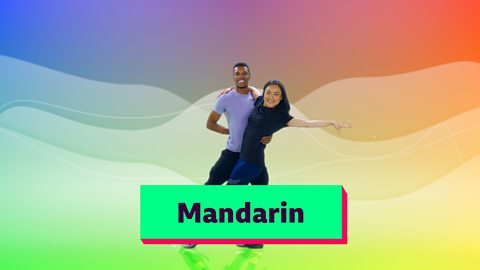
Strictly duo Rhys Stephenson and Nancy Xu perform this Super Movers song teaching pupils how to count to ten in Mandarin.
Teacher Notes
After viewing, singing and dancing along, your class could try some of these activities to further explore their learning:
Talking about numbers
Practise the numbers with your pupils, using the tones to help with correct pronunciation.
To practise listening: say a number and the children will show the corresponding hand sign. You could even practise division sentences in English and children show the correct number with a hand sign.
To practise speaking: Show or draw the number written in Mandarin writing, the children will say the number.
Have the children practise writing the Mandarin numbers: initially write in the air (pupils could use a finger to practise writing on a neighbour’s back), then use whiteboards or black paint on red paper. You could also be creative with sand or glitter in a tray or, on a sunny day, use clean paint brushes and water and ‘write’ using water on the pavement. It will dry and then pupils can practise over and over.
Practise simple addition and subtraction number sentences.
Once you know the numbers you can work out a lot of other words, eg. days of the week, 星期 xīngqī means day of the week and then the first day is Monday - 星期一 xīngqīyī. Only Sunday is actually day of the week ‘sun’ 日rì or ‘sky’ 天tiān eg 星期日 or 星期天 (more casual) xīngqīrì or xīngqītiān:
- Monday 星期一 xīngqīyī
- Tuesday 星期二 xīngqī’èr
- Wednesday 星期三 xīngqīsān
- Thursday 星期四 xīngqīsì
- Friday 星期五 xīngqīwǔ
- Saturday 星期六 xīngqīliù
- Sunday 期日 or 星期天 (more casual) xīngqīrì or xīngqītiān
Similarly, the month of the year can be explained (as seen in this Super Movers song with Rhys and Nancy.
Now you know the numbers to 10 it’s quite simple to get to 99:
- 11 is 10+1 (十一 Shí yī)
- 12 is 10+2 (十二 Shí èr)
- 13 is 10+3 (十三 Shí sān)
- until 19 (十九 Shí jiǔ)
then;
- 20 is 2x10 (二十Èr shí)
- 21 is 2x10+1 (二十一 Èr shí yī)
- 22 is 2x10+2 (二十二 Èr shí èr)
- 30 is 3x10 (三十 Sān shí)
- 40 is 4x10 (四十 Sì shí)
- 99 is 9x10+9 (九十九 jiǔ shí jiǔ)
Finding out about numbers in Chinese culture
- Number 8 is very lucky in China, as 8: 八 bā sounds like fa
- However, 4: 四 sì - is an unlucky number (similar to the number 13 in some countries) as it sounds like si which means death, and it it is often avoided. For example, you must never bring four of something when you are invited to a Chinese person's house.
- 6: 六 liù also means awesome in Chinese slang and you can send the emoji 🤙 for the hand sign instead.
- 2: 二 èr actually stands for the digit 2 however if you are talking about two of anything you need to use 两liǎnɡ.
Language introduced
| Mandarin | English |
|---|---|
| *一 yī * | 1 |
| 二 èr | 2 |
| 三 sān | 3 |
| 四 sì | 4 |
| 五 wǔ | 5 |
| 六 liù | 6 |
| 七 qī | 7 |
| 八 bā | 8 |
| 九 jiǔ | 9 |
| 十 shí | 10 |
Extra Chinese language
| Mandarin | English |
|---|---|
| 我爱你 wǒ ài nǐ 哇 wā | Wah, Wow |
| *酷 kù * | Cool |
| 学霸 xuébà | Top students |
| 很牛! hĕn niú! | Very good! |
Curriculum Notes
The Super Movers song Numbers to 10 and these activity notes address the following learning objectives from the curriculum guidance of the four UK nations.
England
From the Key Stage 2 National Curriculum programme of study for Foreign Languages:
- listen attentively to spoken language and show understanding by joining in and responding
- explore the patterns and sounds of language through songs and rhymes and link the spelling, sound and meaning of words
- appreciate stories, songs, poems and rhymes in the language
- engage in conversations; ask and answer questions
- speak in sentences, using familiar vocabulary, phrases and basic language structures
- broaden their vocabulary and develop their ability to understand new words that are introduced into familiar written material, including through using a dictionary
- describe places and things orally
- understand basic grammar appropriate to the language being studied, including (where relevant): […] conjugation of high-frequency verbs (hacer); key features and patterns of the language (question forms);[…] and how these differ from or are similar to English
Northern Ireland
It is not statutory for primary schools to teach a language other than English or Irish (in Irish-medium schools).
Scotland
Modern Languages - CfE Experiences and Outcomes, Second level
- I explore the patterns and sounds of language through songs and rhymes and show understanding and enjoyment by listening, joining in and responding. (MLAN 2-01a)
- I can listen to and respond to familiar voices in short, predictable conversations using straightforward language and non-verbal techniques (MLAN 2-02a)
- I can take part effectively in prepared conversations by sharing information about myself…or interests of my choice, using familiar vocabulary and basic language structures. (MLAN 2-03b)
- I can participate in familiar collaborative activities (MLAN 2-05b)
Wales
From the Curriculum for Wales (2022)
- Progression step 2:
- I have heard international languages being used.
- I have experienced opportunities to use international languages.
- Progression step 3:
- I can communicate using familiar phrases and sentences.
- I am beginning to reflect on my language use in order to improve the quality of my communication.
- I am beginning to interact with others, sharing information, feelings and opinions.
- I can construct my own sentences using the vocabulary and patterns I have learnt.
- I can recognise high-frequency words and phrases and understand the general meaning in what I hear, read and see.
- I can listen and read empathetically, recognising the differing opinions of others.
- I can listen and read to build a bank of words and sentences and use these to improve my own communication.
- I can listen and read to gain an understanding of how grammar and punctuation affect meaning.
Mandarin greetings with Rhys Stephenson and Nancy Xu. video
Strictly duo Rhys Stephenson and Nancy Xu perform this Super Movers song teaching pupils greetings in Mandarin.
'Months of the Year' in Mandarin with Rhys Stephenson and Nancy Xu. video
Strictly duo Rhys Stephenson and Nancy Xu perform this Super Movers song introducing pupils to the months of the year in Mandarin.
'Colours' in Mandarin with Rhys Stephenson and Nancy Xu. video
Strictly duo Rhys Stephenson and Nancy Xu perform this Super Movers song teaching pupils about colours in Mandarin.