Speaker 1: To get a fraction we need to divide a whole number into parts.
In this case I've divided by four to create quarters.
Speaker 1: Dividing it into equal parts allows me to create a uniformed planting display.
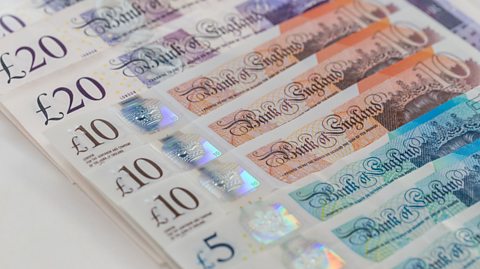
Speaker 2: We often use fractions in a hotel to work out prices for example a standard room rate at this hotel is £200 per night and sometimes we're able to offer that half price to our team members so that works out £100 per room, per night.
It's good to use fractions because half is a quick and easy way to work out prices.
Speaker 3: My job as an advisor and job worker is to get unemployed people into work.
We have a target of one third of everybody who comes through the door that we have to get into sustainable employment.
A third of the amount that we had in last week, which was 30 is 10.
So we would have to get 10 people into jobs.
Fractions represent different amounts of a whole. For example, ½ ⅓ ¼.
Quick tips for tutors
Fractions includes:
- Information about commonly used fractions
- Strategies for recognising, reading, writing and calculating fractions
- Key vocabulary used to describe fractions and parts of a whole
- A fraction wall to aid comparison of fractions
- Fractions practice activities
Downloadable Factsheets
Entry 1 & 2 - What does half mean?
An introduction to half fractions
Entry 3 - Different types of fraction
Summary of how to recognise unit and non-unit fractions.
Entry 3 - Estimating fractions
Summary of estimating fractions in everyday life.
Entry 3 - Recognising fractions from shapes
How to 'read' fractions by recognising shapes
Entry 3 - What is a fraction?
Summary of what a fraction is.
Entry 3 - What do the numbers in fractions mean?
Summary of the meaning the numerator and denominator in a fraction.
Level 1 - Equivalent fractions
How to find equivalent fractions using shapes.
Level 1 - Different ways to get the same fraction
Summary of showing the same fraction using different shapes.
Level 1 - Using a fraction wall
How to use a fraction wall to compare fractions.
Level 1 - Recognising fractions in words
How to recognise fractions when they're written in words and why it's useful
Level 1 - Fractions of a whole
How to divide something into equal parts and put them back together to equal 1.
Level 1 - Fractions that can't be simplified
How to recognise fractions that are already in their simplest form.
Level 1 - Simplifying fractions
How to cancel down to simplify fractions.
Level 1 - Comparing fractions
Summary of ways of comparing fractions.
Level 1 - Fractions that equal one
Summary of how all the constituent equal parts of an item form a whole
Level 1 - Simplifying improper fractions
How to change an improper or top-heavy fraction to a mixed number.
Level 1 - Key words for fractions
Summary of key words used to describe fractions and working with fractions.
Level 1 - Two-step fraction problems
How to calculate fractions of whole numbers.
Level 1 - More improper fractions
How to simplify improper fractions into mixed numbers.
Level 1 - Unit fractions and sharing
How to write fractions in numbers.
Level 1 - What are mixed numbers?
Summary of mixed numbers and how to compare them, including examples.
Level 1 - More fractions in words
How to write fractions and mixed whole numbers and fractions in words.
Downloadable Worksheets
Entry 1 & 2 - Matching fractions
Activity in matching fractions with numbers.

Entry 3 - Finding fractions of time
Exercise in using fractions when talking about time.
Entry 3 - Reading and writing fractions
Exercise in writing fractions in words and numbers.
Entry 3 - Working out fraction problems
Exercise in working out fraction problems.
Entry 3 - Working out fractions
Exercise in working out fractions.
Level 1 - Answer fractions questions using 1, 3, 5, 8, 10 and 12
Exercise in making largest and smallest fractions from a given set of numbers
Level 1 - Are these fractions equivalent to half?
Exercise in working out fractions from shaded parts of shapes.
Level 1 - Change recipes using fractions
Exercise in using fractions to adapt recipes for more or fewer people.
Level 1 - Looking at fraction parts
Exercise in calculating fraction parts of numbers.
Level 1 - Spotting fractions that can't be simplified
Exercise in finding out whether it's possible to simplify any of ten given fractions.
Level 1 - Converting between improper fractions and mixed numbers
Exercise in choosing the correct supplied calculations to convert between improper fractions and mixed numbers.
Level 1 - Draw diagrams and investigate
Exercise using shading of diagrams to make fractions.
Level 1 - Spotting improper fractions
Exercise in identifying top-heavy fractions.
Level 1 - Recognising equivalent fractions
Exercise in recognising fractions of equal value.
Level 1 - Matching up diagrams and fractions
Exercise in recognising fractions expressed in graphical form.
Level 1 - Simplifying fractions to whole numbers
Exercise in recognising fractions that can be simplified to whole numbers.
Level 1 - Simplifying fractions
Exercise in recognising fractions that can be simplified and that are larger than 1.