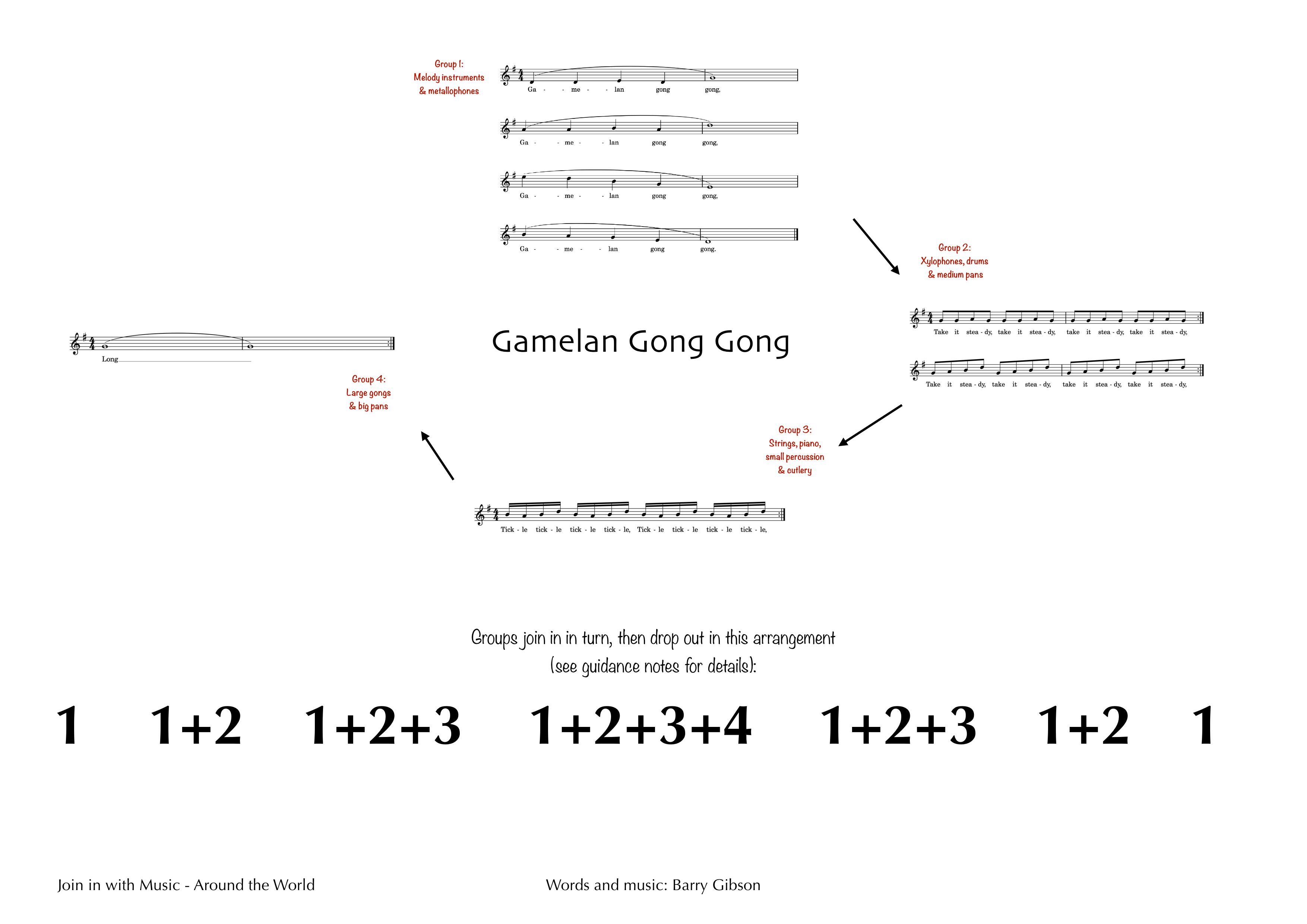
A piece influenced by gamelan music from Indonesia providing an opportunity for pupils to perform repeating patterns which fit together in layers.
The video
Gamelan Gong Gong
This piece is influenced by gamelan music from Indonesia - especially Bali and Java - and provides an opportunity for pupils to perform repeating patterns which fit together in layers.
Gamelan music has a special emphasis on metallic sounds and beautiful mallet instruments, for which glockenspiels, xylophones, metallophones, chime bars, etc provide a good equivalent.
Keyboards, apps, piano and even saucepans can also contribute similar sounds and there is a special section for hand percussion with cutlery.
The main notes are from a five-note pentatonic scale, using D, E, G, A, B, plus a high D and E. In the introduction G and D can be hummed as a drone quietly, continuing right through the piece. Glockenspiels and chime bars can play this too.
- In Verse 1, Group 1 (metal instruments and metallophones) play a tune based on crotchets at a regular pace. To practise this, they can sing and play the tune to the words ‘Gamelan Gong Gong…’ (four times).
- In Verse 2, Group 2 (xylophones drums and medium saucepans) add a pattern of shorter quavers.
- In Verse 3, Group 3 (string instruments, piano and small percussion including cutlery) add a layer of shorter semiquavers.
- In Verse 4, Group 4 (gongs, cymbals and large saucepans) play a layer of long, deep notes to fit ‘Long…, long…’.
Then each group drops out in turn (4, then 3, then 2), until just Group 1 is playing in Verse 7, after which everyone hums a long, low G to finish. Body percussion can also join in with gentle clapping in Verse 1, tapping knees in time in Verse 2, clicking fingers in time in Verse 3 and patting their chest in Verse 4.

Resources
Teacher Notes
Download / print the Teacher Notes for the series (pdf)

Download audio
Download the audio file for this music video (mp3)

Lyric sheet
Download the lyric sheet for this music track (png).