In short...
Themes: Sikhism; celebrating world religions; the 5 Ks.
Summary: This assembly is ideal to use when celebrating world religions or international days. The Sikh New Year festival, ‘Vaisakhi’ (also spelled ‘Baisakhi’), is celebrated on 13th or 14th April. Sikhs also celebrate the Martyrdom of Guru Arjan and of Phalia Prakash Sri Guru Granth Sahib Ji, and Bandi Chor Divas / Diwali.
Resources: the assembly framework and an image of the 5 Ks to display.

The video
TARAN:
Hello.
Hello. My name's Taran. This is my brother Joven. And we like trampolining. You can't beat me at table football.
Yeah I can.
No you can't.
Run at him! Attack!
Let's go!
Do do-do do-do!
SIMRAN: 11-year-old Taran and ten-year-oldJ oven are Khalsa Sikhs. They have dedicated themselves to Sikhism by joining the Sikh community the Khalsa. The word 'khalsa' means 'pure'.
See you later!
Alligator.
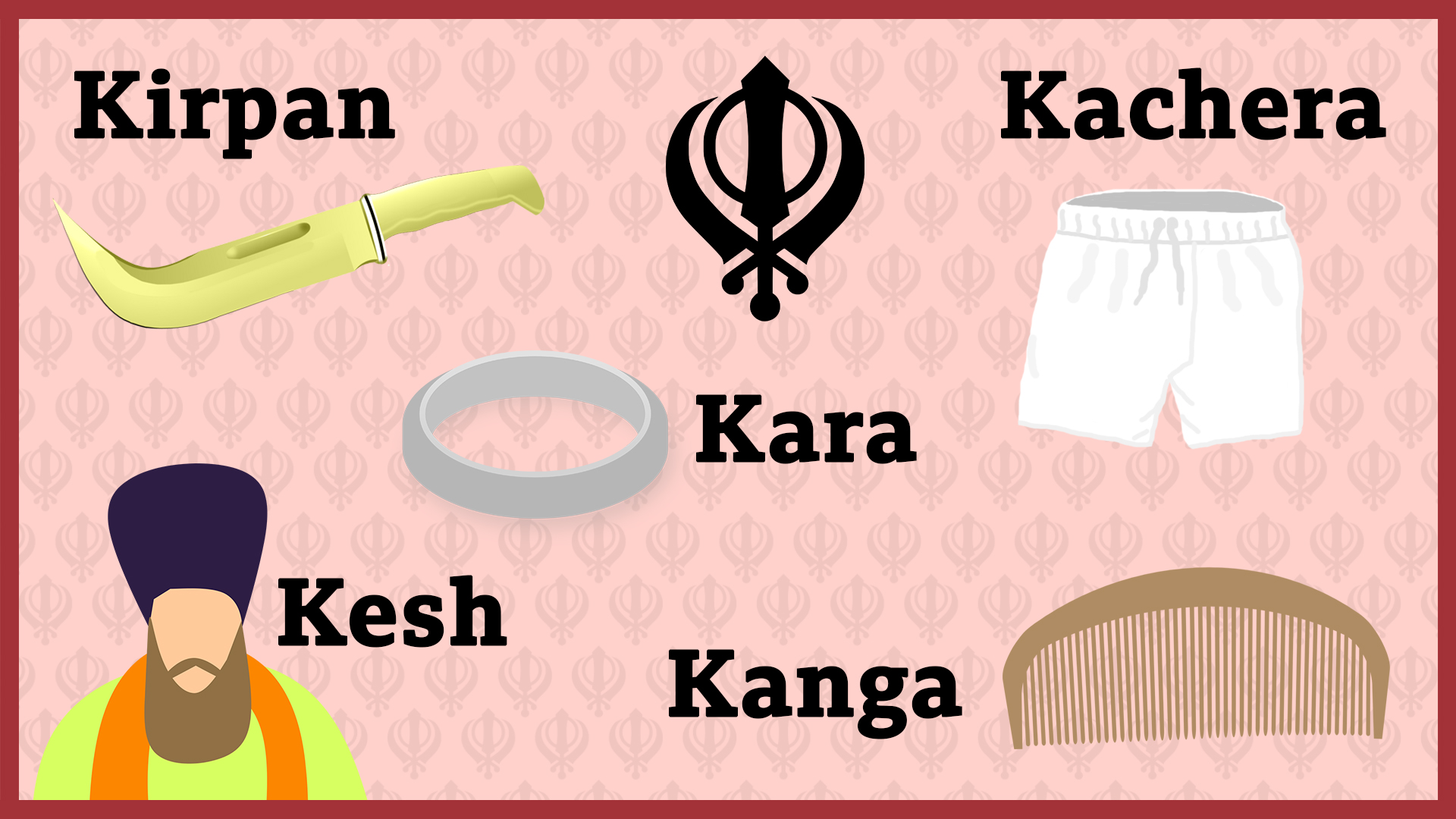
SIMRAN: Khalsa Sikhs wear five symbols called the Five Ks or Panj Kakka to show their devotion to Sikhism. The Five Ks are our uniform as baptised Sikhs. How people wear uniform to school we wear the uniform all the time.
SIMRAN: Kara is a bracelet worn on the wrist and is a reminder that we are connected to God. The circle doesn't have a beginningand doesn't have an end. It just keeps like going round so that kind of signifies that God has never had a beginningand he can't end.
SIMRAN: Kachera is long shortsworn under the clothes for modesty. And Kirpan is a very small sword. Kirpan symbolises that we defendpeople and we protect people. We never use it in a bad way. The Kirpan is an emblem of courage and self-defence. Khalsa Sikhs are alwaysready to defend the weak and fight against injustice. It should never be used as a weapon to attack people. The Kirpan is also usedto bless food.
At school people have found out that I'm wearing it and then like they're always like 'Oh do you have a knife?' Then you just haveto explain to people that it's only if someone's like attacking you seriously it's a life and death situation then you would use it. You wouldn't use it for a joke if someone's punchingyou at school or bullying you. You wouldn't use it for that kind of thing.
SIMRAN: Kesh is letting your hair growand never cutting it. We believe it's a gift from God. So if someone gives you a gift you wouldn't just throw it away you would appreciate it. Some Sikhs grow their hair so long it touches the floor.
CHUCKLING
DAD: How long is your hair?
To my shoulders.
Up to your shoulders?
If I stand up it's up to about here.
I think his hair's slightly longer.
SIMRAN: Finally Kanga is a small wooden comb used to keep the hair neat.
TARAN: We comb my hair twice as day. Once in the morning and then once in like the evening.
SIMRAN: After Taran and Joven have combed their hair they can tie their turbans.
TARAN: That's the first bit done. This one is like eight metres my one.
SIMRAN: It's up to Taran what style turban he ties. I like having it big. My brother now he's just going round.
I'm going to be doing weird and wonderful stuff. Before there was like 'Something's missing' kind of thing. Now it's just like ready.
Taran and Joven explain what it means to be part of the Khalsa and share the 5 Ks and their definitions / uses. The name of each of the 5 Ks appears on screen as it is being defined:
- kara (bracelet)
- kachera (underclothes)
- kirpan (a small sword)
- kesh (hair)
- kanga (comb)
If sharing a sequence of videos about Sikhism, this video should be used after ’The importance of Sikh traditions’.
Duration: 3' 45"
End of speech: '…now, it's just, like, ready.'
Video questions
- What does Khalsa mean? (In Punjabi 'Khalsa' means 'the pure')
- What is ‘kara’? (It is a bracelet to show the connection to God. The bracelet is a circle and never-ending - no beginning or end - symbolising that God has no beginning or end)
- What is the ‘kachera’? (Underclothes - like long shorts - worn for modesty)
- What is the ‘kirpan’? (A small sword)
- When might a Sikh use a kirpan? (To defend others, or to protect oneself - but only if absolutely necessary)
- What is ‘kesh'? (Kesh is hair and Sikhs believe that hair is a gift from God so should not be cut)
- What is ‘kanga'? (A special wooden comb used to keep hair neat)
- How long is the cloth of Taran's turban? (About 8 metres)
Downloadable assembly resources
Assembly framework (pdf) document
Download / print the assembly framework ready for use
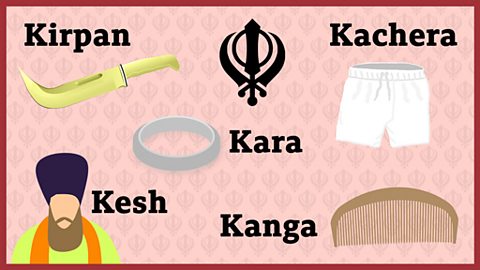
Image - the 5 Ks. image
A visual reference for the 5Ks
Suggested assembly framework
1. Entry music
As the children enter you could play a song emphasising 'belonging' to sow seeds in the children’s minds - eg ‘Consider yourself’ (from the musical 'Oliver!'), ‘Proud’ (M People), 'We are family' (Sister Sledge). You can choose to display the image identifying the 5 Ks: ‘kara’, ‘kachera’, ‘kirpan’, ‘kesh’ and ‘kanga’.
2. Introduction
Tell the children that today's assembly is in the form of a challenge - a challenge to remember the names of five things. Tell them that the five things are all important to a particular community - the Sikh community - and that to find out what they are we are going to watch a short video introduced by two Sikh boys: Taran and Roven.
3. The video
Play the video. The duration is 3' 45". You can choose to pause the video at the appropriate times to emphasise each of the 5 Ks. You can choose to share the Video questions before watching or keep them for the subsequent discussion. Displaying the names of the 5 Ks (see 'Key links') will help children to recognise them when they appear in the video.
4. After the video
Now for the challenge - ask the children if they can remember what the 5 Ks are? Choose five children to represent each one and see if children can remember what each word means.
5. Time to talk
Move the discussion towards more universal considerations. The kara bracelet is a symbol that God never ends. What else is a symbol for God in your eyes? Sikhs do not cut their hair. This might be hard to do. If you belong to a particular faith group, do you have any customs or beliefs that you sometimes find difficult to keep? Keeping them may require strong will-power. When have you been tested to show strong will power…?
6. Opportunity to sing
An opportunity to sing your chosen song. Suggestions from BBC collections below.
7. Opportunity to reflect
The focus of the reflection is on ‘belonging and taking responsibility.’
Sikhs wear five different special items to show that they belong to the Khalsa…
Whether we choose to wear special items or not we can share things that are important to Sikhs - such as taking responsibility for our world by acting in a particular way…
Think about your role in society…
What can you do to show others that you care about your community and the wider world…
How will you reach out to others…?
8. Opportunity for prayer
Use your standard form of address (Dear God, etc) and:
I hope that others see you in my thoughts, words and ways.
I might not wear physical items to show my faith but let others see your values in my choices.
May I have strength to make the right choices so that others see your beliefs in me.
Amen.
Suggested songs
All together as a family - Vocal
Some can dance and some can sing,
Some can fiddle on a violin.
Some can bat and some can bowl,
Some can tackle and score a goal.
Some can paint and some can sew,
Some can juggle and some can throw.
Some can throw, some can throw.
All that we can do or be
All together as a family.
All together as a family.
All together as a family.
All together as a family.
Some can run and some can swim,
Some do somersaults in the gym.
Some can ride or climb a tree,
Some are good at technology.
Some can teach and some can guide,
Some get everybody organised.
Organised, organised.
All that we can do or be
All together as a family.
All together as a family.
One for all and all for one,
All together we get things done.
We get things done.
All that we can do or be…
[spoken] 1, 2, 3, 4, 5, 6, 7, 8
All together as a family.
All together as a family (backing track)
Some can dance and some can sing,
Some can fiddle on a violin.
Some can bat and some can bowl,
Some can tackle and score a goal.
Some can paint and some can sew,
Some can juggle and some can throw.
Some can throw, some can throw.
All that we can do or be
All together as a family.
All together as a family.
All together as a family.
All together as a family.
Some can run and some can swim,
Some do somersaults in the gym.
Some can ride or climb a tree,
Some are good at technology.
Some can teach and some can guide,
Some get everybody organised.
Organised, organised.
All that we can do or be
All together as a family.
All together as a family.
One for all and all for one,
All together we get things done.
We get things done.
All that we can do or be…
[spoken] 1, 2, 3, 4, 5, 6, 7, 8
All together as a family.
Learn more about Sikhism