 Image source, Getty
In the winter months, it can be hard to motivate yourself, whether that’s to get back into work, do more exercise or eat more healthily. Enter positive affirmations. Wellness advocates have been talking about them for ages, but what exactly are they and how can they help you inch from the sofa towards your running shoes?
Dr Anisa-Ree Moses is an educational and child psychologist, who uses positive affirmations with some of her clients, including children who’ve been struggling to get back into school after the Covid-19 pandemic. She says the key is small steps, and using affirmations that really resonate with you and your family.
What are positive affirmations?
Positive affirmations are self-affirming phrases that people repeat out loud. Dr Moses says they’re “designed to promote positive thoughts, feelings and attitudes”. The sentences chosen are specific and individual to each person.
Research by psychologists has shown that positive affirmations can help with the following:
● reducing stress
● increasing physical activity
● promoting healthy eating habits
● improving relationships
● enhancing academic performance
Image source, GettyDr Moses says: “They’re about the idea that language is powerful and if we limit ourselves with our language we will always remain within the confines of that. With positive self-talk, we’re saying ‘I don’t have to limit myself’. You’re confirming to yourself that things can be done to bring about change or promote positive action.”
Why do people use them?
At their core, positive affirmations are about the relationship with the self. We all have a need to see ourselves as having personal integrity and people use affirmations to reinforce a more positive view of themselves. For example, if you’re feeling stressed about events in the news or things that are out of your control, you can still tell yourself ‘I am kind and I am wise’ (if that resonates with your personal values) because it gives you a feeling of still being in control, of still being a good person.
Every day in every way I’m getting better and better.”
A study of preadolescent children showed increased levels of anxiety were associated with higher rates of negative self-talk. Dr Moses says positive affirmations can shape your thinking. She explains that French psychologist Emile Coué believed your thought pattern becomes your reality, ie: the things you focus on are the things you then have more of in your life. So, you could encourage an anxious child to focus on the things they like about themselves, for example ‘I am a good friend’ or ‘I am kind and I care’. To help his patients with their healing, Emile Coué asked them to repeat this now well-known phrase: “Every day in every way I’m getting better and better’.
 Image source, Getty
How do people use positive affirmations?
Some people look at themselves in the mirror and repeat the phrases to themselves, some people say them first thing in the morning or last thing at night. Positive affirmations are most effective when said out loud. Dr Moses says the key is to use a positive affirmation that is relevant to you now. So, if you’re feeling lazy and overweight and you try an affirmation like ‘I can run five miles a day’ it won’t work because it doesn’t match your inner dialogue. “We can’t fool ourselves. Positive affirmations aren’t magic. Instead, start with small steps and affirmations you really believe – something as small as ‘I enjoy moving my body in fun ways’ (like dancing around the kitchen!). The idea is that positive affirmations may be a step up (or a step beyond) from where you are but it still feels attainable, rather than a step that’s a giant leap and is unrecognisable to you.”
Positive affirmations may be a step up (or a step beyond) from where you are, but it still feels attainable.”
Image source, GettyYou can also be a positive role model for your child or your pupils by engaging in positive affirmations that are “real and congruous” to you. Your children will pick up on this, and see that it’s something they can do in their own lives. Dr Moses adds: “Think about phrases that avoid value judgements, like ‘I am smart’ or ‘I am clever,’ and instead use ‘I enjoy learning’ or ‘I am on a journey to learning lots of things’.”
Who uses positive affirmations?
Anyone can use positive affirmations – both adults and children. Many celebrities are now openly using positive affirmations. Michelle Obama, for instance, posted on Twitter that she practices this mantra daily: “Am I good enough? Yes, I am.”
Similarly, in the BBC’s new series of Moodboosters videos which are aimed at primary school age children, Strictly dancers Amy Dowden and Oti Mabuse have used phrases like ‘I feel good’ and ‘I am hyped’ to energise viewers. The use of positive affirmations in Moodboosters films was a conscious decision to get viewers practicing this technique.
Dr Moses uses positive affirmations with pupils who are struggling to get back into school: “We start really small. For example, helping with the morning routine. If a pupil is struggling to get out of bed each morning and that is then having a knock on effect throughout the rest of the day, they could use the affirmation ‘I can get out of bed and get ready’". Each affirmation is tailored to the child, and they build positive affirmations gradually around each next step, or ideal step, that child needs to take.
Watch Amy Dowden in the Emotion in Motion Moodboosters video
Moodboosters positive affirmations
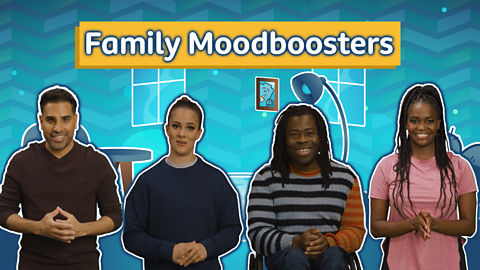
Moodboosters are a suite of short, interactive videos that can be used by teachers and parents/carers at home to get active, whilst supporting mental health and wellbeing. Each Moodboosters video ends with a positive affirmation, why not try repeating some of the affirmations from our Family Moodboosters at home with your family daily:
• I am unique>> Dr Ranj – Self Belief Warriors (Family Moodboosters)
• I feel good>> Oti Mabuse – Dance Party Megamix (Family Moodboosters)
• I am thankful >> Ade Adepitan – Meditation Station: Feeling Thankful (Family Moodboosters)
• I am focussed >> Rhys Stephenson – Moment in nature (Family Moodboosters)
• I feel great >> Dr Ranj – Wacky Workout (Family Moodboosters)
• I feel free >> Bethany Shriever – Proud Peacocks (Family Moodboosters)
• I feel energised>> Evie Pickerill - Let’s Rock (Family Moodboosters)
For more videos and articles that can help children understand their feelings and manage their emotions, check out the Moodboosters website.
Further information
To access more videos and activities go to bbc.co.uk/moodboosters.
For more information about mental health and wellbeing, check out the dedicated area on the NHS website.
BBC Action Line has details of organisations that can offer support.
The BBC is not responsible for the content of external websites. By clicking the link to access the external website you will be redirected to a site controlled by a separate organisation. Please note that the BBC is not the data controller of the personal data you enter into the external website and it is not responsible for the services provided by any external organisation. When using an external website, you are subject to their Terms and Conditions and Privacy Policy.
This article was written in January 2023.
Watch Dr Ranj in the Family Moodboosters video Self Belief Warriors
About Moodboosters. video
Watch a short clip introducing Moodboosters and find out about some of the ways the fun activities can benefit primary school aged children.
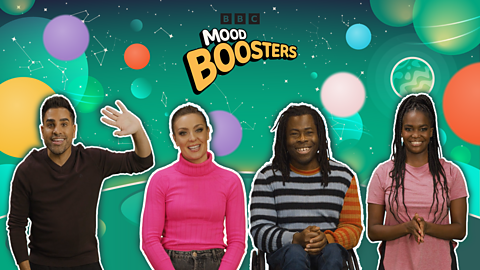
Family Moodboosters. collection
Family Moodboosters - explore videos to try at home and get the whole household moving and feeling good
Dr Ranj Singh: Children more aware of looking after mental wellbeing
Dr Ranj Singh on how dancing boosts his mood and ways movement can support children with mental wellbeing.