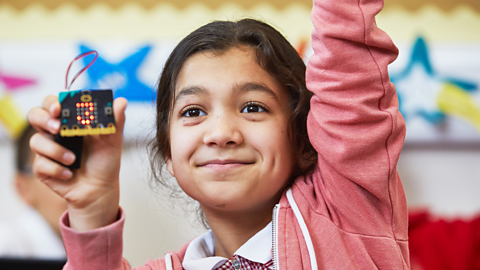
You can no longer submit your playground survey data, but you can still do all of the activities with your class.
An inspiring, active and engaging whole class Information collected for use elsewhere. collection activity that uses the micro:bit The application of AI technology where computer software is designed to perform a task quickly and reliably, having been trained by examples of data provided by humans. This training process can be described as ‘learning’ and this is why we use the term ‘machine learning’. tool to demonstrate how real-world data samples are used to Providing samples of data categorised and labelled by humans to help machine learning software to build a model.A set of rules developed by a machine learning system to categorise data.. Pupils answer the questions:
How can computers learn from data? How can machine learning models be trained ‘better’?
Watch the video
Yussef: Hi. Remember that BBC micro:bit programme that we used to collect data about our physicalactivity in the school playground? I was so impressed I can't stop thinking about it.
Tilly: Me neither. The activity tracker used a built in accelerometer and a special programtrained by machine learning and I’ve had an idea. This time, instead of simply using the micro:bit let's see if we can do some training ourselves.
Yussef: We've actually got a really interesting question about that.
Matila: How can computers learn from data?
Tilly: Fantastic question. Today, instead of a micro:bit program, we're going to be usingmicro:bit’s machine learning tool.
Yussef: We're dealing with cutting edge stuff here, aren't we?
Tilly: Definitely. So I've decided I want to teach the micro:bit to know the difference between waving and clapping. Let's start by training it to detect a wave. So I click here and then wave my hand to collect the waving data samples.
Yussef: Oh, I can see your movement in the graph.
Tilly: Okay, it needs a lot of data though. Let me record five values forhand-waving and five for clapping.
Yussef: Wow, I can already see the patterns.
Tilly: Amazing, look at these graphs.The ones where I'm waving all look similar and the ones where I’m clapping are definitely different to when I'm waving.
Yussef: So it looks like it can tell the difference.
Tilly: Let's see. Now we've collected the data we have to train the machine learning program. It's called a model. Now we can find out if it recognises a wave. Look, it definitely recognises mine. Let's see if it does yours.
Yussef: Okay.
Tilly: So it definitely knows you’re waving but your pattern is a little bit different to mine so it’s not as certain.
Yussef: I suppose that's why it's important to get data from lots of different people like they did when they built the activity tracker program.
Tilly: Definitely.
Yussef: Hang on, I've got my hand down but it’s saying I'm clapping now.
Tilly: I'm glad you noticed that. This is whereit gets really fascinating. So now you've stopped waving, the computer knows that but because it's only been trained to recognise a wave or a clap it's now wrongly identified you as clapping, now you're not waving. Are you still following?
Yussef: I think so, yeah. The model is only as good as the data it gets. So that means we need to tell it what keeping my hand still looks like.
Tilly: Yes, we need to improve the accuracy of the model by giving it some more data.
Yussef: Okay, I'll give it a go.
Tilly: Ready?
Yussef: Yeah, go for it. Right, let's see if it can tell that we aren't moving.
Tilly: There we go. It knows we're still. I believe we can now officially say we've trained a machine learning model.
Children: Yay.
Yussef: That's so cool.
Tilly: It is, isn't it? Machine learning can be used for other things, too, like in the research and development of bionic arms similar to mine. I've heard that scientists are trying to combine machine learning and medical surgery to help more nerve endings connect to a bionic arm. This could mean in the future I could be able to complete complex activities with my fingers, such as playing the flute or piano. And it's all thanks to the advancements in technology.
Yussef: Wow. That makes me so excited for the future to come. Now it's time for you to try.
Tilly: Start by following the steps in my hand-waving activity but then why not try and have it recognise other movements?
Yussef: Get creative and think up some ideas of your own.
Together: Bye now.
How to complete the activity
Download the resource. document
Download the teacher instructions and curriculum map.
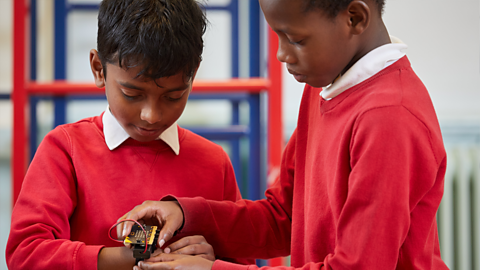
Train a model. External Link
Train a machine learning model using the micro:bit machine learning tool.

Playground survey teacher notes
- To complete this survey activity you will need the helpful teacher instructions.
- This activity is primarily a Computing/ICT lesson that will build on the themes and ideas from the Tracking our activity sessions and dive a little deeper into machine learning and how it works. Pupils will be introduced to an online machine learning tool created by the Micro:bit Education Foundation.
- They will learn/be reminded that the micro:bit has a built-in An input that senses things in the real world, such as movement, temperature, and light levels. called an A sensor that detects movement. that can be used to measure when the micro:bit moves in different directions. They will also learn how to create their own machine learning model that will be able to recognise the difference between specific movements.
- This activity will help pupils understand some of the underlying principles of AI and give them the knowledge they need to be well informed and able to make good decisions about using new technology. It offers some positive ideas for the inclusive use of The ability of computer software designed by people to perform tasks that usually need human intelligence. technology and could get pupils thinking about how AI could help solve real world problems.
- We would love to see how your class is getting involved with the BBC micro:bit playground survey. Why not share updates about your activities on social media and let us know by tagging @BBC_Teach and using #BBCplaygroundsurvey
Topics covered
- Science: Using equipment to measure and record data; Collecting data and using it to answer a scientific question.
- Maths and Numeracy: Reading and interpreting data in the form of table, charts and graphs.
- Design and Technology: Testing a product's ability to fulfil a design brief and/or solve a problem.
- PHSE/RSE/Health and Wellbeing: Data privacy and security; Evaluating digital information – accuracy, honesty and credibility.
- Computing/ICT: Using various forms of Data sent to a computer for processing such as button presses and sensor readings. and Data sent from a computer such as information shown on the LED display. including sensors; Recording, storing, organising and analysing data; Using technology responsibly and safely - see PSHE/RSE/Health and Wellbeing.
Suggested learning objectives
- Introduction and planning: To understand that sensors can transmit data in real time to a A set of instructions written in code that performs a given task. stored on a computing device (Computing/ICT).
- Exploring and training: To learn how data can be used to create a model that can then be used to represent the real world; To understand that an AI machine learning system uses a model to help it make decisions about new data (Computing/ICT).
- Discussion: To use what they learn about data collection and processing to make better decisions about technology; To develop confidence in reading and interpreting data in the form of graphs and tables (Computing/ICT/Maths and Numeracy).
Suggested extension activities
- Science: Find out more about the physical structure of the hand and arm by looking at X-rays and diagrams; Explore the mechanics of waving and clapping by observing muscle and joint activity; Use the micro:bit accelerometer and machine learning tool to explore other aspects of the human body eg. leg movement when running, walking and jumping.
- PHSE/RSE/Health and Wellbeing: Revise understanding of personal and private data and how to keep it secure; Discuss issues around consent when providing data to online tools, platforms and companies – read through sample data consent notices (eg. a cookie notice) and create their own clearer versions; Learn about how keeping personal data anonymous can support data privacy and security whilst still allowing the data to be used.
- Design and Technology: Design a gadget or device that uses the machine learning model you have created; Consider how AI and machine learning models could be added to existing devices and systems – what sort of training data would it need – eg. how to make the perfect cup of hot chocolate.
- Computing/ICT: Discuss how machine learning and AI are changing the way we use technology – using familiar examples; Explore the issues around ‘gaps’ in training data and how this might make a model that was biased or inaccurate – look at some real life scenarios and examples.

More activities from the playground survey
What next? video
Enjoy choosing extension activities with your class once you have completed the playground survey.
Playground survey glossary
A helpful glossary to increase your confidence when teaching the seven BBC micro:bit playground survey activities.