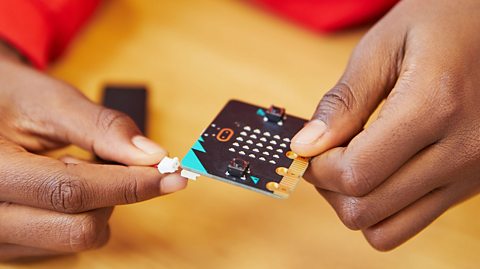
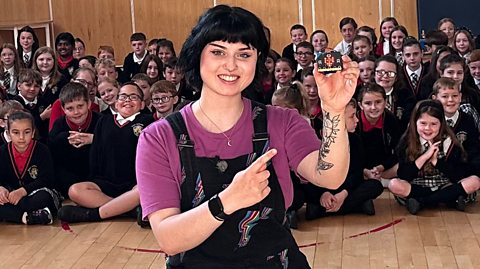
As part of the launch of the BBC micro:bit – the next gen campaign, Blue Peter aired a special challenge that saw presenters Abby Cook and Joel Mawhinney racing to find their way out of a series of escape rooms. Read on to find out how the challenge, that was powered by micro:bits, was brought to life…
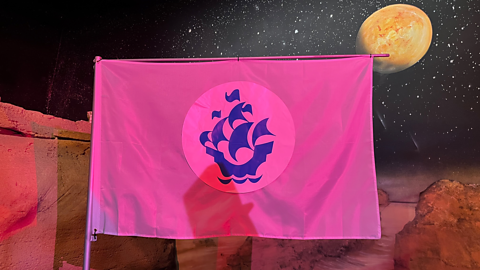
CBBC’s micro:bit takeover week saw the pocket-sized computers featuring in some of the channel’s most popular shows. For Blue Peter, this meant a specially designed escape room challenge that showcased the micro:bits centrestage.
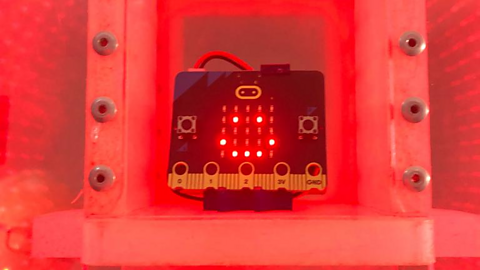
The episode saw Blue Peter presenters Abby and Joel trapped on the CBBC space station by fellow presenter Mwaksy and then having to escape via a series of challenges that were powered by the BBC micro:bit. The challenge began with a musical memory game to release the first micro:bit which the presenters then used to navigate to a laser maze. They then proceeded to the next room where these mini computers were hidden in protective tubs in sand and a micro:bit treasure detector was used to uncover them for the final challenge.
The escape room challenge shoot was the first time that Abby and Joel had interacted with the micro:bit and Abby enjoyed getting to grips with the tiny computer, “it’s so cute, I love the sounds that it makes!” Joel agreed, “I like the noise – it makes me giggle!”.
I think genuinely, if I’d had [the micro:bit] when I was younger I would have paid a lot more attention to coding”
Working closely with the micro:bit and seeing what it is capable of led Joel to reflect on his own experiences of learning computing at primary school back home in Northern Ireland, “I think genuinely, if I’d had [the micro:bit] when I was younger I would have paid a lot more attention to coding”. Fellow presenter Abby was similarly impressed and could see the potential benefits for pupils learning with the device, and not just in the classroom, explaining “I love how versatile it can be, you can put it into so many different parts of your life”.
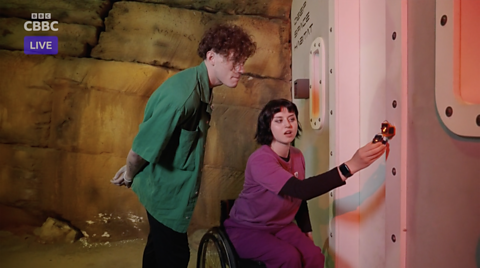
Software design expert David Whale was on hand to code all of the micro:bit aspects of the Blue Peter shoot and described working on the programme as “a childhood dream come true!”.
While designing the code that would be used on the micro:bits to power the challenge, David utilised a famous Blue Peter ethos, “when I was young there was this big thing ‘here’s one I made earlier’ and on this project we spent a lot of time making things earlier.” This included using computational thinking to prepare the challenges, problem solving how Abby and Joel would navigate between the various rooms and how this could form a strong narrative as a piece, as David explained “we thought about each room as a unit of software, we had to make sure once we integrated it all together, it had to make sense as a story”.
Most importantly for David, the code used to power the Blue Peter micro:bit challenge would have to be visually appealing whilst also transferable to teaching primary pupils, explaining “the code was really, really simple but really effective visually.” For David, it’s essential that primary pupils develop their digital skills. He explained: “a lot of technology these days is so pre-packaged, your mobile phone for example, it does everything someone else thought you wanted, but to break outside of that you need to learn coding.”
I think it’s so important for young people to have skills for computing, now more than ever”
Primary school children developing their digital skills is something Abby is also passionate about, “I think it’s so important for young people to have skills with computing, now more than ever”. For Abby it’s also clear why developing these skills will be important for pupil’s futures, as she continues “learning how it all works, learning a little bit of coding can help with so many things like problem solving, even if you don’t end up going into a career in coding or computing you have so many transferable skills”.
It’s not just new skills learnt in computing or with coding that can have a profound effect on your pupils’ future careers, as micro:bit expert David Whale elaborates “it’s really important to use code to customise your tech world, it gives you good thinking skills for everything in life and breaking down problems is an important skill for any career you embark upon in the future”.
You can watch the micro:bit challenge on CBBC’s Youtube channel.
BBC micro:bit - the next gen is a brand new campaign to empower primary school children aged 8 to 11 with the digital skills to understand the world around them and to shape their future.
Primary school teachers can find more information on free training and classroom resources on the BBC micro:bit - the next gen website.
Please be aware that some of the links on this page will take you away from the BBC.

More from BBC micro:bit - the next gen
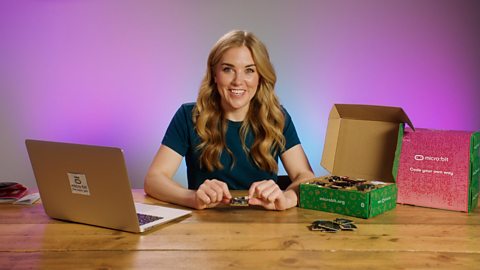
What's inside the micro:bit box? video
Watch an unboxing video and find out how to get coding in less than 60 seconds.
Training resources for teachers
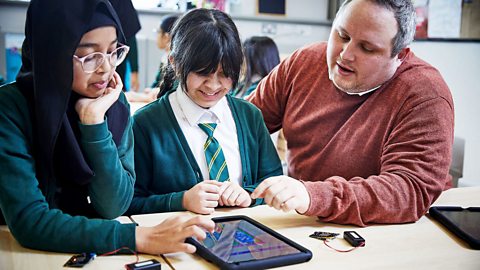
Find out about the free courses - both online and in-person - to help primary schools teach about the micro:bit.
Classroom resources
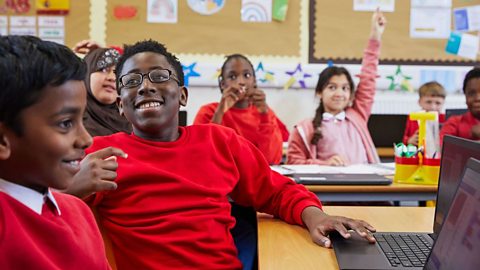
Check out resources that will help you get ready once you receive your micro:bits.
DanTDM on why coding is an important skill for young people
YouTuber DanTDM tells us why he wanted to take part in the BBC micro:bit - the next gen campaign.
Surprise! Celebrities deliver micro:bits to primary schools
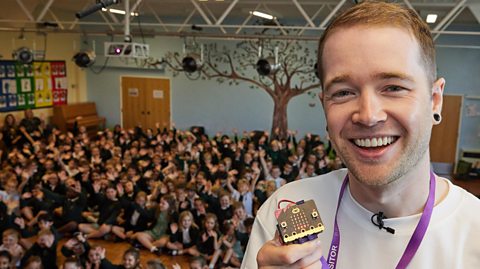
Find out what happened when celebrities including Blue Peter's Abby Cook surprised school pupils around the UK.
Quiz: Is your coding knowledge better than a primary school pupil's? quiz
See how you score in our fun quiz that's based around the primary school curriculum and beyond.