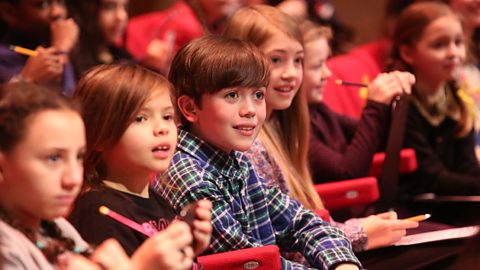
Follow-up programme
We’ve created a full length follow-up programme to this Live Lesson which features our expert guests answering your questions and new curricula linked activities building on students’ learning in the live programme.
Shorter clips from the follow-up programme are also available below, useful for covering individual topics.
Learn more about punctuation with this follow-up programme
Full version follow-up programme
This EXTRA programme encourages students to get active and learn more about punctuation, and answers more questions from our studio and virtual audience.
Punctuation
Naomi:
Right, everyone here in the stands, you in the studio, and you, of course, in your classrooms, are you ready to be Supermovers again?
Children:
Yeah!
Naomi:
Yeah, good. Good, good. 'Cause here are Trevor and Isaac from The Next Step to help us learn about punctuation while we move. Now pay attention because, with this demonstration, you'll be writing sentences with perfect punctuation. So listen very carefully to the words as you move 'cause they will come in handy later on. So if we're all ready to match the moves, singalong!
Isaac:
Yo, Trev. Do you like punctuation?
Trevor:
I have to say, I love me some punctuation.
Trevor and Isaac:
[SINGING] P-p-p-punctuation. Have you heard the news? P-p-p-punctuation. So many symbols to choose. P-p-p-punctuation. With this demonstration, you'll be writing sentences with perfect punctuation.
Trevor and Isaac:
[SINGING] The colon. A couple of dots. What can it be used for? The answer, lots. Following a clause to add an explanation, over list definition, even a statement. Here's an example; this is one. By explaining what I'm saying I'm using a colon. You can introduce a quote with it as well, easy. As someone once said to: "To be or not to be?" P-p-p-punctuation. Have you heard the news? P-p-p-punctuation. So many symbols to choose. P-p-p-punctuation. With this demonstration you'll be writing sentences with perfect punctuation.
Trevor and Isaac:
[SINGING] The semicolon. A fantastic creation. Balancing two pieces of related information. They could be separate sentences on their own, but the semicolon [UNSURE OF WORD]. To create a longer sentence that shares a theme, if only there's a way to show you what I mean. I love the semicolon, it's a useful sign, I just used one then - I blew my own mind. P-p-p-punctuation. Have you heard the news? P-p-p-punctuation. So many symbols to choose. P-p-p-punctuation. With this demonstration you'll be writing sentences with perfect punctuation.
All:
[APPLAUSE]. [SHOUTS].
Male wearing glasses and jumper:
Yeah, that was amazing everyone. Incredible, super moves. And who knew p-p-p-punctuation could be so much fun? Now, don't worry if you didn't get all the moves first time. This brain-booster is just one example of the many free, fun Supermovers videos so you could do it all over again. Now, are you ready to learn more about top notch punctuation? Well let's find out some more about colons and semicolons. That brain-booster taught us that a colon is a couple of dots. So, Dan, what does a colon mean?
Dan:
I've got so much to tell you about colon.
Male wearing glasses and jumper:
[LAUGHS]. Blow my mind.
Dan:
Colons…they introduce a list, a definition, a statement or a quote. For example, please collect from the sports cupboard colon balls, bibs and cones. Or Mr. T. Ennis announced at the press conference colon "We're delighted with the team's rugby progress. If we continue in this way, we shall make our fans extremely proud." So a colon also joins two sentences together where the second adds an explanation or gives a conclusion. So, Jamie and Sam are football goalkeepers colon they spend five nights a week practising their skills. Or, this is for you, the around the world football trick is extremely complex colon while jugging the ball you have to bring one foot right around it in the space of one bounce.
Male wearing glasses and jumper:
Brilliant. Thank you, Dan, and in the brain-booster we just saw then, Trevor and Isaac also mentioned semicolons. So can we find out what a semicolon is used for, Dan?
Dan:
Sure, absolutely. And Trevor and Isaac, they said a semicolon is a fantastic creation balancing two pieces of related information. So a semicolon joins closely related short sentences into one longer sentence, and in a list made up of phrases, and that's groups of words, semicolons comes between each phrase. So I'll give you an example. Now for this game I'll need you to colon keep your eyes on the ball, semicolon, pass well between each other, semicolon, work as a team and enjoy every moment.
Male wearing glasses and jumper:
Okay. Very good. So I think I'm just about getting the hang of that now. So let's have a go at punctuating our own sentences shall we, Naomi?
Naomi:
It's time to put everything that we know about colons and semicolons to the test and, as we're here at Hampden Park, it would be a shame not to get active ourselves as we play Colon versus Semicolon!
Naomi:
[LAUGHS]. And to help us punctuate this challenge, we are welcoming back our four footie mascots from Montrose FC it is Monty the Mole.
Naomi:
From [UNSURE OF WORD], Roscoe the Stag. From [UNSURE OF WORD] United, Terry the Terror, and, from Queen's Park, Webster the Spider. [LAUGHS] They're excited about you, Webster. Now, what's gonna happen is the mascots will each reveal a sentence which will have either a colon or a semicolon missing. You'll also notice we've got two buckets here. One covered in colons, one covered in semicolons. Now you, the audience, you need to decide which is missing from each of the mascot's sentence, and then ten of you will place your balls into your buckets which one you think is correct. So Aisla's going to join in with the audience, you're going to commentate for us. Are you ready to play this game?
Aisla:
I am ready. I will blow the whistle to start if off.
Naomi:
Excellent. Excellent. You can play along in your classrooms at school. What we want you to do is do an action, show us whether you think it should be a colon, colon, or a semicolon. Are you ready? Our studio audience will be doing those actions too. So first up, let's have a look at Monty the Mole. Please reveal your sentence. Okay. Blow your whistle. Okay. They ran and ran and they never stopped running that's why they deserved to win. Audience, is this sentence missing a colon or a semicolon? And where should that mark go? You decide. Supermovers, please choose your bucket.
Aisla:
Off they go. Are they going colons or semicolons? There's a bit of a split.
Naomi:
Oh, a big split, yeah.
Aisla:
Yeah. I'm going to have to get my counting in action.
Naomi:
Yeah, yeah, yeah.
Aisla:
Figure out which is the best. Colons wins it.
Naomi:
I think colons, yeah.
Aisla:
Yeah.
Male wearing glasses and jumper:
Okay, Dan, they're saying colons down there. Are they right?
Dan:
Colons is right because it comes before an explanation. They ran and ran, they never stopped running. Running, colon, that's why they deserved to win.
Naomi:
Okay, Roscoe the Stag, will you reveal your sentence please? There it is. Angus slipped on the wet grass he slid along on his bottom. [LAUGHS] So, audience, what do you think? What's missing? A colon or a semicolon? And where should it go? Choose your bucket. Colon or semicolon?
Aisla:
All going straight–, oh we've got one, one, two going for the colon.
Naomi:
Ooh. What do you thi–
Aisla:
But, yeah, semicolons.
Male wearing glasses and jumper:
Okay. Looked like semicolons, Dan. Which one did that sentence need?
Dan:
Absolutely right. Semicolon because it connects two closely related phrases. Angus slipped on the wet grass, semicolon, he slid along on his bottom.
Male wearing glasses and jumper:
Hm.
Naomi:
Alright, Terry the Terror, it's your turn. Show us the sentence. They were all on their way to the stadium some were dancing and some were marching. Hm. What's missing? A semicolon or a colon? You decide where it should go and do your actions in your classroom - colon or semicolon? Ready? Choose your bucket.
Aisla:
Off they go.
Naomi:
All going straight for the same one this time. Is that a full house?
Aisla:
It is.
Naomi:
Every one.
Aisla:
Absolutely.
Naomi:
A semicolon.
Male wearing glasses and jumper:
Excellent work there. Looks like they all went for the semicolon for Terry the Terror's sentence, Dan. Were they right?
Dan:
They're legends, they're right. It's a semicolon because it's to connect two closely related phrases again. They were all on their way to the stadium, semicolon, some were dancing some were marching.
Naomi:
And, finally, Webster the Spider, it's over to you. Let's see it. I practise passing on Mondays, Wednesdays, Thursdays and Saturdays. There is a semicolon or a colon missing from that sentence but where should it go? Which one is right? Do your actions in your classroom and choose your bucket!
Aisla:
Think all this time.
Trevor:
I think they're all going for the same one again. Ooh.
Naomi:
All going for the same one.Oh, no.
Aisla:
We've got a couple in the colons bucket.
Naomi:
A couple have gone for the colons.
Aisla:
Semicolons.
Male wearing glasses and jumper:
Okay, Dan, we had a lot of semicolons there. Just a couple of colons. Which one was it?
Dan:
Just a couple were right, actually.
Male wearing glasses and jumper:
[LAUGHS].
Dan:
Because the colon introduces lists so in this case I practise passing on, colon, Mondays, Wednesdays, Thursdays and Saturdays.
Male wearing glasses and jumper:
Look at that. Well thank you for the explanations there, Dan, and than you to all our volunteers there. A valiant effort, and I hope you had fun in your classrooms learning about p-p-p-punctuation.
Punctuation
This is a shorter video clip from the follow-up programme focusing on different punctuation marks and their use.
Watch again: Live Lesson video clips
This set of shorter video clips is taken from the Live Lesson programme and can be used to teach individual topics.
Misspelt words
Ben:
Now it's time to kick off with our first super movers brain booster.
Naomi:
Brilliant.
Ben:
Listen carefully to the words and copy the moves. Are we ready?
Naomi:
Up on your feet.
Ben:
Than [WHISTLES].
John Farnworth:
Hi guys. I'm John. Let me spell it out for you. Spelling can be hard so let's make it easy. Learn a few tricks to make it easy. In a few kicks, we'll make it easy. Here we go, here we go, here we go. Speak and spell, speak and spell. If you don't know it, then speak and spell. Say it out loud, break it up, to help you spell the word. Feb-ru-ary. Feb-ru-ary. Feb-ru-ary. Feb-ru-ary. That's how you spell February. Ex-pe-ri-ence. Ex-pe-ri-ence. Ex-pe-ri-ence. Ex-pe-ri-ence. That's how you spell experience. Beat the syllables, beat the syllables. Beat out all the syllables. The syllables will help you remember how to spell the work. Prob-a-bly. Prob-a-bly. Prob-a-bly. Prob-a-bly. That's how you spell probably. In-ter-est. In-ter-est. In-ter-est. In-ter-est. That's how you spell interest.
Naomi:
[APPLAUSE] We're out of breath after that.
Ben:
Brilliant.
Naomi:
Well done, super movers. How good does that make you feel? So tell us what you think and teachers, maybe you just got a great picture of your class. Send them in to us.
Ben:
Yes, please do. Now, I don't know about you, Naomi, but I think that that brain booster was really exciting.
Naomi:
Yeah, it was exciting. But why are you spelling the words out?
Ben:
[LAUGHS] Well, I think if you watched-- Some words are very difficult to spell, so breaking them up into syllables can help.
Naomi:
Oh, I see. Well I better head outside then…
Ben:
Yes.
Naomi:
…and I will set up for our spelling challenge. See you in a bit.
Ben:
She's getting it. Anyway, to find out more, we're lucky to have our supercalifragilisticexpialidocious experts who can spell all the hardest words, including that one, in the English dictionary. So, please welcome superstar author of the Jamie Johnson series and all round spelling whiz, it's Dan Friedman: . [APPLAUSE]
Ben:
Dan, delighted to have you here at Hampden.
Dan Friedman:
Yeah.
Ben:
Excellent. So today we're learning how to spell difficult words. So, do you have any great tips for us?
Dan Friedman:
Yeah,. First tip, like you were just saying, break down words into smaller parts. So, explanation; that's actually got four parts, hasn't it? Ex-plan-a-tion.
Ben:
Okay. I like that. Excellent. Or should I say, ex-cell-ent. Getting the hang of it. What else can you do?
Dan Friedman:
Well, you've got the chance to look for roo words; words within other words. So, in existence, you've got exist. In friendly, you've got friend. If you can get that root word, you're halfway there to the overall word.
Ben:
Okay. Fantastic. So, in the super movers brain booster that we just saw with John Farnworth: , we learnt that saying a word can help you work out how to spell it. So, I think we should have a go. What I need you guys to do is read these words with me. Everyone here as well, please. So, let's go. Transfer. Defender. Referee. Defer. Prefer. Excellent, and I do prefer some of those words actually, Dan. So what sound can we hear in each of those words? What's the recurring sound? It's the er isn't it? Excellent. Or should I say, sup-er-b. Now, you can see the sound er which would suggest the spelling of these words contains the letters E and R next to each other. So, Dan, are there any rules that we can use to help remember these spelling?
Dan Friedman:
There are rules, but you're not gonna be surprised to know that there are also exceptions to the rules. So there's I before E except after C. We know that one. And that works for words like receive and ceiling and things like that. But there's also protein where the E comes before the I and there's no C. But I've got some other tips for you. For example, what's the common sound with these words then, Ben? Official, special, confidential.
Ben:
[Shull]
Dan Friedman:
Right, absolutely. But that [shull] can be spelt in different ways. You can have C-I-A-L, as in special. And you can have T-I-A-L, as in confidential. On the whole, C-I-A-L is common after a vowel and T-I-A-L will be common after a consonant.
Ben:
Okay. I think I'm getting the hang of this. Are there any other rules and exceptions that we should know?
Dan Friedman:
Well, we can talk about words that end with the sound [shun] So think about station. That ends with an I-O-N. But then you've also got magician, which ends with an I-A-N. So a tip there would be, if the root word ends with a C or a C S, then the [shun] is spelt I-A-N.
Ben:
Okay. Alright. So, are there any other tips? You're giving us some great ones, but is there anything else you can teach us?
Dan Friedman:
Let's talk about words that end with the sound [shus] Cautious, delicious. Now, that can be spelt T-I-O-U-S or C-I-O-U-S and a handy pointer there is that if the root word ends with a C, then we would go with C-I-O-U-S. And do you want one final one?
Ben:
Oh, I'd love one please, Dan.
Dan Friedman:
Alright. I'll give you one final one. So, those are the words that end with the sound [ent]. So you've got decent, and that's E-N-T. But then you've got hesitant and the [ent] there is spelt A-N-T. So the trick there is the E-N-T is normally used when the preceding letter is either a soft C, so go decent, or a soft G, regent, or a [qu], so consequent.
Ben:
Okay. Excellent tips. Thank you very much, Dan. A lot to take in but I think we're getting there. Naomi, what's happening in the stands?
Naomi:
Well, we are so excited today, Ben, because we are joined by BBC Sport broadcaster and super movers ambassador, it's Amy Barber. [APPLAUSE] Welcome Amy. Thank you so much for being here with us for our Live Lesson. So, you are no stranger to major sporting events in stadia around the world. Tell us, what's the most exciting event that you've ever covered as a sports broadcaster.
Eilidh Barbour:
Well, this one's a bit personal to me. It was her at Hampden Park. The Scottish Cup Final, where the team I've supported my whole life won their first ever tropy.
Naomi:
Oh, that must have made you happy.
Eilidh Barbour:
So that was exciting, yeah.
Naomi:
And how happy are you to be involved as a super movers ambassador?
Eilidh Barbour:
Yeah. Really can't wait. I've been practising my super moves…
Naomi:
Good.
Eilidh Barbour:
…but yeah, really looking forward to getting active and learning how to spell at the same time.
Naomi:
Yeah. I know, it's good, hey?
Eilidh Barbour:
I could do with sometimes.
Naomi:
Yes. And you're gonna help us out with our super movers activities as well, aren't you?
Eilidh Barbour:
I am indeed.
Naomi:
We're gonna start with a spelling challenge. So, we also need to welcome our other very special guest today. It's our four footy mascot. Eilidh, will you do the honours please?
Eilidh Barbour:
I will indeed. Give them a big round of applause. Our groundsman's nightmare from Montrose FC, it's Monty the Mole. From Ross County, this chap's antlers make him hard to tackle. Roscoe, the Stag. Next, the goalkeeping sensation from Dundee United, Terry the Terror. And finally, from Queen [Spi], a spider whose legs do all the talking, it's Webster the Spider.
Naomi:
[LAUGHS] Thank you, Eilidh. Welcome mascots. Thank you for helping us out with our spelling challenge. So, in this activity, we need you, the audience to decide how to spell certain words. We need to use the tips that Dan has just taught us and tricks from the brain booster. So, what's going to happen? Eilidh's gonna say a word out loud, you then repeat the word after her and decide which spelling is correct. So our mascots will be holding up two options of how to spell that word. You decide which one is right. If you think it's the one on the star team shirt, you hold up your star team shirt and do some star jumps for us. However, if you think it's on the spotty team, if you think that's the correct spelling, you do a little run on the spot. You got that? Got that everyone? Alright the, Eilidh, over to you for our first word please.
Dan Friedman:
Okay. So, repeat after me. The first word is action.
All:
Action.
Naomi:
Right. Mascots, will you reveal your cards please. Is action spelt I-A-N or I-O-N? Audience, decide. Star jumps or running on the spot. What are you gonna do?
Eilidh Barbour:
There's a lot of running on the spot here I think. A couple of star jumps, but I think running on the spot wins it.
Naomi:
What do you think?
Ben:
Oh, some excellent work there. But, Dan, can you see if our audience are largely correct here.
Dan Friedman:
The spottys got it didn't they? Action is spelt with I-O-N.
Ben:
Fantastic. Excellent work. Eilidh, back to you on that.
Eilidh Barbour:
Okay. Repeat after me again, the second word is official.
All:
Official.
Naomi:
Mascots, please reveal your cards. Is official spelt C-I-A-L or is it spelt T-I-A-L? What do you think? Audience, you decide.
Eilidh Barbour:
It's a tough one. What have we got? A lot of star jumping going on here. Stars. You're running.
Ben:
Dan, it looks like the stars have that one. Are they right?
Dan Friedman:
The stars are the stars. It's official It's spelt C-I-A-L.
Ben:
Well that is official. Thank you, Dan. Eilidh, What is our next word?
Eilidh Barbour:
Okay. This next one's getting a bit tougher. Word three. Repeat after me, ambitious.
All:
Ambitious.
Naomi:
Mascots, please reveal your cards. Tell me, do you think ambitious is spelt T-I-O-U-S or is it spelt C-I-O-U-S? Get star jumping or running on the spot now.
Eilidh Barbour:
It's quite a mixture this time, Naomi.
Naomi:
Yeah. We're not quite sure.
Eilidh Barbour:
I'm gonna say stars.
Naomi:
Yeah. Maybe stars.
Ben:
Okay. There was a mix there, Dan. Maybe the stars edged it. Were they right?
Dan Friedman:
That's one for the stars. T_I-O-U-S.
Ben:
Fantastic. And we're getting ambitious now. Well done if you got that. Eilidh, what's the final word in our spelling challenge today?
Eilidh Barbour:
The final word, repeat after me. Frequent.Frequent.
Naomi:
Mascots, please show us your cards. Is frequent spelt Q-U-A-N-T or is it spelt Q-U-E-N-T? Audience, decide. Oh, we're not sure, we're not sure.
Eilidh Barbour:
Oh, not sure. I'm gonna say spots win that. Running on thespot.
Naomi:
Spots.
Ben:
Well I spotted a few spots there, Dan. Were they correct?
Dan Friedman:
Beautiful spots. E-N-T is right.
Ben:
Excellent work, audience.
Misspelt words
This clip is from the main Live Lesson, and looks at words that are commonly misspelt and how we can remember strategies for spelling them.
Word families
Naomi Wilkinson:
We have had so much fun in our spelling challenge; but, there are so many hints and tips we can use to make spelling easier. So, everyone here outside, you might need to get on your feet for this one. In your studio, you in your classrooms, get ready to supercharge your bodies and boost your brains. 'Cause here's the Dumping Ground's Tyler and Sasha. Just follow their moves and sing along.
Sasha:
Alright, let's do this.
Sasha:
[SINGING] In my word family, some things are familiar. There's something inside us all, yeah, it makes spelling easy.
Tyler:
[SINGING] In my word family, some resource is similar. When you look inside the words, yeah, you'll find it's plane to see.
Sasha:
[SINGING] Take a look at act.
Tyler:
[SINGING] Act.
Sasha:
[SINGING] Acting.
Tyler:
[SINGING] Acting.
Sasha:
[SINGING] Action.
Tyler:
[SINGING] Action.
Sasha:
[SINGING] Activator.
Tyler:
[SINGING] Activator.
Sasha:
[SINGING] Activation.
Tyler:
[SINGING] Activation.
Sasha:
[SINGING] Enact.
Tyler:
[SINGING] Enact.
Sasha:
[SINGING] React.
Tyler:
[SINGING] React.
Sasha:
[SINGING] Reading, you'll believe we're the same inside.
Tyler:
[SINGING] We're the same inside… We're the same inside… We're the same inside…
Tyler:
[SINGING] When I act in a film, then I am an actor and I act in action movies; the reaction's always great.
Sasha:
[SINGING] When I'm playing football, I'm a football player and my skills are on display and when I score there's a replay.
Tyler:
[SINGING] When I turn on the lights, I become enlightened. In the twilight of the day, I'm delighted that I stayed.
Sasha:
[SINGING] When I solve a problem, I'm a problem solver. The problem is resolved instead of staying on the [UNSURE OF WORD].
Tyler:
[SINGING] Lights.
Sasha:
[SINGING] Lights.
Tyler:
[SINGING] Lighter.
Sasha:
[SINGING] Lighter.
Tyler:
[SINGING] Lightly.
Sasha:
[SINGING] Lightly.
Tyler:
[SINGING] Lightening.
Sasha:
[SINGING] Lightening.
Tyler:
[SINGING] Delight.
Sasha:
[SINGING] Delight.
Tyler:
[SINGING] Delightful.
Sasha:
[SINGING] Delightful.
Tyler:
[SINGING] Twilight.
Sasha:
[SINGING] Twilight.
Sasha/Tyler:
[SINGING] Reading, you'll believe we're the same inside… We're the same inside.
Children:
[APPLAUSE]
Ben Shires:
Ha-ha-ha-haa! Oh, I don't know about you, but my brain is well and truly boosted after that one. Now, teachers, remember, these brain boosters are just some examples of the brilliant free and fun Super Movers videos. In that one, we sang, [SINGING] "In my word family, some things are familiar." I should get a part now, shouldn't I Dan?
Dan:
You should.
Ben Shires:
Anyway, what does that mean?
Dan:
Okay. So word families are groups of words that have got common letters and spelling patterns in them and that makes them sound the same. So they usually have a common base, or root word; but then, different prefixes and suffixes are added. Shall I explain?
Ben Shires:
Please, yes.
Dan:
Yeah, so example, the root word in that previous example was act, wasn't it? But it might have a suffix added, like action, or it might have a prefix added, like react.
Ben Shires:
Okay.
Dan:
Is that starting to make sense?
Ben Shires:
Okay.
Dan:
And words with the same spelling pattern and with the same sound, they can also be in a family. So, for example, pain, train, drain, acquaintance.
Ben Shires:
Okay. Alright. I think I'm getting there. So, let's give this a go, shall we? Listen for the part of the word that sounds the same and could everyone please join in on this one as well, please. So, we've got…
Ben/Dan/Children:
…pain, train, rain and acquaintance.
Ben Shires:
Excellent work there, excellent work. Now, I think it's time to test our knowledge of word families in another activity with our special guests, Naomi.
Naomi Wilkinson:
Thank you very much Ben. I think we've all just about got that. So let's recap what we've learnt in the brain booster in our new game, which is called Word Family Ties.
Children:
Whoa!
Naomi Wilkinson:
Whoa! As you can see, each of our lovely mascots is holding up a word. Now, what our team are gonna have to do is, they're gonna have to run over, rummage in the mascot's kit boxes and try and find three words from the same word family. They then need to run one word at a time, back over to the goalpost, hand that word to their teammate, who will hang it up. One word at a time. Has everyone got it? You know what you're doing? Alright, so let's hear it for our volunteers, give them a cheer.
Children:
Yeah! [CHEERS]
Female with short black hair: :
Okay, you might notice I have a whistle. When I blow my whistle, you'll have 60 seconds to find your three words from your word family. One word at a time. And, everybody behind the goal, they'll need some encourage; so give them lots of cheering.
Naomi Wilkinson:
Yes, lots of support.
Female with short black hair: :
Okay. Are you ready, set, go. [WHISTLES] Okay, 60 seconds. Oh, we've got one word.
Naomi Wilkinson:
Oh, [UNSURE OF WORD] light. Same word family.
Female with short black hair: :
We've got one word up here.
Naomi Wilkinson:
They've got one word twilight, light. Yeah, that seems good.
Female with short black hair: :
We've got two words up on the ink word family.
Naomi Wilkinson:
You have not finished already?
Female with short black hair: :
I think we've done three already on this one.
Naomi Wilkinson:
In 15 seconds?
Female with short black hair:
We've still got lots of time, so everyone keep going.
Naomi Wilkinson:
Are they done already? I don't believe it, everybody's finished. Okay, stand to the side. They've finished already. Stand to the side.
Female with short black hair:
That wasn't even 30 seconds.
Naomi Wilkinson:
That was ridiculously fast. Well done. My goodness, you are on it team. Well done. So, there are our words. Shall we find out how we got on, while you recover?
Ben Shires:
Wow, they were amazing scenes. We didn't need extra time for that, that's for sure. So, let's find out what the correct word family should have been. Dan?
Dan:
[TUTS] Well, they did great, they got a full house of all the family. So, just to let you know, from the ash family there was brash, there was cash and there was splash and from the light family there was delight, there was twilight and there was lightening. In the ink family we had blink, we had wink and we had stink and in the ate family, debate, relate and great.
Ben Shires:
Well, that is great, I think you'll find. Well done to our volunteers there and, now, it's your turn to find the word family. So, on activity sheet one, hopefully you've got that in front of you, you'll find three root words and we need you to find the two words that fit in each word family. Remember, word families are groups of words that share a spelling pattern. With strings of letters that make the same sound. So, you've got 30 seconds on the clock and off you go. [WHISTLES]
Ben Shires:
Well, that is time up. I hope you got on okay and we've got Lucy here in the audience; who just finished in the nick of time there, didn't you Lucy?
Lucy:
Yeah.
Ben Shires:
So, d'you wanna talk us through your answers, please? What did you get for ide first?
Lucy:
We had stride and glide.
Ben Shires:
Sounds good and what about ped?
Lucy:
Pedal and expedition.
Ben Shires:
Excellent and how about real?
Lucy:
Unrealistic and realise.
Ben Shires:
Fantastic work. They sound very good to me. Now, here on the screen is how your completed worksheet should look. Well done if yours looks like that and, I must say, I was rooting for yer. You get it Lucy, rooting? 'Cause it's like root. You'll figure it out on the way home.
Word families
This clip is from the main Live Lesson, and looks at word families - a way to group words and make them easier to spell.
Your students will need this downloadable activity sheet:
Homophones
Ben Shires:
We've learned that saying a word out loud can help us to spell it. But there are some words where that doesn't quite help. However, fear not, don't panic. Here, that's here, not hear, to help are Johnny and Inel. So, everybody copy their moves. Over to you, boys.
Johnny:
Do you know what, Inel?
Inel:
What's that?
Johnny:
I'm gonna teach these guys something about homophones.
Inel:
Yeah, let's take over the class.
Johnny and Inel:
[SINGING]There are some words that sound the sameThey're not spelled the sameThey're not spelled the same.
Yes, there are some words that sound the sameThey're not spelled the same.
Johnny:
We call them, homophones. Here, h-e-r-e, is where you are.
Inel:
But hear, h-e-a-r, is how you listen.
Johnny:
Here, h-e-r-e, is where you are.
Inel:
But hear, h-e-a-r, is how you listen.
Johnny:
See, s-e-e, is how you look.
Inel:
But sea, s-e-a, is where you swim.
Johnny:
See, s-e-e, is how you look.
Inel:
But sea, s-e-a, is where you swim.
Johnny and Inel:
[SINGING]There are some words that sound the sameThey're not spelled the sameThey're not spelled the same.
Yes, there are some words that sound the sameThey're not spelled the same.
Johnny:
We call them, homophones.
Ben Shires:
Wow. Awesome super moves. Everybody, a huge welcome to you in your classrooms too. Now, as we've just learned, there are lots of words that sound the same, but aren't spelled the same. So, Dan, can you tell us about them?
Dan Freedman:
Yeah. Those are homophones, and homophones are words that have different meanings and different spellings, but they do souind the same.
Ben Shires:
Okay. Are there any examples that we can all have a go at saying with them?
Dan Freedman:
Yeah, shall we all have a go? Do you wanna say these with me? So, let's go with–.
Everybody:
Sun and son, be and bee, night and knight, aloud and allowed, cereal and serial, weather and whether, steal and steel.
Ben Shires:
Okay, they do sound alike. This is tricky. So, are there any rules that can help us remember which spelling belongs to which word when they sound the same?
Dan Freedman:
I've got a little something that can help you, and that is, for word pairs, maybe like advise and advice, device and devise, practice and practise; they may only have the smallest differences in the way we pronounce them. So, useful tip to remember them is that nouns end with a c-e, and verbs end with an s-e.
Ben Shires:
That is a very good tip. So, in that case, it's safe to say, I'd advise you to take good notice of this advice, and it's good practice to practise. Isn't that right, Naomi?
Naomi Wilkinson:
That is right, Ben. Homophones can cause huge confusion. Allow the fantastic, Eilidh Barbour: and I to demonstrate this for you. Earlier, I told Eilidh I found a leak in my kitchen.
Eilidh Barbour:
And I told Naomi, I found five.
Naomi Wilkinson:
Let's try another one. En route to Hampden Park, I asked Eilidh, do you have the time?
Eilidh Barbour:
And I said, no, but I do have rosemary.
Naomi Wilkinson:
So, as we've just demonstrated, two words can sound alike, but have totally different meanings. Luckily, they have different spellings too. So, get ready for an active challenge. It's time to play, the Supermovers Word Wall. And to help, it's the fantastic Footie Four. So, in the centre of our Live Lessons pitch, you'll see we've got our lovely Word Wall. On it, there are three sentences, each with a missing word in it. It just so happens that the word that's missing is a homophone. Now, we have two mascots standing at each end of the pitch. Over there, Monty the Mole and Rosco the Stag. Hello. And over at this end, Webster the Spider and Terry the Terror. For each sentence, one mascot on each side is gonna hold up a word. Both words are homophones, and so they sound alike. But team Supermovers, your task is to run to the mascot you think is holding the correct word to go in the gap on the Word Wall. And audience in your classrooms, you can join in as well, we need your help. Just point to the side that you think our Supermovers ought to be running towards. Everybody got that? Team, are you ready?
Supermovers:
Yeah.
Naomi Wilkinson:
All right, Eilidh.
Eilidh Barbour:
I have the whistle. 60 seconds, starts now.
Naomi Wilkinson:
Kick it over there, or their, towards the goal. Run to which one you think is right.
Eilidh Barbour:
Which one is it going to be?
Naomi Wilkinson:
Get your [words] on there. Quick, give me that one, give me that one. Somebody pass me that one. Quick. The football team past or passed the ball with skill and flair. Everybody, everyone's got this one. All right, thank you very much. Let's whack it on the wall. Third and final sentence: the captain lead, or is it led, her team with excellence. Run now.
Eilidh Barbour:
I think [INAUDIBLE].
Naomi Wilkinson:
Are you gonna sit or-- you're not sure. Right, you're sticking with that one. Which one are we going for? Well, we'll go with the majority, we'll go for this one. Thank you. All right, let's see. Well done, everyone, take a breath. Here's our completed Word Wall. Shall we stop the clock?
Eilidh Barbour:
I think we've done-- yeah. Got stopped a while ago [LAUGHS].
Naomi Wilkinson:
Oh, did we run out of time?
Eilidh Barbour:
Yes, [INAUDIBLE].
Naomi Wilkinson:
Shall we find out how we got on?
Ben Shires:
Incredible, seeing as that's a different kind of wall for a football ground, isn't it, Dan? But how did they do?
Dan Freedman:
Pretty much all right, I have to say. The guys are getting the hang of it, aren't they?
Ben Shires:
Fantastic. I'm glad to hear that. And now, it's time for you lot to have a go. So, on activity sheet two, you'll see a word wall with three sentences relating to an athletic event. Your task is to choose which homophone is the right one and fill in the gaps from the choices given. So, you have 30 seconds, off you go. Oh, we're going.
Ben Shires:
Okay, that is time up. Let's find out how our audience got on. Who do we have here?
Hamad:
[Hamad].
Ben Shires:
Okay, Hamad. And do you wanna talk us through your answers?
Hamad:
So, for the first sentence, I got cereal. I know how to spell my words correct, so.
Ben Shires:
That's good. I can see that, Hamad, yeah. Cereal with a C. And the next one?
HamadThe long jump coach was famous for wearing purple jeans.
Ben Shires:
Yep, with a J.
Hamad:
Because I know that's one for, like, in the body, genes.
Naomi Wilkinson:
Yeah, absolutely.
Hamad:
Gymnastics practice. Gymnastics something takes place every Saturday.
Naomi Wilkinson:
Yeah.
Hamad:
And if practice is something else, I don't know about it.
Naomi Wilkinson:
Practice with a C. Fantastic, that's great. And it's good to know we've got such confident spellers in the audience. So, this is now how your activity sheet should look. Congrats if it does resemble this.
Homophones
This clip is from the main Live Lesson, and looks at homophones - words that sound the same but are spelt differently and mean different things.
Your class will need this downloadable activity sheet:
Watch the full Live Lesson
Catch up with the full Super Movers Literacy - Live Lesson for more active literacy and English activities

Primary BBC Live Lessons
Find out more about our Live Lessons designed for primary school students
BBC Live Lessons homepage
Return to the BBC Live Lessons homepage for more curriculum-linked Live Lessons across primary and secondary