Watch again: Live Lesson video clips
This set of shorter video clips is taken from the Live Lesson programme and can be used to teach individual topics.
Shared sonnet
Naomi Wilkinson:
Are you ready? It is time to delve into the text itself and find out how you can become Text Detectives? Unravel and understand just how amazing Shakespeare's language really is. To tell us more, please welcome the wonderful RSC director Justin Audibert: . [APPLAUSE] Welcome Justin. So, as a theatre director, what is it that you think makes Shakespeare's plays so fascinating to work with?
Justin Audibert:
Hello Naomi, hello everyone. What's so brilliant about Shakespeare's plays is there's just a million different ways of performing them. And it's really important they're performed, that you see them on their feet.
Naomi Wilkinson:
And why have you chosen to focus on Romeo and Juliet today?
Justin Audibert:
Well we've chosen Romeo and Juliet because it's one that lots of people know, but also people know it's a love story, but today we're going to show you that it's a dangerous love story, and there's lots of different ways of playing with that love story.
Naomi Wilkinson:
Okay, a dangerous love story. Ooh. Okay, teachers and our virtual audience, make sure you have your worksheets and a pen or pencil in a place where you can easily reach them. Ed and our audience, are you ready up there?
Ed Petrie:
Oh yes. Primed and ready.
Naomi Wilkinson:
Great, okay, so Justin, what are we as detectives going to be investigating today?
Justin Audibert:
So we're going to challenge what you think you'll know about Romeo and Juliet. We're going to demystify some tricky words, and we're going to find, most importantly, the clues that Shakespeare has given us in the text, that help us to make those scenes really come to life.
Naomi Wilkinson:
Lovely, sounds intriguing. So I'm going to hand over to you now.
Justin Audibert:
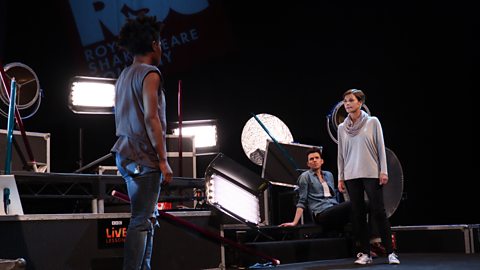
Thanks a lot. Okay, so I just want to introduce our actors here. So we've got Rina, who's going to be playing the Nurse. We've got Joe, who's going to be our Romeo, and we've got Akiya, who's going to be our Juliet. Now, we're going to start by looking at the scene when Romeo and Juliet first meet. So Akiya, could you tell us a little bit about the scene, where it is and what's happening.
Akiya Henry:
So it's at Juliet's house. It's a party which is being arranged for Juliet in order to, it's an engagement party to meet her possible fiance called Paris, which has been arranged by her parents.
Justin Audibert:
Great, and Joe, could you tell us why Romeo is at this party?
Joseph Arkley:
Yeah, at the beginning of the play Romeo's had his heart broken by a girl called Rosalind, so he wants to get over that, so he wants to have a good time. So he ends up going to this Capulet party, and he shouldn't be there, because he's a Montague.
Justin Audibert:
That's right, it's really important to remember that the two families are enemies. And the stakes of this scene, when they first meet, are incredibly high. Now, we're going to focus on just 14 lines of this scene. But they're really important because they're the first time that Romeo and Juliet speak to each other. They've both spoken in the play before, but they've never spoken to each other. And Shakespeare does something really clever here. He makes their first time they talk really stand out because they talk to each other in what's called a sonnet. Now, I was talking about those tricky words to understand, this is the first one. Does anyone in our audience know what a sonnet is?
Ed Petrie:
Oh I do, I do Justin. It's a poem, it's a poem Justin.
Justin Audibert:
Yes Ed, we're supposed to ask the young people, but you're quite right, it is a poem, well done. Now, for our virtual audience and our audiences across the UK, you're going to need worksheet number one. What I want us all to do together, is look at those lines on the page, have a little look, and then the very last word on each line, we call them the end words, I want you to say them all together. We're all of us going to say them all together. So just the very last words on the line, okay? Everybody got that? Alright. Three, two, one. Go. Hand, this, stand, kiss, much, this, touch, kiss, to, prayer, do, despair, sake, take. Great, brilliant. Well done everybody, good. It's good to get the words in the air. So now, Ed, they're the end words of the line. Now has anyone in our audience noticed anything in particular about those words that we just said?
Ed Petrie:
Let's find out, did you notice anything about them?
Male student 1:
They rhyme.
Ed Petrie:
Yes, they rhyme, don't they?
Justin Audibert:
That's right, but they don't rhyme every line, do they? They rhyme, if you look at the sheet, they rhyme every other line. So that's right, they rhyme every other line. Until you get to the last two, where they do rhyme, and that's basically what a sonnet is. It's three blocks of four lines, where every other line rhymes, and then on the last two lines, they rhyme in what's called a couplet. Now, one of our tasks as Text Detectives is to work out why Shakespeare uses a sonnet at this particular moment. So we're going to now look at the words again, just as we do in rehearsals. So you can put your sheets of paper to one side just for a moment, you can put them down. Great. And I want you to really carefully watch the performance, because I'm going to ask you some questions about it afterwards. Is that okay? Okay, whenever you're ready, Joe and Akiya. Take it away.
Joseph Arkley:
If I profane with my unworthiest handThis holy shrine, the gentle sin is this:My lips, two blushing pilgrims, ready standTo smooth that rough touch with a tender kiss.
Akiya Henry:
Good pilgrim, you do wrong your hand too much,Which mannerly devotion shows in this,For saints have hands that pilgrims' hands do touch,And palm to palm is holy palmers' kiss.
Joseph Arkley:
Have not saints lips, and holy palmers too?
Akiya Henry:
Ay, pilgrim, lips that they must use in prayer.
Joseph Arkley:
O, then, dear saint, let lips do what hands do.They pray; grant thou, lest faith turn to despair.
Akiya Henry:
Saints do not move, though grant for prayers' sake.
Joseph Arkley:
Then move not, while my prayer’s effect I take. [APPLAUSE]
Justin Audibert:
Brilliant. I'm going to check how closely you were all watching now. So Ed, I want you to find out from our studio audience, what was the first move that Romeo made, and then how Juliet reacted to that, and then what was the very last thing that we all saw?
Ed Petrie:
Right okay, let's see how closely you were watching, before he even spoke?
Male student 2:
He like, approached her?
Ed Petrie:
Yeah, and…
Male student 2:
He took her hand.
Ed Petrie:
Yes, he took her hand. And then how did she react?
Male student 2:
She like drew her hand away.
Ed Petrie:
Yeah, so she didn't like it.
Male student 2:
No.
Ed Petrie:
And then what were they doing at the end?
Male student 2:
They were kissing at the end.
Ed Petrie:
Yeah, they were having a big old snog, weren't they?
Justin Audibert:
They were. They were having a big old snog. So what I want us to do, and that's not in many lines, that's only 14 lines we go from her going, yuck, to them having this big kiss. So we're going to investigate these words that take us, in such a short time, from that first moment, to the kiss. Now remember even though these two don't realise it yet, their families are supposed to be enemies. And Juliet is supposed to be getting engaged to somebody else at this party. Now, you're going to need your worksheet again, so pick them up please. Okay, and you're about to be Text Detectives. When we tell you, I want you to highlight any words in the text that are repeated by either Romeo or Juliet. So any words in the text that are repeated by either Romeo or Juliet.
Naomi Wilkinson:
We're going to give you a 60 second clock, so are you ready? Go.
Ed Petrie:
Stop everyone, stop. Let's find out what we've got here. So did you find a word that repeated?
Male student 3:
Yeah, kiss.
Ed Petrie:
Kiss. Kiss, okay. Did you find one?
Male student 4:
Pilgrim.
Justin Audibert:
Brilliant, absolutely. So words like pilgrim, saint, that's quite an important one, lips, hands, prayers. Are there any of those words that you guys don't understand what they mean? Because in a rehearsal room, all the time, we have to spend some time just working out what some of Shakespeare's words mean now. Even the most experienced actor gets stumped by the language sometimes. Ed, have you got any words that we don't know what they mean?
Ed Petrie:
Have you found any words there you quite know the meaning of?
Female student 1:
Profane.
Ed Petrie:
Profane? Okay. Have you got one? Any words you're like, what is that?
Female student 2:
Mannerly.
Ed Petrie:
Mannerly. Okay. Have you got one?
Female student 3:
Pilgrim.
Ed Petrie:
Pilgrim. Any others here?
Female student 4:
I was going to say pilgrim.
Ed Petrie:
She was going to say pilgrim as well. What's a pilgrim?
Justin Audibert:
Great, okay, well profane is when something, it spoils something, it makes it unholy. Mannerly is like, like man-like, and Joe, are you going to tell us what a pilgrim is?
Joseph Arkley:
Yeah, a pilgrim is someone who goes on a journey to any kind of religious place, like Canterbury Cathedral for example.
Justin Audibert:
Brilliant. So what Romeo's kind of saying here is that his journey over to Juliet is like a religious kind of journey, that she's so kind of holy and pure. Okay, Akiya, when you notice as an actor that your character is picking up the words of another character, and using them, what does that tend to suggest to you?
Akiya Henry:
It kind of suggests that that character has definitely got my attention, and then if I decide to throw their words back at them, that it means that I'm trying to get their attention too.
Justin Audibert:
Great, it's kind of like a game isn't it, it's kind of like chucking a ball backwards and forward. Now, as we all know, you can throw a ball in lots of different ways. So we're going to try a couple now. Just like we do in the rehearsal room. So you can, again, you can put your sheets down for a second because I'm going to need you to watch. Firstly, Joe, I want you to emphasise those words that are, such as pilgrim and saint and hands and lips, and I want you to really use them to chat Juliet up, those kind of holy words, to chat Juliet up. And Akiya, what I want you to do, is any words that you repeat of Romeo's, you use them to really shut him down, to block him off. Is that okay? Okay, and I want you guys to be watching for that, alright? I'm going to ask you some questions afterwards. Whenever you're ready Joe and Akiya, off you go.
Joseph Arkley:
If I profane with my unworthiest handThis holy shrine, the gentle sin is this:My lips, two blushing pilgrims, ready standTo smooth that rough touch with a tender kiss.
Akiya Henry:
Good pilgrim, you do wrong your hand too much,Which mannerly devotion shows in this,For saints have hands that pilgrims' hands do touch,And palm to palm is holy palmers' kiss.
Joseph Arkley:
Have not saints lips, and holy palmers too?
Akiya Henry:
Ay, pilgrim, lips that they must use in prayer.
Joseph Arkley:
O, then, dear saint, let lips do what hands do.They pray; grant thou, lest faith turn to despair.
Akiya Henry:
Saints do not move, though grant for prayers' sake.
Joseph Arkley:
Then move not, while my prayer’s effect I take. [APPLAUSE]
Justin Audibert:
Really good. I love the way that Joe tried to use pilgrim and be all smooth with it and then Akiya just used it to put him down. Now, I want to know though, what words did work Akiya, that meant that you, that Juliet let Romeo kiss her in the end?
Akiya Henry:
Well, not only is Romeo super fine, but he kept on using the word saint, and it just made me feel really special.
Justin Audibert:
Great, so the repetition really was the thing that affected you there, and the way that he kept on playing with you. And Joe, what does it feel like when Juliet picks up your words and throws them back to you?
Joseph Arkley:
Well Romeo's quite cocky, so when Juliet comes back at him, she engages in his wordplay and it's just really attractive because she's so unbelievably smart.
Justin Audibert:
Great, really good. Okay, so we've already seen there how repeating the words changes characters, and now I want to build on that, because earlier on we said how dangerous this situation is for Romeo and Juliet. So Joe and Akiya are going to play the scene again, but this time, there's a real awareness that if they get caught, they will be in real trouble. I want to smell that danger. And because they can't touch each other, those words they share heighten the intimacy, and become a kind of code between them. Whenever you're ready Akiya and Joe, off you go.
Joseph Arkley:
If I profane with my unworthiest handThis holy shrine, the gentle sin is this:My lips, two blushing pilgrims, ready standTo smooth that rough touch with a tender kiss.
Akiya Henry:
Good pilgrim, you do wrong your hand too much,Which mannerly devotion shows in this,For saints have hands that pilgrims' hands do touch,And palm to palm is holy palmers' kiss.
Joseph Arkley:
Have not saints lips, and holy palmers too?
Akiya Henry:
Ay, pilgrim, lips that they must use in prayer.
Joseph Arkley:
O, then, dear saint, let lips do what hands do.They pray; grant thou, lest faith turn to despair.
Akiya Henry:
Saints do not move, though grant for prayers' sake.
Joseph Arkley:
Then move not, while my prayer’s effect I take. [APPLAUSE]
Justin Audibert:
Okay, that was great. I really felt that danger. Now Ed, I want to ask the audience a question. Going back to that idea of the sonnet earlier and this shared sonnet. Has anyone in the audience got any idea why the last two lines of that sonnet rhyme? What does it say about Romeo and Juliet's relationship, that those last two lines rhyme, any thoughts?
Ed Petrie:
Oh we got lost in that performance. I could watch these guys all day. Why do you think the last two lines rhymed, from Romeo and Juliet?
Female student 5:
They fell in love?
Ed Petrie:
Because they fell in love?
Justin Audibert:
Brilliant. Absolutely, that's right. I mean, it definitely shows that they're attracted to each other. It's a really clever thing that he does. Shakespeare uses a shared sonnet here, because it lets us see how straightaway we know they're in sync with each other. Great work Text Detectives.
Shared sonnet
Justin Audibert explores the party scene and Romeo and Juliet's shared sonnet.
Your students will need this downloadable activity sheet:
Iambic pentameter
Justin Audibert:
Text Detectives, in this very famous balcony scene, we're going to look at something scary. Something that always terrifies people about Shakespeare, and that is iambic pentameter. Sometimes that's called blank verse as well. And it means the same thing, which is a line with 10 syllables, with a rhythm that alternates between a short beat and a long one. Still sounds confusing, but actually it's really simple. It's like this. De-dum-de-dum-de-dum-de-dum-de-dum. That's all it is. And it's a rhythm that we use all the time in everyday speech. Rina here, have you got an example for us of a line of iambic pentameter we use all the time?
Rina Mahoney:
Yes, I do. I think I'd like to have a cup of tea.
Justin Audibert:
Brilliant, and obviously we wouldn't normally spend our time beating it out. Joe, have you got one for us?
Joseph Arkley:
Yeah. Yoda has one in Star Wars when he says, try not, do or do not, there is no try.
Justin Audibert:
Brilliant. Okay, but even more commonly, it's just like the human heartbeat, isn't it? So iambic pentameter is just five lots of heartbeat. De-dum-de-dum-de-dum-de-dum-de-dum. Now, I want you all in our studio audience, and in classes, to put your hand on your chest and just join me in doing that really simply, to get it in our bodies. So we're just going to save five lots of de-dum. One, two, three.
Everyone:
De-dum-de-dum-de-dum-de-dum-de-dum.
Justin Audibert:
Simple. Great. So those 10 heartbeats make up a regular line of iambic pentameter, but in life what happens to our heartbeat if something happens that either surprises us or excites us, or maybe confuses us? Have a little think about that. Ed, have you got any suggestions from the audience out there?
Ed Petrie:
Yeah, what do you think, what happens to your heartbeat?
Male student 1:
It gets faster, beats quicker.
Ed Petrie:
Gets faster?
Justin Audibert:
Absolutely, it gets faster. Sometimes it might skip a beat, or it just changes in some way. It responds to how we're feeling. And that's what Shakespeare's language does. So a regular line of iambic pentameter will have those 10 syllables, but when Shakespeare writes a line that isn't regular, it really stands out, and that's where you're going to come in now, Text Detectives. By understanding the rhythm, you can make character choices when that rhythm is disrupted. So again, you can put your worksheets down for a second. And Akiya, could you remind us of what's going on in this scene?
Akiya Henry:
So it's after the party, Juliet is out on her balcony and a little bit excited about receiving her first kiss from Romeo. But she's also just found out that Romeo is a Montague, and Juliet is a Capulet, and the Montagues and the Capulets are enemies. So she's a little bit confused about how she could possibly fall in love with her enemy.
Justin Audibert:
Great, and Joe, where is Romeo at this point?
Joseph Arkley:
Well Romeo's left the party but he feels like he wants to see Juliet again. So he sneaks in to Capulet garden and waits for her under the balcony, and it's really, really dangerous because he's a Montague, if the Capulets find him, they'll either lock him up or even beat him up.
Justin Audibert:
Great, okay. So I want everyone now to watch this scene really carefully. When you're ready.
Akiya Henry:
O Romeo, Romeo! Wherefore art thou Romeo?Deny thy father and refuse thy name.Or, if thou wilt not, be but sworn my love,And I’ll no longer be a Capulet.
Joseph Arkley:
Shall I hear more, or shall I speak at this?
Akiya Henry:
'Tis but thy name that is my enemy.Thou art thyself, though not a Montague.What’s Montague? It is nor hand, nor foot,Nor arm, nor face, nor any other partBelonging to a man. O, be some other name!What’s in a name? That which we call a roseBy any other word would smell as sweet.So Romeo would, were he not Romeo called,Retain that dear perfection which he owesWithout that title. Romeo, doff thy name,And for that name, which is no part of theeTake all myself.
Joseph Arkley:
I take thee at thy word.Call me but love, and I’ll be new baptised.Henceforth I never will be Romeo.
Akiya Henry:
What man art thou that, thus bescreened in night,So stumblest on my counsel?
Joseph Arkley:
By a nameI know not how to tell thee who I am.My name, dear saint, is hateful to myselfBecause it is an enemy to thee. [APPLAUSE]
Justin Audibert:
Great to watch that, wasn't it? Now, we're going to break this down for you and give you some tools that you can use to unlock Shakespeare's text. Akiya, could you just say that, your first line again, and then tell us what it means please?
Akiya Henry:
O Romeo, Romeo! Wherefore art thou Romeo? And it means, ugh Romeo, Romeo, why are you called Romeo?
Justin Audibert:
Brilliant. Okay, now everyone in our studio audience and at school, we're going to listen to that first line again, and we're going to count out the beats as Akiya says it. Remember, there should be 10, so get ready here. Put your hand on your heart. Great. And whenever you're ready Akiya.
Akiya Henry:
O Romeo, Romeo! Wherefore art thou Romeo?
Justin Audibert:
Wait a minute. Something's up there, isn't it? We have got way more than 10 beats in that line. So that's what's called an irregular line. So what's it telling us? Well, it's Shakespeare giving us a clue about how Juliet is feeling at the moment. Akiya, what do you think it might mean?
Akiya Henry:
Well Justin, I think it means that Juliet is really trying to work out in her head how she could possibly be in love with her enemy. So it's kind of representing a little bit of that confusion.
Justin Audibert:
Great, absolutely, the clue is in the rhythm itself. Now, could everybody, we're going to look at the next line now, and then count out how many beats are in it as Akiya says it. So again, the same thing. Great. Excellent. Thanks Akiya.
Akiya Henry:
Deny thy father and refuse thy name.
Justin Audibert:
Great, so that line, suddenly we've got a nice regular 10. And then the two lines after that also have 10. Really good. So Akiya, why do you think the first line is irregular, but then after that it gets regular, have you got any ideas?
Akiya Henry:
Well it kind of like ties in with what we've been talking about, about the heartbeat. So when you're a little bit unsure or a little bit uncertain, your heartbeat changes rhythm, and when you become really sure and really certain and focused, your heartbeat kind of gets back to a regular beat. So I think in the beginning what's happening is that you're seeing, you're hearing Juliet's heartbeat because of the confusion, it's a little bit out of sync, and she's a little bit unsure. And then when she becomes really practical about being able to solve the problem, her heartbeat kind of calms down and it becomes regular again.
Justin Audibert:
That's a really good definition. That's right. Shakespeare uses the rhythm to give us clues about how the character is feeling. Now for our virtual audience, and for our audience here, I've got another bit of Text Detective work for you. Can you all pick up your worksheets again? And all I need you to do, is just look at the words, how the words are arranged on the page. There are clues here, okay, even before you need to worry about what they mean. And we're going to try and find them. So what I want you to look for, can anyone see on that page where there isn't a full line, where there isn't a full line, can anybody find that? And Ed, have we got any suggestions out there?
Ed Petrie:
Yeah, I think so. Yeah, can you see?
Male student 2:
It says take all myself.
Ed Petrie:
Yeah, Juliet just says that and then Romeo cuts in, doesn't he?
Justin Audibert:
Brilliant. That's right. Around that line, take all myself. Suddenly it's not a full line. So at that point we have to make a choice. The actors can even share the line by Romeo jumping in, or we can leave a big pause, and we can fill it with some action or some thinking. So we're going to try and show you that a little bit now. So first up, Joe, I want you to just play a shortened version of the scene, but really play that pause. And you in the audience, I want you to look for what that might mean. What does that, what do we read into it if Romeo plays a big pause there? Okay, whenever you're ready, take it away Joe and Akiya.
Akiya Henry:
So Romeo would, were he not Romeo called,Retain that dear perfection which he owesWithout that title. Romeo, doff thy name,And for that name, which is no part of theeTake all myself.
Joseph Arkley:
I take thee at thy word.Call me but love, and I’ll be new baptised.Henceforth I never will be Romeo.
Justin Audibert:
Great, thank you Akiya and thank you Joe. [APPLAUSE] Oh they got around of applause, lovely. What I want you to think about audience, is what do you think was going on for Romeo in that big pause? What did it look like to you? Ed, have we got any answers out there in the audience?
Ed Petrie:
Why do you think he might have been pausing?
Female student 1:
It looks like he was scared.
Ed Petrie:
He was scared?
Justin Audibert:
Brilliant answer, that's right. He's scared. Maybe he's worried that the Capulets are going to find him in that garden, which he shouldn't be in, and are going to stab him. Excellent, great answer. Okay, now I want to try something different. So this time, I want to go from the same place, but Romeo's going to jump in and share that line with Juliet. Whenever you're ready Joe and Akiya, off you go.
Akiya Henry:
So Romeo would, were he not Romeo called,Retain that dear perfection which he owesWithout that title. Romeo, doff thy name,And for that name, which is no part of theeTake all myself.
Joseph Arkley:
I take thee at thy word.Call me but love, and I’ll be new baptised.Henceforth I never will be Romeo.
Justin Audibert:
Great, well done Joe and Akiya. Great. [APPLAUSE] Oh, another round of applause. And what did you guys see then? What did it look like then, with Romeo just jumping straight in? Have a think about that. Ed, have we got any suggestions from the audience?
Ed Petrie:
Yeah, why do you think Romeo might have jumped in like that and messed up Juliet's iambic pentameter?
Female student 2:
Because he wanted to say something because he wanted to like say I'm here, I can hear you, and she wasn't expecting it.
Ed Petrie:
So he was what, he was quite excited?
Female student 2:
Yeah.
Ed Petrie:
Yeah, so he was really excited and just couldn't wait to speak.
Justin Audibert:
Absolutely, that's right. He got really excited, didn't he? It was like he was really keen to speak to her. So you can see, just by looking at the text itself, straightaway there are clues that Shakespeare's left us about the rhythm of the lines and whether they're shared or not. And we can make hugely different choices about how the scene is played. Also remember that idea of the heartbeat. If two characters share a line, they complete a sequence of heartbeats. A shared line has been described as like two hearts beating as one. So when Shakespeare's characters share lines, it can mean there's a closeness between them. Maybe they're friends, really good friends, or maybe they're lovers, or maybe they're conspirators plotting something together.
Naomi Wilkinson:
Thank you so much Justin, thank you so much Akiya and Joe.
Iambic pentameter
Explore iambic pentameter and its effects in the famous Romeo and Juliet balcony scene.
Your students will need this downloadable activity sheet:
Antithesis
Naomi Wilkinson:
Now we're going to discover another clever language device that Shakespeare often used. It's time for our last scene which is from Act three, scene two and for this you're gonna need worksheet three at the ready.
Ed:
The story so far, after their romantic rendezvous on the balcony, Romeo and Juliet have gone and got married. Yes, married, but in secret, they haven't told their parents as they know they'll be in so much trouble. Then Romeo gets caught up in a fight and it all turns very nasty.
Naomi Wilkinson:
So what's going to happen? What would Juliet do, I hear you cry, well to tell us more and lead us in our last investigation, please welcome RSC Director, Justin.
Justin:
Thanks Naomi and Ed, what a great summary. Well this time Text Detectives we're going to explore a technique that Shakespeare uses in lots of his plays. It's called Antithesis and again don't be put off by the complicated word, it's really quite simple. Rina, who's playing the Nurse is going to help explain it to us. Thanks Rina.
Rina:
Yes, so Justin Antithesis literally means opposite. So it's when two opposite themes or ideas are put into one sentence, it really illustrates the contrast between them.
Justin:
Great, have you got any examples for us Rina?
Rina:
Okay, so a really good example is when Neil Armstrong, who was the first man on the moon, said "This is one small step for man and one giant leap for mankind". So the Antithesis or the opposites in that sentence are "small" and "giant", one small step, one giant leap and man which is singular, one man, and mankind which means everyone who lives in the world.
Justin:
Brilliant thank you Rina. Now, Text Detectives in this next scene the nurse has come to tell Juliet some very bad news, I want you to listen out for what that news is and also if you can hear any examples of Antithesis. Listen out for those opposites. Thanks very much Akiya and Rina.
Rina:
Tybalt is gone, and Romeo banished, that Romeo that killed him, he is banished.
Akiya:
Oh god, did Romeo's hand shed Tybalt's blood?
Rina:
It did, it did, alas the day it did.
Akiya:
Oh, serpent heart hid with a flowering face! Did ever dragon keep so fair a cave? Beautiful tyrant! Fiend angelical! Dove-feathered raven, wolvish-ravening lamb! Despised substance of divinest show, just opposite to what thou justly seems, a damned saint, an honourable villain! Oh nature, what has thou to do in hell when thou is bower the spirit of fiend in moral paradise of such sweet flesh? [CRIES] Was ever book containing such vile matter so fairly bond? [CRIES] That deceit should dwell in such a gorgeous palace.
Rina:
There's no trust, no faith, no honesty in men. All perjured, all forsworn, all naught, all dissemblers. Ah, where's my man? Oh give me some aqua vitae. These griefs, these woes, these sorrows make me old. Shame come to Romeo! [APPLAUSE]
Justin:
Great, thanks Rina and Akiya. Now we're gonna need worksheet three and I want everyone to look at line seven and eight. So, what does our audience think are the opposites in the lines "dove-feathered raven" and "wolvish-ravening lamb"? Dove-feathered raven, wolvish-ravening lamb. Ed, have you got any suggestions?
Boy:
Different birds?
Ed:
Yeah, they're different birds aren't they, I suppose the represent different things, don't they.
Justin:
That's right, doves are, people think of peace and ravens, people think of darkness and evil. Good and what about the other one?
Ed:
Wolvish-ravening lamb, what's opposite there?
Boy 2:
The wolf and the lamb.
Ed:
Yeah, what's opposite about them?
Boy 2:
That the wolf would be more violent and the lamb would be, it would be.
Ed:
Sort of lovely.
Boy 2:
Yeah.
Ed:
Just prancing around eating grass, going "oh I'm a lovely lamb" [LAUGHS] yeah?
Justin:
That's exactly right, that's brilliant. Now what I want us to do is to really get a feeling for those words in our mouths. So I want us all together to explore those opposites, so I need you all in our audience and in our virtual audience to repeat after me dove-feathered raven. Dove-feathered raven and then I want us to repeat, wolvish-ravening lamb.
Audience:
Wolvish-ravening lamb.
Justin:
And can you feel how even as you say those words, dove-feathered, you feel positive, but then you add in the raven and it becomes kind of negative and then wolvish-ravening is really sinister, but then the lamb makes it sweet and that's because at this point Juliet is describing how she feels about Romeo and that's just one of the sets of Antithesis in this speech. Okay, Akiya why do you think Juliet has all this different examples of Antithesis?
Akiya:
Well, she's just found out that the person that she is completely in love with has killed her cousin, who she completes loves and so I think that she's really kind of like in conflict and emotional turmoil in relation to how Romeo, who is this beautiful person in her eyes can be such, become something so horrible and gruesome as a, like as a killer. So I think what she's doing is she's, she's using negative and positive words in order to try and deal with this conflict.
Justin:
Brilliant, excellent, that's right Shakespeare often uses Antithesis to show a character being torn either intellectually or emotionally. Now I want us to do an exercise to help Akiya to really feel that inner turmoil, so could you come and join me Rina and Akiya please, thank you. So we're going to play the scene again and Akiya when you get to your big speech, whenever there's a negative word like "raven", I want you to move to this side of the stage and then whenever there's a positive word like "dove, I want you to come to this side if you can. Is that clear?, and you're going to give her that news again Rina. Whenever you're ready, thanks.
Rina:
Tybalt is gone and Romeo banished. That Romeo that killed him, he is banished.
Akiya:
Oh god, did Romeo's hand shed Tybalt's blood?
Rina:
It did, it did, alas the day it did.
Akiya:
Oh serpent heart hid with a flowering face! Did ever dragon keep so fair a cave? Beautiful tyrant! Fiend angelical! Dove-feathered raven, wolvish-ravening lamb! Despised substance of divinest show. Just opposite to what thou justly seems, a damned saint, an honourable villain!
Justin:
Great, thank you Akiya. [APPLAUSE]. So what did physicalising make that, make you feel?
Akiya:
Well Justin I'm definitely not going to need the gym, because I am exhausted.
Justin:
[LAUGHS]
Akiya:
[LAUGHS] But it just emphasis how like the emotional, the escalation of her emotional turmoil and actually just how split she is between it.
Justin:
Brilliant, excellent, okay now, what I want you to do, I want to split your classroom and here I'm gonna split in the audience from this line here. I want you to imagine there's an imaginary line being drawn down the middle of the room, teachers you can do the same. Now can everyone stand up. Put your sheets down. Now we're going to do the speech one more time and this time this side whenever you hear any negative words, like serpent heart, you're going to stamp, okay. So we'll have a little practice.
Akiya:
Oh serpent heart.
Justin:
Great, excellent and then this side whenever you hear any positive imagery, like flowering face, you're going to beat out on your chest like that, okay. So we'll have a little practice on this side as well, thank you Akiya.
Akiya:
Hid with a flower face.
Justin:
Great, okay. So, Akiya's going to do that speech again and we're going to listen out of those opposites and physicalize them. Great, thanks Akiya.
Akiya:
Oh serpent heart hid with a flowering face! Did ever dragon keep so fair a cave? Oh beautiful tyrant! Fiend angelical! Dove-feathered raven, wolvish-ravening lamb! Despised substance of divinest show, just opposite to what you thou justly seems. A damned saint, an honourable villain! Oh. [APPLAUSE]
Justin:
[LAUGHS] Well done everybody, you can sit back down. How did that feel for you Akiya?
Akiya:
Well it was really interesting because at the end I got a little bit confused, so it highlighted actually just how confused Juliet is within thinking is he bad, is he good, is he bad is he good? But also it kind of really relayed back into the whole heart beat thing that we've been talking about, which is actually just how quickly her heart escalates and how fast it's beating as the speech continues with your stamping and your heart beats, it was really amazing.
Justin:
Great.
Naomi Wilkinson:
Well, well done Akiya, honestly I don't know how you did that, that was amazing [LAUGHS] and thank you much, so much to all of you, it's been a fantastic insight into one of the most famous love stories and Shakespeare's incredible use of language.
Antithesis
Learn about antithesis and how Shakespeare uses it in Act 3, Scene 2 of Romeo and Juliet.
Your students will need this downloadable activity sheet:
More about Romeo and Juliet
The Artistic Director of the RSC, Greg Doran, gives us more insight into Romeo and Juliet in these Live Lesson exclusive video clips.
The balcony scene
Gregory Doran:
After the party Juliet appears on her balcony and there is Romeo in the garden. Now I've seen productions where Juliet comes down off her balcony or Romeo shimmies up the drainpipe and gets onto the balcony. I think that misses the point. The balcony in a way is an image of the separation between them and frankly if he gets up there or she gets down into the garden, you don't need the rest of the scene. The language of wooing, of starting this relationship is quite formal again, but it's a really beautiful scene, but it uses quite heightened language as I say, and I think it's important to be able to give that language its scale if you like, because they are flirting with each other using that language.
The balcony scene
The Artistic Director of the RSC explains the balcony scene in Romeo and Juliet.
The Prologue
Gregory Doran:
There are two households in Verona, they've been at war, feuding for a long time, and two young children from either side fall in love with each other. But read the prologue really carefully, because there's ambiguity in that prologue, there's a trick in the prologue to look out for. It says, "Two households, both alike in dignity, in fair Verona where we lay our scene. From ancient grudge break to new mutiny, where civil blood makes civil hands unclean." And then it says, "From forth the fatal loins of these two foes a pair of star-crossed lovers take their life." Now, when you first hear that, you might hear a pair of star-crossed lovers, crossed by the stars, kill themselves, take their life. But read it again, swap those two lines round and what do you get? It says, "A pair of star-crossed lovers take their life, from forth the fatal loins of these two foes." Now, that's entirely different. They take their life from their parents. Now, that means that they are born, not that they die, and I think that's a clue, if you're going to direct Romeo and Juliet, about how to approach the play. In other words, if you think, oh, Romeo and Juliet is this death marked tragedy, you'll miss the fact that the first three acts of the play are very funny. They're actually a comedy. So don't assume that it's all going to work out badly. It is, but you shouldn't, at the beginning, know that. So, for instance, when Romeo and Juliet meet for the first time, the sense should be of excitement, of something about to happen.
The prologue
Artistic Director of the RSC Greg Doran tells us about the prologue of Romeo and Juliet.
The shared sonnet
Gregory Doran:
What's a sonnet? Well it's a poem of 14 lines if you count them. It's broken up in a very particular way, there's four lines which rhyme, first line with the third, second with fourth. Another four lines, a third quatrain of four lines and then a rhyming couplet. And that's a very particular form of poetry. When Romeo and Juliet meat for the first time, that's exactly what they do, they share a sonnet. Romeo starts out with four lines, he says a kind of introduction, he lays out his case if you like. Juliet then replies in a way formally with another four lines. They then start sharing those lines and then they come to a rhyming couplet which is presumably where Romeo gets his kiss. And then it seems they start another sonnet, maybe Romeo's hoping to get another kiss, but they're interrupted by the nurse. Now what does that heightened language, that nobody speaks in poems these days, well not very often anyway. But what does that mean if these two people are sharing that sort of formal language creating lines which rhyme, sharing those rhymes, completing each others lines. It's like the rest of the world goes into slow motion. It's as if everything else slows down and the only thing in those two peoples minds are each other.
The shared sonnet
The Artistic Director of the RSC defines a sonnet and explains how it's used in Romeo and Juliet.
Juliet's story
Gregory Doran:
Juliet's a very young girl. The nurse actually tells us. She says, "at Lammas-eve at night shall she be fourteen". So, I think I'm right in saying, that's about the 1st of August is Juliet's birthday and she'll be 14. So, she's 13. And suddenly meeting this handsome young guy, something happens; she changes. She feels a kind of rush of excitement, and that pounds away in the language: "Gallop apace, you fiery-footed steeds". You feel the way that her blood starts sort of racing through her body. She has to make some very tough decisions. She never, you think, perhaps until that point, has ever really crossed her parents. You feel as though there's not a great relationship with the mother. You feel as though the father is actually quite a volatile, angry, dangerous man, that when he's crossed, in that scene where Capulet hears that Juliet is disobeying, he can go into a towering fury, which must be really quite frightening for Juliet to witness. The nurse is a surrogate mother, if you like, kind of, for Juliet. And, for a long time, they've probably confided in each other. But there's a very particular moment in the play where the nurse gives her opinion that actually, Juliet should forget about Romeo and marry Paris. And there's a very clever little bit of text, which I'm sure you'll look at, where you realise that Juliet has suddenly decided she will never trust the nurse again. And suddenly there's a distance between them that's represented there in the language. And she's out then on her own. She doesn't know whether her messages will get to Romeo, whether the Friar's plan is going to work. And, of course, it does work up to a point; she does wake up when he said she would, with the potion. But too late, because, whatever, the postal service between Verona and Mantua isn't too good, and Romeo didn't get the letter. So, that's tragic.
Juliet's story
The Artistic Director of the RSC tells us about the character of Juliet and her journey.
Engaging the audience
Gregory Doran:
I think there are very important ways in which Shakespeare engages you as an audience with the dilemma that those two you people are going through. I was assistant director on this play once, in this very theatre, The Swan Theatre. And I remember a rehearsal on this stage. The actress playing Juliet was wondering whether or not to take the poison that the Friar has given her, which is going to send her to sleep. She doesn't know whether it's a poison or a potion. And the actress was doing a really good job, she was sitting her on the stage and going, "What if this be a poison? The Friar subtly have ministered to have me dead." And the director stopped her and said, "Who are you talking to?" Well that's a really interesting question, who is she talking to? The actress said, "Well, I'm talking to myself." And the Director pointed to this auditorium and said, "So who are all these people?" And she said, "Well, the audience." And he said, "No, they are your friends, they're your sounding board, they are your confidantes, talk to them." So she did and she did it again. She went, "What if this be a poison. The Friar subtly have ministered to have me dead." And I sitting there as an assistant director went, "I don't know", because suddenly she was talking to me and I was engaged. Instead of sitting back thinking, yeah, what a problem, suddenly I was being asked what I felt about it. And that made me engage with the whole story in a completely different way. And I think that happens throughout Romeo and Juliet. And it's an important act if you're directing the actor to address the audience and make us complicit in that story.
Engaging the audience
The Artistic Director of the RSC explains choices you can make to engage the audience.
Why is Romeo and Juliet still relevant?
Gregory Doran:
Romeo and Juliet is a play, is a story, that occurs all over the world in almost every culture. In Japan there is a story called The Double Suicide; there's an ancient Persian version a thousand years before Shakespeare's Romeo and Juliet called Majnun and Layla. There are versions in Cambodia, there are versions in India. It's a story that has a sort of eternal significance because everybody can relate to it 'cause everybody's been young and everybody has fallen in love. It's also the fact that the barrier between them, between the Capulets and the Montagues, which can be about gender, about tribe, that occurs in so many different formats. So it's one of those plays that is constantly relevant. I sometimes think Shakespeare is a bit like a magnet that attracts all the iron filings of whatever's going on in the world, and somehow he is always relevant; there will always be a Romeo and Juliet story of star-crossed lovers, which is why that phrase gets so often used in the papers whenever there's a tragedy involving young people who are in love with each other. Shakespeare based Romeo and Juliet on a poem. The original poem by Arthur Brooke had a very different take on the story. It criticises Romeo and Juliet for being too hasty, for giving in to their lust, and that they should have waited and obeyed their parents, so the story wags its finger at Romeo and Juliet. Shakespeare doesn't do that, Shakespeare never does that, Shakespeare has great compassion for all the characters that he writes. So he sees it from both Romeo's point of view and Juliet's point of view, and Romeo and Juliet decide that their love transcends everything else, it's the most important thing in the world, and somehow because they're never able to be together, the fact that they die together, as sad as it is, is also sort of inspiring.
Why is Romeo and Juliet still relevant?
The Artistic Director of the RSC tells us why the play has an eternal significance.
Watch the full Live Lesson
If you enjoyed these clips, why not catch up with this Live Lesson and learn more about Shakespeare and Romeo and Juliet here.
Secondary Live Lessons
Find out more about our Live Lessons designed for secondary school students

BBC Live Lessons homepage
Return to the BBC Live Lessons homepage for more curriculum-linked Live Lessons across primary and secondary