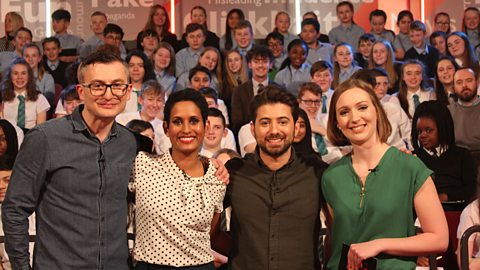
Watch again: Live Lesson video clips
This set of shorter video clips is taken from the Live Lesson programme and can be used to teach individual topics.
Setting
Naga Munchetty:
Now, it's time to begin exploring the first of our story building blocks, remember which one it is? Setting. Frank, it's time to be quizzed.
Frank Cottrell Boyce:
Okay.
Naga Munchetty:
Okay, so, can you explain what a story setting is, and why it's so important?
Frank Cottrell Boyce:
A setting is where your story happens, and a setting will give the audience some idea of what's gonna happen in the story. So if a story's set in the middle ages, we're gonna expect dragons and knights, if it's set in a graveyard, we're gonna expect ghosts and bumps in the night and things like that, and a setting is somewhere that you should enjoy to be in your imagination, even if it's quite scary. So, even though there are dementors and orcs, we all would quite like to be in Hogwarts or [middle Earth].
Naga Munchetty:
So where's a good place then to start when you're trying to think of a setting?
Frank Cottrell Boyce:
Well if your audience is gonna believe in your setting, you have to believe in it too, so I think a really good thing that I do is, I take somewhere that's very familiar to me, and then I give it a twist. So I imagine my house, or my school, maybe set in space, imagine what your classroom would be if it was weightless.
Naga Munchetty:
So be familiar, but also, one of the things the 500 words judges are looking for is originality, isn't that true, Malorie? So, you might want to do something different with your setting, be creative, try to make your everyday setting standout.
Barney Harwood:
Okay, roll up, roll up, Frank and Naga, come and join me as we're about to play our first game at the 500 words funfair. Thank you very much, I'm gonna stop the voice for now. For this section, you're gonna need activity sheet one at the ready, have you got it? It looks like this, good. Now, this game is about creating original settings, and to help us with it, we've got a surprise for you, a very, very special guest.
Naga Munchetty:
He has worked with some of the greatest stories ever. He's worked with Lord of the Rings, Batman, Harry Potter, Marvel's Avengers, I like that one.
Barney Harwood:
I'm Iron Man.
Naga Munchetty:
Iron Man?
Barney Harwood:
Yeah, I want to be.
Naga Munchetty:
Yeah, I can see that. Doctor Who, and of course, Star Wars. Please welcome the head of design at TT Games who produces Lego video games, let's welcome Arthur Parsons. [APPLAUSE]
Naga Munchetty:
Hello.
Barney Harwood:
Arthur, so good to see you, so tell us about your job, you're a games designer, it sounds quite simple, but there's a lot involved.
Arthur Parsons:
Yeah, it isn't just playing video games, unfortunately. No, what we do is, so we'll take if it's an existing story, so like when we made Lego Harry Potter, we'll take the settings that already exist, which are fabulous, and then we'll mix those with the emotions that we want you all to experience we'll you're playing to really make the best game play we can. But if it's an original game, say like Lego dimensions, Lego Marvel, we'll actually make up the story, but we'll start with the settings. We'll pick the best settings, and again, we'll then look at, you know, what we want people to feel while they're playing, and really try to make what's the best game we possibly can.
Barney Harwood:
So how important would you say a writer's description of a story setting is, and once you've got it, what do you do with it?
Arthur Parsons:
Oh, it's vitally important to us and to the team because, you know, the setting is where it all kind of starts. And then we'll be sort of looking at, you know, what do we want the player to feel? Do we want them to be excited or do we want to be scared? You know, maybe a little bit of [UNSURE OF WORD]. So we'll kind of mix those together, really helps us sort of design the game play and so, you know, take Lego Batman, we had a funfair, not too dissimilar to this, and we wanted players to feel a little bit scared, but also excited. So, we took the setting of a fairground and made it [UNSURE OF WORD] and rundown where nothing's quite as it may seem. And, it made for some really standout game play moments, settings are so important.
Naga Munchetty:
It's fascinating all of this, so, I think we're gonna take what you do, and, let's challenge Frank, I think, are you ready, Frank? We're gonna get Frank to to turn an ordinary setting into something completely different, and in order to do that, we need to play a game, you up for a game?
Arthur Parsons:
I'm always up for games.
Naga Munchetty:
Always, always. So we're going to play our very own 500 words, Hoopla.
Barney Harwood:
[It's so good]. So, here we have three everyday places, we've got a train, a forest, and a home. And Arthur, we need your help. We want you to hoop one of the [UNSURE OF WORD] please. Now, to make this a little more interesting, Arthur, we'd like you to close your eyes, okay? 'Cause you are very close.
Arthur Parsons:
Okay.
Barney Harwood:
And then, Frank, you can come up with an on-the-spot idea of what you would do with that setting to make it different, and, of course, original. Okay, ready?
Naga Munchetty:
Okay, so you've picked your hoop, you're limbering up the shoulders, ready?
Arthur Parsons:
Yep.
Naga Munchetty:
Let's build this up for you.
Barney Harwood:
Close your eyes, please.
Naga Munchetty:
Ready? You've picked one.
Barney Harwood:
Not that way.
Naga Munchetty:
Okay, ready?
Arthur Parsons:
About here, yeah?
Barney Harwood:
Yeah, ready?
Naga Munchetty:
Go.
Barney Harwood:
Ah, unlucky, have another go.
Arthur Parsons:
I'm so bad at this.
Barney Harwood:
Thank you, Malorie, beautiful assistant, Malorie Blackman. Here we go, go for it.
Barney Harwood:
Wow, what an amazing shot.
Naga Munchetty:
That was a great throw.
Barney Harwood:
Can you believe that, with his eyes closed and everything. So, Frank, how would you turn a home into a different setting and make it original?
Frank Cottrell Boyce:
Right, so home is familiar, it's something that I know, but I wanna twist it so it could be under the sea or it could be made of gingerbread, but what about this, what about people say that the eyes are the windows of the soul, so what if it's my home? What if I imagine my front room, bu it's inside somebody's head, and a soul is looking out through the windows of my eyes.
Barney Harwood:
That's so cool.
Naga Munchetty:
I'm there.
Barney Harwood:
I am there.
Naga Munchetty:
I'm there.
Barney Harwood:
My granddad's got big glasses, does that mean he's got double glazing in his house?
Frank Cottrell Boyce:
Double glazing for the soul. [LAUGHS]
Barney Harwood:
Well done, that was funny.
Naga Munchetty:
Very imaginative, wondering if you can top that 'cause we still have a forest and a train left, which would you go for, Arthur? What would you do with it?
Arthur Parsons:
I'd have to pick a forest I think.
Naga Munchetty:
Okay.
Arthur Parsons:
And then, you know, say we wanted the player to, I don't know, feel lost and alone out in this forest. But, it's not a forest with trees and planets, let's think of a forest where, say the growth that you get in a forest and the movement you get in a year, is happening every second, so everything's alive and moving. And, say it was brightly coloured as well, so like corals, so it's all very, very alien and it's shrinking and growing and moving and, that'll be a great place to play a game in. Forests are brilliant, I think you could do anything with a forest.
Barney Harwood:
Now, when you first arrived at the funfair today, I asked you to close your eyes and think of one word. Now that word is really important, and this is where it becomes important, Frank, tell us why.
Frank Cottrell Boyce:
Because, that purpose that you've got, whether it's to frighten or to make people laugh, keep thinking about that when you choose your descriptive words. So, say you've got Arthur's forest, but you want a scary story, then make sure you say the forest is dark and shadowy and eerie. Or, if it's a funny story, or a magical story, may say it's shimmering and golden and amazing, or whatever. So choose all those words that go back to that purpose, but don't waste words, you've only got 500 words, so don't use words that you don't need, don't say it was a huge mansion, because all mansions are huge. But if there's something surprising, then use the words. So you could say, there was a tiny mansion, nestling in the root of a tree.
Barney Harwood:
Really clever. And remember that one of the criteria for judging the competition is language, isn't that right, Malorie? So beautiful. So that's a good tip, if you're writing these things down, that's a really good one to write down, don't waste your words.
Naga Munchetty:
Absolutely not. Now, it is time to let your imaginations run wild. Everyone, get in pairs, choose one of these three ordinary locations, remember, we had a train, a forest, or a home, so then think about how you could make this setting original. Where else could it be? How would it look?
Barney Harwood:
Teachers, remember to send your class' ideas in please, details are on the screen below. You've got 30 seconds for this, are we all ready?
Audience:
Yes!
Barney Harwood:
Are we all ready? Louder than that.
Audience:
Yes!
Barney Harwood:
Go!
Naga Munchetty:
Let's go!
Naga Munchetty:
It goes so quickly, doesn't it? I can hear all the ideas still being mulled around in the audience. Right, with me now is Mickle, and Abdul, and they've come up with their idea. So, Mickle, what did you choose?
Mickle:
Oh, well, we chose a train.
Naga Munchetty:
A train? What does it look like?
Mickle:
Well it's shaped as a tree, 'cause it's like a tree train where the destinations are the moon, and, the person who drives the train is a fox, and it has woodland creatures and stuff as passengers.
Naga Munchetty:
Abdul, what else can you tell me about it?
Abdul:
Basically, while they're travelling there, some martians jump onto the tracks and they can't speak English so, they have to try and tell them with sign language to try and get them off the tracks.
Naga Munchetty:
There are so many ideas here, Frank. So you've got communication, you've got travel, so much to think about.
Frank Cottrell Boyce:
I love that, I mean, it's so out there and it's brilliant. And you, I think, start to ask yourself questions like, why are they going to the moon? And what do the martians want?
Barney Harwood:
Yeah, some people say those ideas are bark-ing, but I think they're oak-ay. Arthur, how would you picture that setting?
Arthur Parsons:
I think that's amazing, a tree train, driven by a fox? All that was going through my head was, he's going to the moon, how's the fox gonna breathe? Forget the communication, but, has he got an astronaut's helmet? Or has he got some other device? I think it's amazing.
Barney Harwood:
Brilliant. Some great work there, everyone. We've also had lots of ideas from original settings, from our virtual audience, they're real people. Bankier Primary School, from Bonnybrdige, hello. Rachel's setting is a house on a lake, and the house is surrounded by underwater tigers. That sounds terrifying. Frank, what do you think?
Frank Cottrell Boyce:
It's great. I mean, what do the tigers want? Are they good tigers? Are they bad tigers? Do they live there? Are they on a visit? Are these the tigers who came to tea?
Barney Harwood:
Nice. Arthur, what do you think?
Arthur Parsons:
I think it's amazing. I was just sold on underwater tigers. That is just phenomenal. It's like, you know, you've got seahorses, but underwater tigers, that's brilliant.
Barney Harwood:
Tigers with snorkels on is less scary though, isn't it, really? Okay, next one, let's have a look. Our setting includes a train going back to the Jurassic period, and a small and tiny home in a desert. That's year two, Holy Family Primary School in Preston. What do you think, Frank?
Frank Cottrell Boyce:
I love the Jurassic train, is it going there on purpose, or has that just been diverted to the Jurassic period?
Barney Harwood:
Arthur?
Arthur Parsons:
Yeah, absolutely. I'm just kinda thinking, what does the train look like? If it's going to the Jurassic period, is it sort of like a classic, you know, sort of 40s carriage? Or, is there something really, really sort of fantastical about the actual train itself? That's got me hooked straight away.
Barney Harwood:
Amazing. We've got time for one more. From Holmer Lake Primary School, sugary underground forest, already like this, where the leaves are toffee, and the trees are bubblegum. Hands in the air if that's a setting you wanna be in. Oh, yes. Frank, what do you think?
Frank Cottrell Boyce:
'Cause that's what I said before, you want a story where it's somewhere that you want to be, and I really wanna be there.
Barney Harwood:
Just over your shoulder, I saw Malorie licking her lips there.
Frank Cottrell Boyce:
Yeah, she's licking her lips.
Barney Harwood:
Arthur?
Arthur Parsons:
Yeah, I think that's brilliant. It's, just straight away, that word "sugary underground forest," so I'm kind of seeing there's like sweets dripping down from above you and everything. I am absolutely in there.
Barney Harwood:
I'm totally there. Boys, thank you very much, some great tips there. So think carefully how your setting can help to enhance your story. And, remember, these are just examples, and now that we've used them of course, they're not so original anymore.
Naga Munchetty:
Sugary leaves, toffee leaves, lovely.
Setting
Learn all about settings in this clip with Frank Cottrell Boyce and games designer Arthur Parsons.
Your class will need these downloadable activity sheets:
Character
Naga Munchetty:
Let's continue with it, shall we? We'll delve into the heart of any story and take a look at characters. For this section, you'll need activity sheet two ready.
Barney Harwood:
Got it? Good. Now, characterisation is one of the key judging criteria in the 500 words competition, Frank, if you could point to that for us, please. Beautifully done, just not as beautiful as Malorie. Malorie, let's talk about characters, it sounds like an obvious question, but why are characters important?
Malorie Blackman:
Well, your main character is who your story's about, and, that character gives your story a voice, and it's the eyes through which we're gonna see the world that you create. So you need to bring your characters to life so the audience connects with them. So a character is more than just their appearance, it's important to understand how the character feels and how the story effects them.
Barney Harwood:
Now this sounds a lot like acting, so, it's perfect that we've got one of the best with us here today to help us with our next game.
Naga Munchetty:
He's all grown up since you first saw him as Neville Longbottom in Harry Potter, he's played many different characters, on stage, and on screen. You guessed who it is yet?
Barney Harwood:
She has.
Naga Munchetty:
Ooh, it's Matthew Lewis, everyone! Let's give him a big round of applause. [APPLAUSE]
Naga Munchetty:
Hi, Matthew.
Barney Harwood:
Matthew, hi.
Matthew Lewis:
Hello.
Naga Munchetty:
Hello, lovely to have you with us. You know, as an actor, I think when you first get a script, what do you think you need to know? You absolutely need to know to get into character?
Matthew Lewis:
Well, there's a few questions that you need to ask yourself very early on. First of all, who, or what, is the character that you're being asked to play? I mean, it could be a wizard, for example, or a solider, a policeman, or even, something not even human. You could be playing an alien, a monster, or animal, and so those things are very, very important as a basis to learn. You need to know the history of the character, how has he ended up in this situation, that the film or play is requiring for him? What's his world view? What's happened to him in the past that have shaped his opinions? You're gonna want to know things like how he moves, or he acts, the actual physicality of the role, the body language of a character can quite often really help you embrace his emotions and his feelings, and that can really come through in the line. And then finally, quite simply, what accent does he have? How does he talk? How does he speak?
Barney Harwood:
Now a huge part of a character is what they say and how they say it, so, Malorie, from a writers perspective, why is dialogue so important?
Malorie Blackman:
Well dialogue isn't necessarily just what your character's saying, it's also how they say it, and also sometimes what they don't say, and all of that can show you how a character feels.
Naga Munchetty:
Let's think about a line of dialogue perhaps, Matthew, that you had, that was really important that you needed to show off a character, can you think of one?
Matthew Lewis:
Yeah, I mean, fortunately I've had quite a few over the years, but, I remember, many years ago on Harry Potter and the Chamber of Secrets, Neville says, "why is it always me?" Which, when you read the line in the script, it sort of was quite a throw-away line, but when you add the context to it and you think the situation he's in, at that moment, Neville had just been lifted up by his ears and hung from a chandelier, so he was pretty down on his luck. And he's also talking to his three sort of closest friends, Harry, Ron, and Hermione, so he's able to be a little bit more vulnerable with them than he necessarily would've been with other people he didn't know quite as well. And the fact that he says, "why is it always me?" It's so loaded with history because, he's there showing to the audience, that this kind of thing happens a lot to Neville, he's always the butt of many jokes and, if anyone's gonna pick on someone in the class, it's gonna end up being him. There's so much history there in that one, very, very throw-away line.
Naga Munchetty:
Do you know, I can see you doing, you performing that line right now in the show, can you?
Barney Harwood:
It's all about amazing acting, that.
Naga Munchetty:
It is.
Barney Harwood:
Award-winning performances.
Naga Munchetty:
This is all good, because in our next game, we want to do, just that, we want to build a character based on just one line of dialogue, and we're going to use our 500 words funfair, character coconut shy.
Barney Harwood:
Very good.
Naga Munchetty:
Matthew, are you ready to have some fun?
Matthew Lewis:
I'm slightly nervous, but yeah, we'll have a go.
Naga Munchetty:
Yeah, you can be nervous, there is a little basket there with some little beanie bags. And, here, we have our three coconuts, and each one has a different line of dialogue attached to it. So, you get to choose one, anyone you want, and then you're gonna throw your beanie bag and hopefully hit one.
Matthew Lewis:
Hopefully.
Naga Munchetty:
Hopefully, and knock it over to reveal the line of dialogue.
Barney Harwood:
He doesn't seem too confident, shall we move this way a little bit?
Naga Munchetty:
Ready?
Matthew Lewis:
Yeah. [LAUGHS]
Naga Munchetty:
Yeah, I might move a little.
Matthew Lewis:
Thanks, thank you.
Naga Munchetty:
I think drum roll, maybe? Let's get you in the mood, shall we? Here we go.
Matthew Lewis:
You ready?
Naga Munchetty:
Oh, and we've got the tapping of the legs. [APPLAUSE]
Matthew Lewis:
First shot, just amazing.
Naga Munchetty:
Good throw, good throw. And let me reveal what it says.
Matthew Lewis:
I can see you.
Naga Munchetty:
That's your line, I can see you.
Barney Harwood:
That's good.
Matthew Lewis:
I can see you.
Barney Harwood:
Okay, so now that we've got our line of dialogue, we need to design a character around it. So Malorie, where do you begin?
Malorie Blackman:
Well, there's some key questions to think about when you're creating your character, so let's come back to that one word we thought of before, the word that describes the purpose of our story. Now, I want this story to be scary. So, thinking about the purpose, we can start to build a character around that line of dialogue, I can see you.
Barney Harwood:
Okay, so, Naga, we're gonna take you through the questions, and Malorie, you can tell us what the character's all about.
Naga Munchetty:
Okay, so let's look at the next one, it's who or what the character is.
Malorie Blackman:
How about an old man, who's crouching over, 'cause he's found something very small, but magical, in the sand and it's a living creature.
Barney Harwood:
It's all yours, Matthew.
Matthew Lewis:
I'll do this, shall I?
Naga Munchetty:
Yeah.
Matthew Lewis:
Okay. An old man? Okay.
Naga Munchetty:
An old man.
Matthew Lewis:
Got a bad back, you see?
Barney Harwood:
Okay, a round of applause for old man acting there. [APPLAUSE]
Matthew Lewis:
Thank you.
Barney Harwood:
You're watching a professional, everybody. How does the character feel, Malorie?
Malorie Blackman:
I think he'd feel quite excited 'cause he's found this creature that he doesn't recognise, and maybe quite a bit powerful as well.
Naga Munchetty:
Okay, so we've seen the emotions and we've seen what the old man looks like, but how does the character move, or act?
Malorie Blackman:
Let's have him a bit bossy, and teasing, maybe he's just teasing this creature, maybe there's a bit of spite in there.
Barney Harwood:
Okay, and what about where the character is? Where is he doing this?
Malorie Blackman:
Oh, let's have him on a beach, definitely.
Barney Harwood:
Oh, I can help with that.
Malorie Blackman:
And it's on nice, hot, sunny day.
Naga Munchetty:
Sunny, sunny day.
Barney Harwood:
Is it a sunny day?
Naga Munchetty:
Yeah.
Barney Harwood:
Beautiful.
Naga Munchetty:
You were hoping it was a sunny day today.
Matthew Lewis:
There we go.
Barney Harwood:
I had this prepped, there you go, Matthew.
Matthew Lewis:
Now I'm on a beach, there we go.
Barney Harwood:
I want those back.
Naga Munchetty:
Very cool glasses.
Barney Harwood:
Yes.
Naga Munchetty:
Who's the character speaking to, Malorie?
Malorie Blackman:
How about a baby dragon?
Barney Harwood:
Why not?
Malorie Blackman:
Ooh, how 'bout that. And, the baby dragon's trying to hide, and our old man can say…
Matthew Lewis:
I can see you.
Malorie Blackman:
Only to have someone or something behind him echo the words…
Matthew Lewis:
I can see you.
Malorie Blackman:
When he turns around and sees the dragon's mother who is as tall as two double-decker buses.
Barney Harwood:
As tall as two double-decker buses?
Malorie Blackman:
Yes.
Barney Harwood:
Hang on.
Matthew Lewis:
Better, that's better. I'll go down.
Barney Harwood:
Brilliant, so now that we know how to design a character, we want you to design your own character around the same line of dialogue, I can see you.
Naga Munchetty:
Right, using the character chart on worksheet two, write down the line of dialogue "I can see you," and then fill in the chart.
Barney Harwood:
I'm staying here as mummy dragon. And remember to think about that one word you thought of earlier, how do you want the read to feel? Try and be as creative as you can, you've got 60 seconds, are we all ready? You ready? Go.
Naga Munchetty:
Go.
Barney Harwood:
Let's see how we've got on. Lilia and Violet, hello, welcome to the show. So let's talk about what you've come up with.
Lilia:
So we have a human-looking alien, that is on the run from galactic police after being framed by his mother.
Barney Harwood:
Standard. Okay, what else?
Violet:
So, he was framed because of loads of planets kept crashing, loads of like, ships from other planets kept crashing into their planet, and his mum had fairy lights, and that kept the lights on so that the planets wouldn't crash into it.
Barney Harwood:
Very clever, big fairy lights to go around a planet.
Lilia:
So he is talking to a tree, because he think that he is from another planet and thinks the tree's hiding, because all the aliens in his planet look like trees.
Barney Harwood:
And he says "I can see you," to the tree?
Lilia:
Yeah, he says "I can see you," to the tree.
Barney Harwood:
Okay, a lot of tree themes today, what do we think?
Malorie Blackman:
Oh, I love that, it's really quirky, isn't it? And I love the idea of an alien that looks like a tree, that is absolutely brilliant, I love it.
Naga Munchetty:
What about the idea, Matthew, of the mean mum framing her son?
Matthew Lewis:
That's brilliant, it's like a great tragedy or something very Shakespearian, I think it's brilliant, amazing imagination, it'd be quite fascinating to play as a character. The freedom that you have playing other-worldly being, who's probably quite uncomfortable in a human skin, I imagine, that would be a lot of fun.
Naga Munchetty:
See, I can see your mind working now, you're building him and making him almost real.
Matthew Lewis:
It's fascinating.
Naga Munchetty:
It's brilliant. We've had lots of ideas come in from classrooms around the UK, let's show you some of 'em. This is from Roseacre Primary Academy, which says that Calum's character is a robot that speaks in Spanish, and his friend is a hedgehog who translates in any language, and they're both a bit naughty. Matthew, would you like to play the robot or the hedgehog?
Matthew Lewis:
I think the hedgehog, yeah.
Naga Munchetty:
How are your language skills?
Matthew Lewis:
Yeah, not so great, I might need some work on the language, absolutely. But, again, you get to do, try all different accents out from around the world, it'd be a lot of fun.
Naga Munchetty:
Malorie, what would you do with this?
Malorie Blackman:
I think I'd want to know what kind of robot it looks like, does it look sort of humanoid? Is it a robot dog? Or is it some kind of animal? That might be quite fun.
Matthew Lewis:
Yeah, there's lots of scope there, let's see what else has been coming through as well. This is year two at Leamore Primary School in Walsall, which, says a triple headed rhino teacher in Space School on the Planet Zorg, the heads are always arguing about who is correct. Malorie, you love this.
Malorie Blackman:
Oh, I love it, I think that's absolutely brilliant, and now I wanna know kind of, does she ever get any teaching done, or does he get any teaching done? Or are the heads always arguing, and what do they argue about? That could be really funny.
Matthew Lewis:
And that's great, and would you get three different actors to play the three different heads? And have they always been arguing for their whole life? Always tryna get ahead of the other two.
Naga Munchetty:
[LAUGHS] Well done, your jokes are almost as bad as Barney's. Let's take one more look at another comment, Toby and Leo at Shute Primary School, have said a scuba diver, who is a Brummie with an ill-fitting scuba suit, is stuck in a fish tank, he's very scared, he was placed there by an evil crocodile. Doing scared, Matthew.
Matthew Lewis:
Yes. I mean, anything with a Brummie accent's gonna be good anyway, it's gonna be a lot of fun.
Naga Munchetty:
Have you got a good Brummie accent?
Matthew Lewis:
No, mine's dreadful, you wouldn't wanna hear mine at all. I mean, that might be where a lot of humour would come from, me tryna do that. But, yeah, playing as scared from an evil crocodile, that'd be a lot of fun.
Malorie Blackman:
I know, I like the idea of him trying to maybe out-wit the evil crocodile and get out of that fish tank, so you've got your plot right there, haven't you?
Naga Munchetty:
It's a huge fish tank as well, isn't it?
Matthew Lewis:
What made the crocodile evil? That's what I want to know, I need the history behind that.
Naga Munchetty:
Yeah, absolutely. There is so much here going on, look, we've had some great advice, Matthew, thank you so much, I know your time is tight, you're very busy, you took time to spend with us, and for that, we're very, very grateful. Let's give Matthew a big round of applause, he's gotta leave us. [APPLAUSE] Matthew Lewis.
Character
Malorie Blackman and actor Matthew Lewis help you create your very own character in this clip.
Your class will need these downloadable activity sheets:
Plot
Barney Harwood:
Now it's time to look at our third story building block in today's 500 words live lesson, that's, the plot. Love that. And for this section, you'll need activity sheet three, have we got that? Beautiful. So, Malorie, let's start by talking about the plot, what is it?
Malorie Blackman:
Well, a plot isn't just a series of events, those events have to be connected. So, for example, the school laptop went missing, I got accused of stealing it, it's a bit, meh, but how about, the school laptop went missing, I got accused of stealing it, but I saw who had really taken it, it was my best friend. And instantly, we've got a plot, because am I gonna tell on my best friend and perhaps lose that friendship forever? Or am I, am I gonna take the blame and maybe get excluded from school?
Barney Harwood:
Malorie, I could listen to you all day telling me stories, could you record your voice so it plays when you're reading one of your books, that would be amazing. And, Frank, how do you begin creating a story plot?
Frank Cottrell Boyce:
I take the first thing I've got, like the setting or the character, and start to ask questions. So, like, what would be the worst thing that could happen to this person? What could be the most surprising thing that would happen in this space? So, for instance, imagine that I've got a character who's on the International Space Station, tens of thousands of miles above the Earth, all alone, and then suddenly, there's a knock on the door.
Barney Harwood:
It's Tim Peake, he forgot his sandwiches, no? Well that does lead nicely into our third and final game, we're gonna be giving you some tips and tricks on how to create an interesting plot, and what we're gonna do is this, take a well-loved story, the story of Jack and the Beanstalk, and give it a little twist. So here's a quick remind of what Jack and the Beanstalk is all about.
Narrator:
Poor Jack and his mum have no money, so Jack swaps their only cow for some magic beans? Doh! Surprisingly, this doesn't go down too well with his mum. Raging, she throws the beans out of the window! But then they grow into a giant beanstalk. Jack climbs it, and sees a giant snoozing, a goose that lays golden eggs, and a golden harp. Seeing an opportunity, Jack steals the goose and the harp, and makes a break for it. He rushes down the beanstalk with his loot, but the giant wakes up. Jack and his mum go to cut down the beanstalk as the giant follows him down, and the giant falls to the ground. And funnily enough, no one sees the giant ever again. Jack and his mum live happily ever after with a lifetime supply of golden eggs. [APPLAUSE]
Barney Harwood:
So, everyone remembers the story, yes? Good. Okay, to help us with our next game, we've got enough super special guest with us here in the studio.
Naga Munchetty:
Who? Who? Who?
Barney Harwood:
Well, funnily enough, he played Jack in Jack and the Beanstalk, in BBC One's Roald Dahl's Revolting Rhymes. And teachers, you might recognise him from film and TV, it's only Isaac Hempstead Wright, everybody, a huge round of applause. [APPLAUSE]
Naga Munchetty:
Hello.
Isaac Hempstead Wright:
Great, how are you?
Barney Harwood:
Isaac, welcome to this 500 words wonderful world of fun. So let's start by talking about Jack, what was it like playing him?
Isaac Hempstead Wright:
It was great fun. I mean, I've obviously grown up with all of Roald Dahl's stories as a child, so, to get to play one of his beloved characters was a lot of fun for me.
Barney Harwood:
Well the plot in Roald Dahl's version of Jack and the Beanstalk is actually wildly different to the traditional one that we've just heard about. Can you tell us a bit about it?
Isaac Hempstead Wright:
Yeah, it certainly is. So, Roald Dahl wanted the purpose of his story to be funny, so he shifted the focus onto the fact that, you know, a minute detail from the original story was that the giant could smell Jack. So, Roald Dahl said, right, let's make the emphasis on the fact that the giant can smell Jack, and all he needs to do is take a bath, and then he can get away with nicking all the gold.
Barney Harwood:
Was that what you were hinting at earlier when you sent me that text say "fee-fi-fo-fum?"
Naga Munchetty:
It wasn't a hint.
Barney Harwood:
Oh, I do apologise, I'll stand over here.
Naga Munchetty:
He didn't pick it up.
Barney Harwood:
I need a bath.
Naga Munchetty:
Again, then, what you picked out there, Isaac, was that the purpose of the story, so in Roald Dahl's case he wanted it to be funny. So, today, what we've decided to do is take Jack and the Beanstalk, and put a spin on it. You'll see, spin's gonna work, look what I'm doing. We're gonna use our wonderful 500 words, wacky wheel.
Barney Harwood:
Isaac, are you ready to play?
Isaac Hempstead Wright:
I am.
Barney Harwood:
Course you are, that's why you're here. On our wheel are five questions that you can use to explore your own ideas and develop your plot. They all revolve around the question, what if. So, what if the worst thing happened?
Naga Munchetty:
What if the best thing happened?
Barney Harwood:
What if you told the story in a different way, like in text, or in newspaper clippings, or in a different order?
Naga Munchetty:
What if you change the point of view? You know, I think, we could've told this story from the giant's point of view, because no one has sympathy for this giant. He was robbed, he was robbed!
Barney Harwood:
That's a fair point, that's very fair, that could be an idea. What if nothing is what it seems? Like, Jack's one of the toys in your bedroom, and maybe you're the giant.
Naga Munchetty:
There are lots of ideas, Isaac, would you do the honours, please? And spin the wheel for us, and depending which question it lands on, Malorie and Frank, you're going to have to use the question to put a new spin on Jack and the Beanstalk. Let's do it, Isaac.
Barney Harwood:
Okay.
Isaac Hempstead Wright:
What if the best thing happened?
Naga Munchetty:
What if the best thing happened?
Barney Harwood:
So, how would you take that and put a spin on Jack and the Beanstalk?
Frank Cottrell Boyce:
Okay, 'cause the giant wants to eat Jack, yeah? So what if the giant suddenly became a vegetarian, and didn't wanna eat Jack at all, just wants to have dinner with him?
Barney Harwood:
And they eat the beanstalk.
Frank Cottrell Boyce:
Yeah.
Barney Harwood:
Done.
Malorie Blackman:
What if Jack, all the way through the story, you think Jack's trying to escape, but actually, he wanted to get caught, and then you have to explore why he wanted to get caught.
Naga Munchetty:
Perhaps he wanted to make friends.
Barney Harwood:
You two should be writers, you're amazing at this.
Naga Munchetty:
Yeah, have you thought about that? Shall we have another go? Isaac, would you spin again?
Barney Harwood:
Okay.
Naga Munchetty:
Okay. What if you told the story in a different way, Frank?
Frank Cottrell Boyce:
Okay, so what, instead of it being a fairy story, what if it was a gardening programme with Alan Titchmarsh on the telly, talking about how to get giant beanstalks to grow?
Naga Munchetty:
Lots of fertiliser.
Frank Cottrell Boyce:
Loads of fertiliser and then the giant appears.
Barney Harwood:
Amazing.
Malorie Blackman:
I think, yeah, how about if the giant was a robot? And maybe it was the giant's wife, has set the whole thing up with Jack and it's revealed at the end that it's a giant robot, and not a real giant at all.
Barney Harwood:
That's amazing, [it's not like] any Jack and the Beanstalk I've ever heard of.
Naga Munchetty:
No.
Barney Harwood:
Now we want you guys here in the audience, and of course, you back at school to do the same thing. Using activity sheet three, in pairs, can you choose one of the what if questions from the wacky wheel, and think about how you would use this to put a new spin on the classic Jack and the Beanstalk story.
Naga Munchetty:
You're not gonna have long, so make the most of your time.
Barney Harwood:
It's not long, is it?
Naga Munchetty:
No, you've got 60 seconds to do this.
Barney Harwood:
You've already started, haven't you?
Naga Munchetty:
Time to get your thinking caps on, teachers, as always, you're our eyes and ears, they've started already. You can get in touch using the details.
Barney Harwood:
You've already started, you should start too. Go!
Naga Munchetty:
Go!
Naga Munchetty:
This place is buzzing with ideas, even after 60 seconds. With me now is Isabelle and Edy, and, let's find out, Isabelle, what you chose.
Isabelle:
Well, we chose, what if nothing is actually as it seems.
Naga Munchetty:
Okay. Edy, what did you come up with?
Edy:
Well, basically, he's joking about being poor.
Isabelle:
He's a thief, and he's found in the middle of the giant's house with his hat, holding a goose and a bunch of things that he'd stolen, and so he gets arrested.
Edy:
And then he goes to the giant court of justice and is sentenced for three years and then has to do community service.
Naga Munchetty:
I love it. I love the fact that the sentence is that, and there's a giant court of justice. How would you imagine that?
Frank Cottrell Boyce:
I love the idea of Jack and the Beanstalk as a crime thriller. DCI on the case and, oh, that's so good, a really good idea, that's a really different way of telling the story.
Malorie Blackman:
It is, isn't it? And I love the courts of justice, I mean, and a whole trial going on, that'd be really good.
Barney Harwood:
Isaac, would you play Jack in that story?
Isaac Hempstead Wright:
Definitely, I love the idea of a whole other giant realm where you've got the giant court of justice [UNSURE OF WORD].
Barney Harwood:
Amazing. We've had some great ideas from our virtual audience, they're real people, let's take a look. Jack is unable to sell Daisy the cow, so Jack takes her back home. They're still hungry, so they have a-- [LAUGHS] Absolute genius. And they have a big barbecue and they eat her. Stonehenge Class, St Barnabas Primary School, you get my vote. Frank, what do you think?
Frank Cottrell Boyce:
Stonehenge Class, you've won the day, the day belongs to you. [LAUGHS]
Barney Harwood:
Poor Daisy. Malorie?
Malorie Blackman:
Well I love the idea, it kinda closes down your story a bit, so they need to get the beans in somehow shape or form. But, the poor cow, I feel sorry for the cow.
Barney Harwood:
I know, I have to say here, on behalf of the BBC, if you are a vegetarian, udder meals are available. [LAUGHS]
Frank Cottrell Boyce:
You really milked that one.
Barney Harwood:
Okay, well that was good, you can have that, high five, well played. That's how quick you are. Okay, our is, "What if the worst thing happens?" This is from Erin from St Thomas CE, hi, Erin. When the giant falls, Jack and his mum are squished. Well that would soon finish the story, wouldn't it? What do you think?
Frank Cottrell Boyce:
It's not gonna be 500 words, is it?
Barney Harwood:
No, not quite.
Frank Cottrell Boyce:
Unless you were really falling in slow motion.
Barney Harwood:
Yeah. [LAUGHS] If it's just "aah!" Break. "Aah!" Malorie?
Malorie Blackman:
I love that actually, it's kinda quite gruesome, isn't it? So, maybe the giant's wife set it up, that's her way of killing them. So she pushed the giant off to squish them.
Barney Harwood:
Yeah, and since the beans were laid, the beanstalk has grew some. No? Okay, moving on, that's not a funny joke. Isaac? The best that could happen to Jack was if he was half way up the beanstalk and discovers that there is a magic button to turn it into an escalator. What do you think of that one?
Isaac Hempstead Wright:
I think that'll be great. He could then turn around and see his mum's already on the escalator going, "why are you climbing up?"
Barney Harwood:
Amazing. Frank?
Frank Cottrell Boyce:
Yeah, you could get loads of people [UNSURE OF WORD], this is very Roald Dahl, isn't it? It's Charlie and the Great Glass Elevator. Great grass elevator.
Barney Harwood:
Amazing. Thank you very much for that. Some great ideas, everyone. Now these questions are a great starting point to develop your plot once you've got an idea for your story.
Naga Munchetty:
But, remember, there are many ways to think about a plot, it's all up to you, it's your story, do it how you wish.
Plot
Frank Cottrell Boyce, Malorie Blackman and actor Isaac Hempstead Wright help you come up with new ideas for your story plot.
Your class will need these downloadable activity sheets:
Your questions answered
Barney:
So, you know how when school finishes and you have those extra classes after school, that's kind of what this is now, because we just didn't get a chance to ask all of your questions to Frank and Malorie throughout the live lesson, so let's do that now and see how many we can get through. Okay, let's take a look, we have so many people getting in touch. Kianain Class P6B at New Elgin Primary, what was your favourite subject at school and do you need to be good at writing, in school, to be an author when you grow up?
Malorie:
Well, my favourite subject was English. I love, I absolutely loved English, I love reading. Do you have to be good at writing at school? I think you have to have a love of reading and a love of books and a love of language definitely but as far as spelling and so forth is concerned, I mean, that's really good but you do have spelling checkers etc but you can still learn, know the basics but they're, that's not as essential as just having that love of reading and that love of creating stories.
Barney:
I guess if you wanna be a musician you've gotta wanna play the instruments haven't you?
Frank:
Yeah, you've gotta like playing with words I think.
Malorie:
Exactly.
Barney:
Yeah.
Malorie:
My favourite subjects were, I liked all the science subjects, I especially loved biology but I, and partly I think it was the words that are in there, you know, finding that there are things that you can't see that have got names and words for them. So, playing with words I think. I don't know about being good at writing but loving words I think is a good thing.
Malorie:
And I think also you need to have a love of just everything that you're doing. I mean I was, I liked chemistry and it all serves your writing, that's the point.
Barney:
You two have a great chemistry, actually. It's [UNSURE OF WORD], everyone can see. Okay, next one. Year 4 at St Anne's Primary School in Grantham. Sometimes we struggle to show how our characters are feeling in an interesting way, can you help us?
Malorie:
Wow. That's a very good question.
Malorie:
That's a good question, isn't it? Gosh. And you're right because the thing is, you don't wanna be always just telling people how your character feels, you need to show how your character feels and there's a difference and when, in writing one of the things I got taught, first of all was show, don't tell. So, you know if your character is sad don't just say I'm, you know, so and so was feeling really sad today, show it, how does that? You know are they bent over? Are there tears trickling in their eyes? Are they kind of, their shoulders drooped?
Frank:
Yeah, think of the ways that you show your feelings, you don't just say I feel angry now, do you? You bang a table and you walk out of the room or you don't eat your food or something like that, so go back to what you do.
Malorie:
Yes, exactly.
Barney:
Okay, next one. This is from Year 6 at St Mary's in Swinton. How can we put a twist? Everyone likes a twist, don't they?
Frank:
Yeah, yeah.
Barney:
But how do you put a twist into a story?
Malorie:
Another—
Frank:
I wouldn't think too hard about twists, cause sometimes we see stories in 500 Words that everything is heading towards that twist, don't worry too much about the ending. A story can be entertaining on the way, so don't, I mean a twist is an amazing thing if you can get it right, but don't worry too much about it.
Malorie:
I'd echo that actually. Not every story has to have a twist and sometimes it can just be beautifully written and real emotion in it and that's gonna grab us as well so, but if the story lends itself to a twist you want people to kind of think oh, this story is going in this direction and then you switch and that's fine but don't feel you have to have a twist in there.
Barney:
I like books that lead you into a path where you think there's going to be a twist and you've almost convinced yourself, oh here we go, then when you get there, there is no twist and that is the twist, [CROSSTALKING]
Frank:
Yeah, that's good yeah.
Barney:
Okay, next one. Do you use sketch books to go with your story? That's actually a great question. Stella Maris Catholic Primary School and that's because in movies they have those story boards don't they to tell the story?
Frank:
Story boards yeah, yeah, we use story boards all the time in film and I do little sketch, I made little scrap books for my stories so if I'm doing a Doctor Who, I don't kind of just write what I think the story is gonna be, I put little pictures in and things out of magazines and books to say this is what I thinking of.
Barney:
Yeah.
Frank:
Cause sometimes you're drawn to something and you don't quite know why but it's really good to keep it front of you.
Barney:
Is that like when you go to the hairdressers and you want this kind of haircut that you've seen. Do you take the clipping and you go, give me the hedgehog look.
Barney:
[LAUGHS] I want, give me a barnet. [LAUGHS] I want a barnet like Barney.
Barney:
Malorie?
Malorie:
I can't draw to save my life but I do have notebooks and I just kind of write little snippets of conversation or and I must admit, I do love eavesdropping on people and, you know if I hear a really good piece of conversation I will write it down, so I always carry a notebag, a notebook in my handbag.
Barney:
Okay, lovely. Time for another one. Are you ever tempted to write a character that's just like you in your stories? 7H at Sarah Bonnell School.
Frank:
That's a great question. No, I think, I like to look out and I like to look at other people and I think what happens is you write a story and then you find out it's like you afterwards, but you don't know that you're doing it.
Barney:
It happens by accident?
Frank:
Yeah, it happens by accident.
Barney:
Okay.
Malorie:
I think part of the joy of writing for me is the fact that I can become all these other characters as I'm writing.
Frank:
Yeah, yeah.
Malorie:
So, I don't wanna write about me. I think the closest I've ever come perhaps is in Noughts and Crosses where Callum's character is maybe the closet to my own cause a lot of the things that happen to Callum actually happened to me in real life and so Noughts and Cross, that was my way of kind of dealing with it, it's kind of writing that out but I had to write a number of books before I got, I was, I felt confident enough to do that.
Barney:
A classic ice breaker if you're having a conversation with someone for the first time is, if you could be anything in the world what would you be? You as writers have that opportunity at your fingertips, you can be whoever you want to be.
Malorie:
Yeah.
Frank:
Yeah, yeah, yeah.
Malorie:
Exactly.
Barney:
It's actually quite interesting that you don't choose to make yourselves something else. Another one. How many times have you started writing a story and then had to start all over again? The Market Bosworth School. So, I presume that's because you've written a story, you've got a few chapters and then you've gone, do you know what, it's just not working, or is there a different way of setting that up.
Frank:
That's all the time. [LAUGHS]
Malorie:
I'm the same. [LAUGHS]
Frank:
It happens with all my jobs, that is my job. Starting again is my job.
Barney:
How far do you get before you start again?
Frank:
I kind of give up after like, I don't give up but I kind of go, this is not quite working and I kind of want it to be. Isn't that the best thing about writing, that isn't true about football or running or any of the other things. You get the chance to start all over again, you get, at the end of the game you get the chance to go, I didn't like that own goal, I'm gonna start again and I'm gonna score this time.
Barney:
Yeah.
Malorie:
[LAUGHS] Yeah. I mean, absolutely that's, as you say that's the wonderful thing about writing, I mean, most of my books it's gonna be oh, that doesn't work or I'm gonna start that somewhere else or whatever. But that's the beauty of doing it and I think sort of, when it comes to repartee or a wonderful conversation it, you know usually I'm rubbish at that, I can't do that to save my life but give me two weeks writing it down. [LAUGHS] And you know, I'll be there so, I just, for me it's all the time. Every book, all the time.
Frank:
Yeah, that's the job.
Barney:
Okay, next one. What is the best way to overcome a writer's block? Year 4 at St Peter's Primary.
Malorie:
Oh, that's such a good question. I've had writer's block and it was no joke. I had it for four months and I'd stare at the computer and absolutely nothing would come. So, in the end what I did is I thought, okay I'm not gonna force that, what I did is I went and did other creative things. I did a piano, I went and started my piano lessons again and I went to lots of art galleries and museums and watched lots of films and tried drawing, I start, I bought myself a book on how to draw and tried to just do other creative things around it and thank God, it only lasted four months and I got over it, but it was really scary.
Barney:
You have a pressure as well don't you, because you have to write books. So, when you're an author and you're well established.
Frank:
Yeah, I've got mouths to feed, man.
Malorie:
Yeah. [LAUGHS]
Barney:
Exactly. You've gotta get this book done. Do you think the pressure makes a difference?
Frank:
Yeah, maybe, I mean I think just don't think of it as writer's block. Think of it as your story is not quite ready to tell itself yet and just give yourself the chance, just wait for it. You know, bit of patience.
Malorie:
Exactly and I think that was the thing as well, if you try and force it sometimes it doesn't work and sometimes you need to just go for a walk or do something entirely different and you'll find it'll come to you.
Frank:
It'll come to you, yeah.
Barney:
Do you know what, Frank and Malorie, it's so good to actually speak to you, real life advice from two absolute stalwart legends. Thank you so much for joining us and not just for being judges on the panel but also being so nice and for helping everybody with their stories.
Frank:
Thank you.
Malorie:
You're welcome. It's my pleasure.
Barney:
So, we hope that's given you enough information so that you can go away and write some fantastic stories. We can't wait to hear what you come up with.
Your questions answered
Experts Frank Cottrell Boyce and Malorie Blackman answer your questions about writing.
Watch the full Live Lesson
If you enjoyed these clips, why not catch up with this Live Lesson and get more top tips on writing a great short story?

Primary BBC Live Lessons
Find out more about our Live Lessons designed for primary school students
Secondary Live Lessons
Find out more about our Live Lessons designed for secondary school students