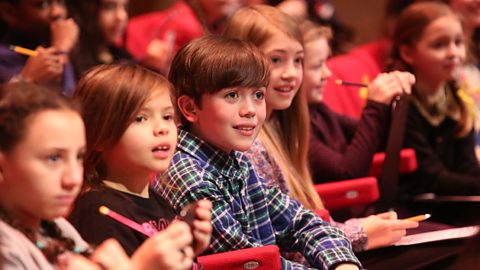
Follow-up programme
We’ve created a full length follow-up programme to this Live Lesson which features our expert guests answering your questions and new curricula linked activities building on students’ learning in the live programme.
Shorter clips from the follow-up programme are also available below, useful for covering individual topics.
A look at the role fossils play in helping to understand evolution
Full version follow-up programme
This EXTRA programme takes a look at the roles fossils play in helping to understand evolution and answers more questions from our studio and virtual audience.
Your students will need this downloadable activity sheet:
What can fossils tell us about the past?
Michelle Ackerley:
In the live lesson we found out how the process of evolution filled the planet with such a wide variety of animals, Albert included.
Greg Foot:
Yeah, but Ben, you know, how are we so sure of this amazing array of life?
Ben:
Well, we look at a combination of things in evolutionary biology. We look at things that are alive today like Albert, we look at things that are fossilised like fossil snakes of Albert. And we piece them all together and we have a better understanding.
Greg Foot:
Mm.
Michelle Ackerley:
So how to fossils actually help with this?
Ben:
It's best to think of all of life on Earth like one big jigsaw. And if you're meant to have, say, 100 pieces to this jigsaw and you've only got ten pieces, you don't really understand the whole picture. Fossils help by acting like extra pieces and the more pieces you have, the better understanding you have of the total picture. So we can use these to fill in the gaps where we don't understand things yet.
Greg Foot:
And, you know, the word fossils is probably something that you've heard of before, but we scientists like to actually classify things a bit more than that. We get different types of fossils, right?
Ben:
Yes, and actually you can see them there with your ammonites, the first one is true fossil.
Greg Foot:
Okay, so that's this one.
Ben:
That one there. So that thing was swimming around in the seas probably around the UK millions of years ago and all the actual body parts have been replaced by rock and it's a complicated process. But that's a true fossil. The one next to it is a trace fossil. Now this is an imprint left in the mud, so the actual fossil itself was resting in the mud and the mud has been fossilised.
Greg Foot:
Like this.
Ben:
Just like that.
Greg Foot:
So it's actually pushed on top of it like that. Oh I see.
Ben:
So two types of fossil can really help us understand a lot of things.
Greg Foot:
That's amazing. And I tell you what, we are dying to know what this fossil is, uh, that Michelle presented us with earlier. I'm really hoping that it isn't dinosaur poo.
Ben:
Well, what do you think?
Greg Foot:
Well, Michelle, are you out there?
Michelle Ackerley:
Yeah, I'm gonna get a few guesses from the audience. So we saw that fossil earlier, what's your name and what's your guess? What do you think it is?
Maisie:
Maisie and I think it might be a plant or a leaf.
Michelle Ackerley:
Okay, a plant or a leaf. Interesting. And what's your name, what do you think it is?
Cowan:
[Cowan] and I think it's a fish.
Michelle Ackerley:
A fish, see I was thinking about a fish as well actually 'cause it almost looks like ribs. And finally, what's your name and what do you think it is?
Jude:
I think it might be a fish as well, and my name's Jude, because on the rock it looks like ribs as well.
Michelle Ackerley:
Yeah, looks a bit fishy, doesn't it? Ben, are we along the right lines?
Ben:
Well, there are some good guesses there and I guess if you look along here you can see the vertebrae, you can see the backbones, you can see the ribs of this fern. This is actually a plant and it looks like a fish, it's over 140 million years old, was found in the UK and you're right, it does look like a big flat fish. And this is part of the problem with fossils, we're never quite sure all the time. So this is a really good example why you've gotta be really good at what you know.
Greg Foot:
Oh you've gotta be a good detective, I tell you.
Michelle Ackerley:
[LAUGHS] Ben, I know you've got a few more examples of fossils to show us, so whilst you get set this is a good chance actually for everyone else to grab activity sheet number one, because we're about to do some fossil detective work of our own.
Greg Foot:
Ben, this is amazing, right, it's pretty terrifying. Who, or indeed what, did it belong to?
Ben:
Well, this thing was walking around about 100 million years ago and was a terrifying animal indeed. What do you think?
Greg Foot:
Hm.
Michelle Ackerley:
Hm.
Greg Foot:
I don't know. We're gonna need to do some detective work and work this one out.
Michelle Ackerley:
I think so. So guys, get your worksheets out, this is your chance to play prehistoric detective. You've got 30 seconds to jot down a few things you think this fossilised foot told scientists about its owner. Okay, you ready? Off you go.
Greg Foot:
Right, so let's find out. What do you guys think that foot can tell us about its owner. Hello, what's your name?
Sophie:
Sophie.
Greg Foot:
What did you write down then? What size is this animal?
Sophie:
It's very huge and it has sharp nails.
Greg Foot:
Oh so what do we think it might have eaten if it's got very very sharp nails?
Sophie:
Some rocks.
Greg Foot:
Some rocks. Something big, possibly. What about you? What do you reckon?
Boy, brown hair, white shirt:
I think it like eats something sharp 'cause it's got sharp nails.
Greg Foot:
Ooh and how many legs do you think this animal would have had?
Boy, brown hair, white shirt:
Four.
Greg Foot:
Four legs. All right then, we've been playing detective. What's the answer?
Ben:
There are some good detectives out there looking at these things. Now, when we piece this together we don't always have the full fossil at the same time, so we've gotta look at what we've got and guess and estimate really of what we've got here. So this thing would have come from the foot of an animal about as tall as this studio. So a very big animal first of all. And we know that by having feet like this you never have more than two legs. So we know this thing was a two-legged animal about the size of this studio. And you said it had big claws and big teeth, it did. This was an ultimate predator.
Greg Foot:
What is it? Come on, tell us.
Ben:
This is the foot of a Tyrannosaurus Rex.
Greg Foot:
No!
Michelle Ackerley:
No way.
Greg Foot:
Wow.
Michelle Ackerley:
That is amazing and all that just from a foot?
Ben:
Yep. We can tell so much just by looking at one little bit of an animal to understand the rest of it.
Michelle Ackerley:
That is so impressive. I mean I wonder how old T-Rex would have done in our terrific scientific flexible foot investigation.
Greg Foot:
Well, not very well because this is a T-Rex right? It wouldn't actually be able to reach the piece of paper to write down the answers.
Michelle Ackerley:
[LAUGHS]
Greg Foot:
All right, Ben, what else have we got on this table of fantastic fossils?
Ben:
We've got some great discoveries here. The tooth you can see over there is from, well it's a very special animal.
Michelle Ackerley:
That is massive.
Ben:
Big cheesy grin there. Now this is the tooth of a shark. It's from a fossilised shark and it's one of the biggest sharks that we ever had. This is from Megalodon.
Greg Foot:
Wow.
Michelle Ackerley:
Wow.
Ben:
Megalodon was so big, it was swimming around the oceans about 30 million years ago and it ate whales.
Greg Foot:
Wow.
Ben:
Not the country, the animals.
Greg Foot:
Must have been humongous.
Ben:
It was. It was absolutely massive. So these teeth can get even bigger. They can get twice as big as that, so that wasn't fully grown.
Greg Foot:
Gosh.
Michelle Ackerley:
That is seriously amazing.
Greg Foot:
Wow, wow, wow.
Michelle Ackerley:
And what else have we got?
Ben:
We've got this discovery here. Now, this is one of the most important fossils that we know of ever. If you look really closely you can see these tiny trace fossil imprints next to the real fossil.
Michelle Ackerley:
Oh yeah.
Greg Foot:
Yeah.
Ben:
And you've got the trace marks of feathers.
Greg Foot:
Gosh!
Ben:
This is a dinosaur that could fly and it looks half bird, half dinosaur. It lived about 150 million years ago and is called Archaeopteryx.
Greg Foot:
Oh wow.
Michelle Ackerley:
Great name.
Greg Foot:
So we've seen loads of different types of examples of fossils. I think we should have a look at how they are actually formed, all right. Now it's my turn to do a very complicated demo. It's not, it's fantastic, you can try this one.
Michelle Ackerley:
I'll be your assistant.
Greg Foot:
Yeah, please do. All right, so talk us through this one, Ben.
Ben:
You've got your little fish, beautifully made here, swimming around about 100 million years ago. Sad news, your little fish dies.
Greg Foot:
Ah!
Michelle Ackerley:
Oh.
Greg Foot:
Sinks to the bottom of the ocean.
Ben:
Sinks to the bottom and lays on the seabed.
Greg Foot:
Yes.
Ben:
Now, waves come in and other sand gets washed over him and it builds up.
Greg Foot:
So layers of sand start pressing down on top of it.
Ben:
Over hundreds of years, then thousands of years and millions and millions and millions of years. And you're squashing down there and that's right, because there's lots of pressure squashing down onto these body parts and it squashes so much that all the body parts disappear and tiny bits of rock seep in instead and only a rock fossil, like these ones, are left. Now, what happens millions and millions of years later erosion. So either the seas disappear or the wind comes in or people dig deep down, and all these extra layers get removed.
Michelle Ackerley:
Digging.
Greg Foot:
Digging.
Michelle Ackerley:
That's it.
Ben:
Here we go.
Greg Foot:
Digging down.
Ben:
Greg's the erosion here. And eventually somewhere deep underneath all this extra stuff you might find a fossil and this is how they're made.
Greg Foot:
It's hard being a fossil hunter, I tell you. Hang on a minute, digging down my next layer.
Michelle Ackerley:
So fossils are basically an animal or a plant that has been turned into rock.
Ben:
Into rock, yeah.
Greg Foot:
I think I've got it. I've got it. Would you be able to tell what that was?
Ben:
You could sort of tell it's a fish. Now this I the problem.
Michelle Ackerley:
Yeah, yeah you can.
Ben:
Identifying fossils and getting them out the ground can be really hard, as you've seen.
Greg Foot:
Wow, okay, well I think that worked perfect. What else have you got here? What's that one there?
Ben:
I've got one more very important discovery. Now this is one of the best things I own. This is a footprint. This is a laser scanned footprint, a cast of a fossil, and it was taken from Norfolk in the UK from a footprint left by a person nearly a million years ago.
Greg Foot:
Wow.
Ben:
This is one of the first people that ever walked or lived in the UK. Now this is before our species, homo sapiens, it's before the Neanderthals, this is four species of humans ago. And this is still left in the UK.
Greg Foot:
So we're looking at the actual print that their foot made and you've scanned it with a laser and then reproduced it?
Ben:
Yep.
Greg Foot:
That's incredible.
Michelle Ackerley:
That is incredible.
Ben:
We even know it's a size nine.
Greg Foot:
[LAUGHS]
Michelle Ackerley:
[LAUGHS]
Ben:
That's how cool this is.
Michelle Ackerley:
Well there are lots of footprints left in the sand here today from our earlier Live Lesson. So footprints are usually in soft earth aren't they, so how can they leave a fossil?
Ben:
In exactly the same way. You don't always need just an animal to be dead or a plant to be dead. You can leave a footprint. And we've even found burrows or worms that have been fossilised over millions of years. So if we leave a footprint or our camel leaves a footprint here, then millions of years later as more mud, as more sediment is pushed on top of it, then that eventually can become fossilised as well.
Michelle Ackerley:
That is absolutely incredible. And we've got a lot of footprints left in the sand here from our earlier Live Lesson with Abdul the camel, so when footprints are made in soft earth or sand, how can they leave a fossil?
Ben:
Well I could explain, but I'm gonna show you. So unfortunately Greg, your shoes need to come off.
Greg Foot:
All right sure, all right.
Michelle Ackerley:
I mean this is kinda good for you Greg, isn't it. I mean your surname is Foot so it's only right.
Greg Foot:
My surname is Foot. Greg Foot: . Right, so I'm gonna be one of these old humans, right walking through the-- grr, how do they–? Ug, Ug.
Ben:
Nothing like that, but good impression.
Greg Foot:
Argh, urgh.
Ben:
Now what you can see here is Greg, our early human, is walking around a beach or an estuary and he's leaving loads of little footprints. And we're gonna pick this one here, this is a nice one. Now what would happen is he's walking around and a load of mud washes in or something happens to preserve this footprint. Now these get preserved for millions and millions of years, covered in loads of mud and fossilised. And then millions of years later someone like me, a fossil hunter, comes along and we need to preserve it. And we can use lasers and all this amazing technology now.
Greg Foot:
Like we saw for this one.
Ben:
Like we saw for that one.
Greg Foot:
Yeah, yea.
Ben:
But probably one of the best ways and one of the oldest ways to do it is to use this stuff. Now this is Plaster of Paris and it's a liquid that turns solid. Now what we're gonna do is pour, it's really thick and gooey, gonna pour that into your footprint here.
Michelle Ackerley:
Oh that's so cool.
Ben:
It's great, isn't it?
Greg Foot:
It's filling up all the gaps.
Ben:
Filling all the gaps and eventually, within about ten minutes this will become absolutely solid.
Michelle Ackerley:
Well, Ben it's just as well we have one that we made earlier.
Greg Foot:
Look at this. Look at that, it's my foot!
Ben:
[LAUGHS]
Greg Foot:
That's my foot! [LAUGHS]
Ben:
Now we can see your foot here is beautifully pre-- I say beautifully, It's preserved, it's not beautiful. You've got your heal here, you can see the side of your foot and we can even count the number of toes. Now this would be great if we were trying to understand what you were like half a million years ago.
Greg Foot:
Yeah, I love that so much. It's wicked. And you can try this yourself at school. Just get a shoebox, fill it full of sand, get some Plaster of Paris, give it a go.
Michelle Ackerley:
That is a great activity to try and who knows what footprints future scientists will be digging up millions of years on from now?
Greg Foot:
You know what, they could be yours.
Michelle Ackerley:
[LAUGHS]
How do fossils help us understand evolution?
This is a shorter video clip from the follow-up programme which gives us a closer look at how fossils help us understand the process of evolution.
Your students will need this downloadable activity sheet:
Watch again: Live Lesson video clips
This set of shorter video clips is taken from the Live Lesson programme and can be used to teach individual topics.
How animals adapt to their environment
Greg:
Footwear has allowed humans to survive and thrive in different, sometimes, extreme environments all over the planet. But, what if you're an animal?
Michelle Ackerley:
Mm.
Greg:
It's not like penguins can pop on a pair of slippers when it gets nippy, down in the Antarctic, can they?
Michelle Ackerley:
No.
Greg:
So, how do animals adapt to the different environments around the world?
Michelle Ackerley:
Yeah. Well, here to help us with the answer, is animal expert, evolutionary biologist, Dr. Ben Garrod: , and a very special guest.
Audience:
[APPLAUSE]
Michelle Ackerley:
We've only got a camel in the studio. This is Abdul, the camel.
Greg:
Everybody, this is Abdul. I don't think we have ever had an entrance like that to a live lesson, Ben?
Dr. Ben Garrod:
Well, here we have, as you can see, Abdul is a camel. Now, camels, as you know, …
Michelle Ackerley:
Amazing.
Dr. Ben Garrod:
…live in the middle of deserts. They're very harsh environments to live in, and Abdul, like all camels, has very specially adapted feet, in order to help him.
Greg:
Yeah. It's amazing. Look at those feet. They're so big and they're so wide, and that's really useful for Abdul, right?
Dr. Ben Garrod:
Well, first of all, yeah, I mean, the last thing you want is a really small…
Greg:
Oh, Abdul's going for a walk.
Dr. Ben Garrod:
He's off.
Greg:
Alright, buddy.
Michelle Ackerley:
Oh.
Greg:
We thought this was gonna happen.
Michelle Ackerley:
[LAUGHS]
Greg:
Now, we're gonna go…
Michelle Ackerley:
So, we're gonna go round this side.
Greg:
…this way. Hey, Ben, I'm gonna look at a camera round the backside of a camel.
Dr. Ben Garrod:
[LAUGHS]
Greg:
You keep telling me about its feet.
Dr. Ben Garrod:
The last thing you want is really small feet where you disappear into the sand. By having these really big, flat feet, stops Abdul from sinking into the sand. Now, the next thing, what you really don't want…
Dr. Ben Garrod:
Hello.
Michelle Ackerley:
Hiya.
Dr. Ben Garrod:
…what you really don't want are very thin soles of your feet, because you'll get burnt in the sand, so if you can look at Abdul's feet, if he moves again, they're like car tyres. They're really thick, and it stops him getting burnt.
Michelle Ackerley:
Oh, you've got a new friend.
Dr. Ben Garrod:
Lovely. I love him.
Greg:
Oh, it's delightful. And, yeah, it's like us walking on sand. It can, sometimes, be too warm, or we can sink into the sand. It's like us wearing flipflops that we saw in the activity sheet just now.
Michelle Ackerley:
It is amazing to see, though. As you said, though Ben, I mean, their feet are specifically adapted to suit their environment, aren't they?
Dr. Ben Garrod:
Exactly. Some animals need really…
Greg:
Going for a wander again.
Dr. Ben Garrod:
…small feet for jumping up things, and some need these really big, flat feet, like Abdul. He's perfectly suited to his particular environment.
Michelle Ackerley:
Yeah.
Greg:
But, you know, just having well adapted feet is not enough. You wouldn't try to go walk across the Sahara in just flipflops, would you?
Michelle Ackerley:
No.
Greg:
You need a whole load of other things. You'd need some water, some cool clothes, some sunglasses, so the whole of the camel's body is adapted to its environment. It's feet are just the start of it.
Michelle Ackerley:
Right. No clues, Greg, because we're gonna see if you and your classrooms, and in our audience here, can spot the key adaptation, so you need to take activity sheet number two. You'll find a photo of our lovely Abdul here, and we need to see if you can spot the features that help him live happily in the hot, dry, sandy desert.
Greg:
You can see that the feet are already circled on there. We're gonna give you 30 seconds to circle four more features, and that 30 seconds starts when, Abdul? Now. Yes.
Michelle Ackerley:
[LAUGHS]
Michelle Ackerley:
OK, guys. Time is up. So, let's see what we've got in the audience. You've been circling away there. What's your name, and what key features have you circled?
Sonny:
Sonny.
Michelle Ackerley:
Sonny. So, let's see what you've got there?
Sonny:
I've got the poo. [LAUGHS]
Michelle Ackerley:
The poo. Interesting. [LAUGHS] What else have you circled?
Sonny:
I've circled the hump.
Michelle Ackerley:
Poo and the hump, and there's another one there. What's that?
Sonny:
Yeah. The mouth.
Michelle Ackerley:
OK. We've got poo, hump and mouth. And, what's your name? What have you circled?
Cerys:
Cerys. I circled the poo, [LAUGHS] the hump, and the neck.
Michelle Ackerley:
Poo, hump and neck. OK. So, there's a theme going on. We've got a bit of poo. But, hands up who else has circled the hump? OK. Oh, everyone, basically. And so, Sonny, do you know what the hump is used for? What would be your guess?
Sonny:
People sit on it.
Michelle Ackerley:
Sit on it? Ben, what would you say?
Dr. Ben Garrod:
Well, it's not…it's a good answer. The hump is right. It's a really good adaptation, but it's not for sitting on and, for a long time, people thought they stored water in there. But, they don't store water in their humps, it's for fat, so they store a lot of fat for energy, in their humps on their backs.
Greg:
That is a great fact. And, of course, so many other adaptations on Abdul, our camel. Talk us through a few more of them, Ben. I'll just keep feeding him. It's all good.
Dr. Ben Garrod:
He'll be happy. Keep him nice and happy. So, if we look across Abdul's body we can see, first of all, he's got these very long legs. Now, if you're living in the middle of the desert, and it's really hot, the last thing you want is for your tummy to be near the really hot sand, so he walks on these lovely, long stilts.
Greg:
Yeah.
Dr. Ben Garrod:
We then go to this hump, that we already talked about, which is really special to the camels. His nostrils. Great. Try and close your nostrils.
Greg:
Try to close my nostrils?
Dr. Ben Garrod:
That is rubbish.
Michelle Ackerley:
[LAUGHS]
Michelle Ackerley:
You opened them more. [LAUGHS]
Dr. Ben Garrod:
You can't close your nostrils.
Greg:
Is it working?
Dr. Ben Garrod:
[LAUGHS] No.
Greg:
I can't do it.
Dr. Ben Garrod:
But, Abdul can close his nostrils. If he's in the desert and it's really, really blowing, and there's lots of sand everywhere, he can actually close his nostrils shut.
Michelle Ackerley:
[LAUGHS]
Dr. Ben Garrod:
And, it stops sand from getting in there. That's very, very cool. And, as a lot of you said, their poo is very special. Now, when we have a poo, there's a lot of water in there. But, if he did that, he could become really dehydrated really quickly, and he'd be sick. So, his poos are really solid, and it sounds weird, but that's a really special adaptation for animals that live in deserts.
Michelle Ackerley:
Wow. They are amazing creatures. They're so soft, as well. It's just so furry and warm.
Greg:
Fantastic. So special. Oh.
Michelle Ackerley:
[LAUGHS] So special.
How do animals adapt to different environments?
This clip is from the main Live Lesson, and looks at how animals have adapted to their environments.
Your students will need these downloadable activity sheets:
What is evolution?
Michelle Ackerley:
So how did all these amazing animal adaptations come about?
Greg:
Well it's all down to evolution. Now that is a process that can take millions of years. But, to understand how evolution works, you first have to realize that every individual animal is a little bit different from every other animal, even within the same species.
Michelle Ackerley:
And obviously us humans have no trouble telling each other apart. I mean, we have small variations. It might be blue eyes, curly hair, or, or big feet. Or, in Greg's case, you know his incredibly chiselled jaw line. I mean, look at that.
Greg:
Thanks. [LAUGHS], we pass those features down to our off-spring, so the reason why you can often tell people are members of the same family, even though they're different ages, or a different sex from one another.
Michelle Ackerley:
Well it's a bit trickier for us to spot individuals in other species. The pet owners can usually recognise their dogs or their rabbits, but how do you tell individuals tortoises apart?
Greg:
I, I really like tortoises.
Michelle Ackerley:
I mean, or fish?
Greg:
I love fish.
Michelle Ackerley:
Or even snakes.
Greg:
Don;t like snakes. Snakes are one of the–
Ben: :
Did someone say snakes?
Greg:
No I'm good. Don;t even joke. Don;t go there Ben: .
Michelle Ackerley:
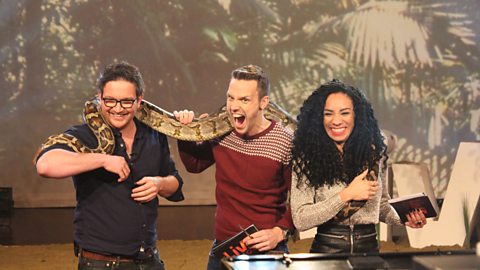
Yes, so this is a pretty big, pretty big snake. [LAUGHS] Okay, okay.
Greg:
I'm not looking.
Michelle Ackerley:
Whoa, whoa, whoa, whoa.
Greg:
I don't-- Okay, what's this snakes name Ben?
Ben:
So this is Albert, and Albert is an Indian rock python. He is lovely, look at him.
Greg:
Oh, what does? What does Albert the rock python eat?
Michelle Ackerley:
Good question.
Ben:
Well, he'll eat a lot of things in the wild. He'll eat everything from small birds, small, small rodents, even things as large as crocodiles.
Greg:
Not presenters. I hope not the human size.
Ben:
Not so far.
Michelle Ackerley:
Okay, not so far.
Greg:
I mean, it is actually quite beautiful. Very heavy it turns out. Fantastically adapted to its environment.
Ben:
He is perfectly adapted to live in a thick forest. So he can be on the ground in the leaves, he can be up in the trees with the, the other animals that he is perfectly suited for a forest habitat.
Michelle Ackerley:
Now, and Ben interestingly, obviously this is a show about feet,but snakes don't have feet. So, so what's going on here?
Ben:
You're right and you're wrong. If we were in a time machine and went back millions and millions of years, the ancestors of snakes used to have legs. But, they've lost them over generations and generations and generations, and now they're these smooth long legless things. But, Albert does have a little pair of legs, or a little pair of claws right in the back of his tail. So they still hae the remnants that that show that they used to have legs millions of years ago.
Greg:
I tell you, I tell you what, it's great a squeezing.
Michelle Ackerley:
I can feel it go around my tummy.
Greg:
Really good at squeezing.
Michelle Ackerley:
[LAUGHS] So how do you tell individual snakes apart then?
Ben:
Well, first of all, different species all look very different, and they have different reasons for that. Some are venomous, some are camouflaged. Some want to warn other things off, and some want to hide. But, even with individuals like Albert and other of the same species, they all look slightly different, in the same way we do, and that's we call natural variation.
Michelle Ackerley:
Okay. I mean I must say he just feels incredible doesn't he. It is getting tighter, but, but we are going to have a go at identifying them ourselves in a moment. So guys, make sure you've got activity sheet three at the ready.
Greg:
Yeah. I've not, I've not presented with a giant snake squeezing around me before so this is interesting. Alive, whoa, now the slight differences, we call it natural vaiation as Ben said, it's really important isn't it. Oh you buddy, it's gonna lick, yes, tasting. I'm glad I'm not near the head. Talk to me about the individual variation and why it's so important?
Ben:
So, if all the snakes looked exactly the same, then a predator might say, well I'm looking for this particular type of animal, this particular pattern. By having all these different patterns on every individual, it allows t hem to be perfectly camouflaged.
Greg:
You've got a snake around your head mate. It, it's, it is really important to say that these, these inhe-- these.
Michelle Ackerley:
Oh my gosh, oh my gosh.
Greg:
[LAUGHS] There the glasses are going. [LAUGHS] Now Ben, can I ask you a question? You should probably know me, I ask the question. [LAUGHS] A snake around your face. It's important to say that, that these inherited traits right. We should say there's no danger here. We have two expert handlers. Ben is also very used to handling these animals, so nobody needs to be worried, okay. So, what we're talking about is these inherited traits, they aren't the same as somebody's foot just becoming more flexible from living in the countryside. They're different things, right?
Ben:
Yes, so if you go walking every day, or running every day, your feet become stronger, or more flexible. But, that's not passed down to your offspring, your children, and then new generations. That's, t hat's variation just within your lifetime. That's very different.
Michelle Ackerley:
Okay. Bit of an activity then. This is your chance to see if you can pick out an individual snake from the crowd. So, on you activity sheets you'll see nine different pythons, but only one is our lovely friend Albert here.
Greg:
You've only got 30 seconds, which is about the amount of time it's gonna take us to get untangled from this snake. The pressure is on, off you go.
Michelle Ackerley:
Did you manage to spot Albert here. Uh, Greg how's everyone getting on in the audience.
Greg:
I think we're good. We all got ourselves a little bit excited about that snake, didn't we. How are we doing over here? We enjoying it so far?
Audience:
Yeah.
Greg:
Alright, whose next to me. Have you identified Albert?
Charlie:
Yep.
Greg:
What's your name?
Charlie:
Charlie.
Greg:
And what do you reckon? Which one is it? What letter?
Charlie:
Um, I think "C".
Greg:
And what do you reckon young man, same?
Baron:
Yes "C".
Greg:
C as well. And, what's your name?
Baron:
Baron.
Greg:
So both reckon "C". Are they correct?
Ben:
Oh, oh, well they are absolutely correct.
Greg:
Hey! Nicely done, nicely done.
What is evolution?
In this clip from the Live Lesson, we look at how animals have evolved over millions of years.
Your students will need this downloadable activity sheet:
Animal ancestors
Greg Foot:
So, the question is, how have we ended up with such a mind-boggling variety of amazingly adapted species?
Michelle Ackerley:
Mm!
Greg Foot:
And the answer is evolution. You can picture evolution like a tree. Ben, this is your area, talk us through it, buddy.
Ben:
Right, now, there are millions of species of organisms on Earth. By that I mean plants, bacteria, animals, you name it, it's there. But we're all related, and it's easier if you can imagine it as a big tree. Now, this started about 450 million years ago.
Greg Foot:
Wow!
Ben:
This is millions and millions and millions of years ago, and it helps to think that's a long time, even between this split here, that's five million years. And all of these things are related. Now, you can see the human, there's a chimp, there's a dinosaur, there's a crab. These are more related because they're closer on the tree than we are to something like a crab. But if you travel back and go along the tree, you suddenly get to a point where we've got mammals and amphibians and reptiles, and if we go all the way back, we used to be fish.
Greg Foot:
No way!
Michelle Ackerley:
Fish?
Ben:
Yep! Several hundred million years ago, we, our great-great-great-great-- if you said "great" for about six months…
Greg Foot:
[LAUGHS]
Michelle Ackerley:
[LAUGHS]
Ben:
…grandparents were swimming around in the seas with gills.
Michelle Ackerley:
I mean, that is…
Greg Foot:
Wow!
Michelle Ackerley:
…absolutely amazing, 'cause there's such a variety of life there as well. But imagine meeting one of those early fish, you'd never guess that in a million years they'd evolve into us.
Greg Foot:
I mean, I have got a few friends and they still look pretty fishy.
Michelle Ackerley:
[LAUGHS] I hope they're not watching now.
Greg Foot:
If I'm honest. So, it's those very small, individual variations that eventually led to that mind-boggling variety of species, each one adapted to their environment thanks to a process called natural selection.
Michelle Ackerley:
Yeah, and to understand that, we need some helpers from our audience. So, guys, get yourselves ready.
Greg Foot:
Okay, let's go for this, this is gonna be wicked.
Michelle Ackerley:
This is gonna be interesting.
Greg Foot:
We're gonna try to do millions of years of evolution in just three and a half minutes.
Michelle Ackerley:
[LAUGHS]
Greg Foot:
Starting with one ancient animal who lived seven million years ago, the Samotherium.
Michelle Ackerley:
So, if you look at activity sheet number four, you'll see the evolutionary tree. And there's our Samotherium way back in the development of mammals. So, have a quick think about what modern animal you think it might have evolved into, and write it down in the box.
Greg Foot:
Here's a little clue, it looks a bit different today.
Michelle Ackerley:
Okay, so we're gonna have the first generation of Samotherium, please trot into position, guys, come in! Come in! So we've travelled seven million years back in time. And, I mean, these are beautiful beasts. So, Ben, what were they actually like?
Ben:
Well, they were a little bit like horses, they're the same sort of animal, part of the mammal group, in the same sort of group there. But, as you can see, they travelled around in groups as well, so they were social, they lived in herds, and they were herbivores, so they ate plants. Sometimes plants on the ground, but also plants up in trees as well. What we're seeing here is some of them, though, have slightly longer necks than others, and this will make them have an advantage over all their other mates.
Greg Foot:
So that's what I wanna try to show. All of you come and try to scoff this branch here, this tasty branch, see if you can reach it. Now, what we're gonna do is keep those sticks on the floor at all time.
Michelle Ackerley:
Yes, no tip-toes.
Greg Foot:
No tippy-toes. Let's see who can manage to eat it.
Ben:
Now, the problem here is all the food down here has gone and they're trying to reach up there, but there's one that's slightly taller than all the others.
Greg Foot:
Yeah!
Ben:
And this one can reach the leaves, so this one will do really well, the others might–
Michelle Ackerley:
Not so much.
Greg Foot:
So, sadly, as happens, all of these shorter ones die.
Michelle Ackerley:
Sorry guys!
Greg Foot:
So they all die, and this one is just left to have more babies, and their next offspring also with similar long necks. So we're gonna fast-forward, you guys, goodbye, thank you so, so much, you were brilliant.
Michelle Ackerley:
Thanks guys.
Greg Foot:
Let's jump forward a whole load of generations of Samotheriums, let's see how they get on. So, they've now all got very slightly longer necks.
Michelle Ackerley:
Yes, yeah, yeah.
Greg Foot:
Come on in, you herd!
Michelle Ackerley:
[LAUGHS]
Greg Foot:
Try to scoff this bough here. Sorry! I'll get out of your way.
Michelle Ackerley:
Oh! Oh! Oh! He's fierce!
Greg Foot:
Have a little scoff, see who can reach it.
Michelle Ackerley:
So, what are we seeing here, Ben?
Ben:
Now, each time, we are talking across generations, so this is occurring over hundreds of thousands, if not millions of years, and each time that ability to have a slightly longer neck is passed on to the next generation.
Michelle Ackerley:
Whoa!
Greg Foot:
Oh, we got one! [LAUGHS]
Michelle Ackerley:
Skills!
Greg Foot:
Good job!
Ben:
With problems like droughts, more and more of these animals will die, and fewer will survive.
Michelle Ackerley:
I'm not a Samotherium!
Greg Foot:
Oh yeah.
Ben:
You're not a Samotherium, your neck's too short! But with a really long neck like this…
Greg Foot:
Yeah.
Ben:
…this one'll do really well again.
Greg Foot:
So, again, let's have a look. Those of you who can't reach the bough, sadly you die. So, you're okay, you die, sorry. You die.
Michelle Ackerley:
Aww! [LAUGHS]
Greg Foot:
So, these ones are left, you're left. So the next generation pass on and you have some offspring. But we'll wave goodbye, thank you guys so much!
Michelle Ackerley:
Bye guys! Bye guys!
Greg Foot:
This way, please, thank you very much. Let's bring on our next wave of Samotherium, so as Ben said, generations and generations and generations ago.
Michelle Ackerley:
Yeah. And, as we can see, I mean, these have got longer necks, but what else are the long necks good for, apart from reaching the high vegetation, which these guys are doing?
Ben:
Well, it's gonna sound weird, but their long necks were weapons.
Greg Foot:
Weapons?
Michelle Ackerley:
No way!
Ben:
Weapons. Now, you can see these really long necks and these special horns on the end, they were using them, mainly the males, to actually fight. And they would grrr! Try and fight with each other.
Michelle Ackerley:
Vicious!
Ben:
Yeah. Partly to try and get more food, and also partly to try and mate, trying to get a girlfriend and pass on those genes again. So they're using that same adaptation for a different purpose, and it all helped.
Greg Foot:
Well, let's have a go, let's try scoffing this one, let's see how we do. Can we eat it? Can we eat it? Oh, now, almost all of you can reach it. Sadly, I think this one is gonna have to die. Actually, just eat this, you'll be fine. But the rest of you, you're gonna survive to the next generation, so we're gonna thank you all very much and you're going thataway, which means we've got one final wave to come. Let's have a look at their offspring quite a few years later. On you come! Final wave. So, Ben, it's pretty clear that these long necks, they give all sorts of benefits don't they? And what we're talking about here is something called survival of the fittest, right?
Ben:
Yes. Now, what you're seeing each time is this individual variation that we talked of before.
Greg Foot:
Yes.
Ben:
So, individuals randomly, through mutations and through their genetics, might have a slightly longer neck, and if that helps them in their environment, they'll go on to have more and more successful babies.
Michelle Ackerley:
Mm.
Greg Foot:
Yes.
Ben:
And their necks will be larger and longer and longer, and so over millions of years that passes on through evolution through natural selection. And eventually new species appear.
Greg Foot:
New species, wow! Thank you so, so much to all of our Samotheriums.
Michelle Ackerley:
Thanks guys. Good job! Good job! [APPLAUSE]
Greg Foot:
And our very successful long necked Samotheriums! You're going that way! [APPLAUSE] Thank you so, so much!
Michelle Ackerley:
Now, having a look at these Samotheriums, has it made you think of a modern animal? Does it remind you of anything?
Greg Foot:
Hungry?
Michelle Ackerley:
'Cause as Ben said, they evolved into an entirely different species, didn't they? And it's one that we know today, so any ideas in the audience? Shout out for me, what are you thinking?
Greg Foot:
What do you reckon?
Audience:
Giraffe! A giraffe!
Michelle Ackerley:
Giraffe?
Greg Foot:
Gerbil?
Michelle Ackerley:
Okay, everyone seems to-- [LAUGHS] not gerbil, giraffe!
Greg Foot:
Giraffe, giraffe!
Michelle Ackerley:
Well, let's see if you're right, let's reveal the animal.
Greg Foot:
Look at that!
Michelle Ackerley:
You were correct, well done, guys!
Greg Foot:
Such a long neck!
Michelle Ackerley:
[LAUGHS] And if you guessed correctly in your classrooms, good on you as well.
Greg Foot:
Hello giraffe!
Michelle Ackerley:
Very majestic animal.
Greg Foot:
So, millions of years of evolution have given us the giraffe. That famous long necked animal perfect for reaching all of those succulent, high up leaves. And a long, strong neck comes in handy when battling for a mate as well. Watch this. Boof!
Michelle Ackerley:
Whoa! Whoa! Whoa!
Greg Foot:
This evolutionary process has been going on all over the planet for millions of years, and the result is the incredible world we live in today, full of countless varied species all adapted to their different environments.
Michelle Ackerley:
And evolution never stops. I mean, what we see around us is just a snapshot of where the evolutionary process is now, and who knows how plants and animals will adapt over millions of years into the future?
Greg Foot:
Well, I mean, we have, you know, one of the world's best evolutionary biologists, Dr. Ben Garrod, with us, we're very lucky, but you probably can't even predict the future. But I know who can, and he has a theory.
Animal ancestors
This clip is from the main Live Lesson, and looks at animal ancestry and inherited characteristics.
Your students will need this downloadable activity sheet:
Watch the full Live Lesson
Catch up with the full Terrific Scientific Feet - Live Lesson and learn more about evolution and inheritance
Primary BBC Live Lessons
Find out more about our Live Lessons designed for primary school students
BBC Live Lessons homepage
Return to the BBC Live Lessons homepage for more curriculum-linked Live Lessons across primary and secondary