Follow-up programme
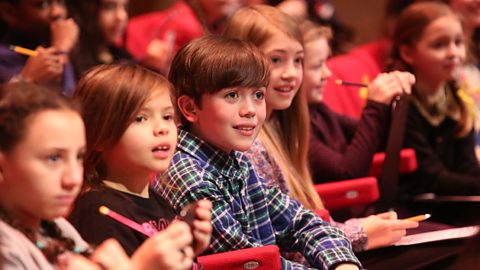
We’ve created a full length follow-up programme to this Live Lesson which features our expert guests answering your questions and new curricula linked activities building on students’ learning in the live programme.
Shorter clips from the follow-up programme are also available below, useful for covering individual topics.
Learn about fractions, decimals and money
Full version follow-up programme
This EXTRA programme looks at how fractions and decimals can help you get to grips with money and answers more questions from our live studio and virtual audience.
Your students will need this downloadable activity sheet:
Money
Katie:
Well when we write down amounts of money, we use a pound sign to show that we're writing down money, and we've also got the letter P that we can use at the end to indicate the number of pence. So if you have less than a pound, if you had 81p, you would write a P at the end to show that's 81 pence, and once you get to 100 pence you can convert to a pound. So if you wanna write an amount of money with a decimal point in the middle, you can write £1.00, and that's the same decimal point that we had earlier in our decimals and fractions.
Female - blond hair:
Which we know a lot about.
Ben:
Mm hmm.
Katie:
And you can also write down amounts that are less than a pound, so you could write £0.81, that would be the same as 81p. And if you've got more than a pound, you could have £1.25, that means you've got £1.25, which is 125p.
Money
This is a shorter video clip from the follow-up programme focusing on representing money as a decimal.
Your students will need this downloadable activity sheet:
Fractions: Bigger or smaller?
Ben Shires:
So in the game our mascots will hold up two cards at a time and you have to shout out whether the second fraction is bigger or smaller than the first. And to get us moving if it's bigger I want you to reach up. Everybody reach up if it's bigger.
Alex Scott:
That's it.
Ben Shires:
And if it's smaller you touch your toes. Oh. That hurts. [LAUGHS] And all good games need a referee of course. So to help us today, Alex will you do the honours please?
Alex Scott:
I've got my whistle.
Ben Shires:
Oh she's got her trusty whistle so let's get this game started. So, on Alex's whistle mascots, Mighty Red you're gonna start. So Alex over to you.
Alex Scott:
Three, two, one. [WHISTLES]
Ben Shires:
Okay, so we have one-tenth there from Mighty Red. Monty Magpie, what have we got from you?
Ben Shires:
Oh, it's one-quarter. Okay so we've got one-tenth and one-quarter. Audience, is one-quarter bigger or smaller than one-tenth? Show us now.
Naomi Wilkinson:
Bigger or smaller?
Ben Shires:
Is it bigger or smaller?
Naomi Wilkinson:
Big or smaller? What do you think?
Ben Shires:
Oh, I'm seeing a lot of arms in the air.
Naomi Wilkinson:
Lots of arms up. Lot of arms down.
Ben Shires:
I think, the audience think it's bigger. Katie, are they correct?
Katie:
It is bigger.
Naomi Wilkinson:
Yeah. [CHEERS] [APPLAUSE]
Naomi Wilkinson:
Well done, audience.
Ben Shires:
Yes it is bigger and let's flip those boards around mascots and see how that works with our watermelon pieces. So you can see quite clearly, one-quarter is much bigger than a tenth. Fantastic. Right, now, we're gonna go for the next one. Harry Hornet what have you got for us?
Naomi Wilkinson:
Well done. Well done audience.
Ben Shires:
Ooh. A third. Okay. And what have you got for us Sammy The Saint?
Naomi Wilkinson:
One-third.
Ben Shires:
One-fifth. So do we think one-fifth is bigger or smaller than one-third? Is it bigger or smaller?
Naomi Wilkinson:
Big, bigger or smaller than a third?
Ben Shires:
Oh.
Naomi Wilkinson:
Everyone, oh, there's lots of touching their toes.
Ben Shires:
Ooh, they're not quite sure yet. Lots of touching their toes. Or they're tying their shoelaces, we don't know. [LAUGHS] Katie lots of touching their toes. Do we think it's smaller?
Katie:
It is smaller.
Naomi Wilkinson:
Yeah.
Ben Shires:
Yeah, it's smaller. Okay, it's smaller than a third. [APPLAUSE] Let's flick the boards and make sure we got that right. Yes, as you can see it's smaller than that one. Fantastic. So shall we have one last go? This last one is a little trickier as the numerator, that's the number at the top is different. So Katie can you explain what we do if the numerator is more than one.
Naomi Wilkinson:
Yeah, go on.
Naomi Wilkinson:
Uh-oh.
Katie:
If the numerator on top is more than one, you're gonna have to think a bit more carefully. So I guess if the denominator on the bottom is the same in both fractions so you might say have two-tenths and three-tenths, then three-tenths is definitely bigger than two-tenths. But if it's different then it gets a bit more complicated. So if you have, say for example, two-eights and three-quarters, you're going to need to use an equivalent fraction. So two-eighths is the same as one-quarter. So one-quarter and three-quarters you can see that three-quarters is bigger.
Naomi Wilkinson:
Okay.
Ben Shires:
Okay. Audience did you get that?
Audience:
Yeah.
Ben Shires:
Excellent. So mascots, reveal your cards. First up it's Mighty Red. What have we got? Alright, we've got four-eighths. And now Monty Magpie, what have we got from you? Three-quarters or three-fourths. So audience is three-quarters bigger or smaller than four-eighths, what do we think? Bigger or smaller? Mmm.
Ben Shires:
Bit more difficult.
Naomi Wilkinson:
We've got quite a mixed reaction here in the audience.
Ben Shires:
Okay, alright.
Naomi Wilkinson:
Mainly bigger I'd say.
Ben Shires:
I think mainly bigger too. So Katie, how did they do if they're saying it's bigger?
Katie:
Well in this case we can simplify it, we can use an equivalent fraction so four-eighths is the same as two-quarters. And that is smaller than three. So three-quarters is bigger.
Naomi Wilkinson:
Hooray. Bigger are right. [CHEERS]
Ben Shires:
Ah, fantastic.
Naomi Wilkinson:
Well done if you had your arms in the air.
Ben Shires:
Excellent work, audience. And thank you Katie as well.
Fractions: Bigger or smaller?
This is a shorter video clip from the follow-up programme about how to order and compare fractions.
Watch again: Live Lesson video clips
This set of shorter video clips is taken from the Live Lesson programme and can be used to teach individual topics.
What is a fraction?
Female - blond hair:
Katie, can you explain what maths skills our audience will be using?
Katie:
Well, if the piece of fruit is divided into equal pieces, then we can use fractions to work out how much each team has. So fractions are equal parts of a whole thing. So in this case, the whole thing is this one big piece of watermelon, and if we divide this into equal pieces, each one of them will be a fraction of this watermelon. So, for example, if we split this into two equal pieces…
Female - blond hair:
Shall I do that? Let's move these two over here, right.
Katie:
OK, so now there are pieces of watermelon and each of them is one out of two pieces, so we can write that as one over two, or a half.
Female - blond hair:
Now that is quite a big piece for one person, isn't it?
Katie:
That is quite a big piece for one person, so maybe let's split it again. So if we split each of those pieces in half as well.
Female - blond hair:
Oh, yeah, stuck on very well. There we go.
Katie:
So now we've got more pieces but they're each smaller, so in total we've got one, two, three, four pieces of watermelon, so each of them is a quarter, or one over four.
Female - blond hair:
Now you always see a fraction written like that, one number over the other. Why is that?
Katie:
OK, well the number on top is called the numerator, and the number on the bottom is called the denominator, and the denominator tells you how many pieces you've split something into, so in this case four, and our fractions have got four underneath, and the numerator on top tells you how many pieces you've got. So if you just have one piece, that's one quarter, one over four, or if you had say two pieces of watermelon, that's two over four.
Female - blond hair:
Now isn't that the same as a half?
Katie:
It is, that is the same as a half. So if you look at two pieces of watermelon, that is half the watermelon, and in fact a half and two quarters are the same thing, it's just a simpler way of writing it. They're called equivalent fractions.
Female - blond hair:
So what about our mascot's watermelon?
Katie:
So their watermelon is going to be split into ten equal pieces, each of them will be one tenth of the piece of watermelon, and if you had say five pieces that would be five tenths, which is also an equivalent fraction to a half.
Female - blond hair:
I see. Cor, you getting it, Ben?
Ben:
I am, although I'm getting a bit hungry as well, I've got to admit.
What is a fraction?
This video clip from the main Live Lesson provides an active introduction to fractions.
Your students will need this downloadable activity sheet:
What is a decimal?
Katie:
Decimals are another way to write down numbers that are parts of a whole thing, and they're especially useful if the number is divided into ten equal parts, which is what we've got here. So all of the fractions that we've written down are number of tenths, we can convert those to their decimal equivalents. So if one is the whole thing, then each tenth is 0.1. So if we had say three tenths, that would be 0.3.
What is a decimal?
This video clip explains how to write fractions as decimals.
Your students will need this downloadable activity sheet:
What is a percentage?
Katie:
Percentages are another way to look at things which are parts of a whole, and percentages are always measured out of 100. So when we had our quarters of watermelon, each of those was 25% because 25 is a quarter of 100.
Female - blond hair:
I see. So, why is it called percent?
Katie:
Ah, well percent literally means out of hundred because cent is the Latin word for 100. So a century is 100 years. And there's even a special symbol for per cent, which is two zeros with a line in between so you can remember that it's 100.
Female - blond hair:
Cause it looks like 100, that's great. So in this competition, the score is out of ten, not 100, so how are we gonna work out the percentage if it's not out of 100?
Katie:
Well you can still use percentages even when you're not measuring something out of 100, you just have to work out what percentage each one is worth. So in this case we're gonna have ten shots on goal, so we need to do 100 divided by ten to see how many percent are for each goal. So 100 divided by ten is ten, and if you say, manage to save six goals, six times ten is 60, that would be 60%.
What is a percentage?
This video clip is from the main Live Lesson, and covers the topic of percentages.
Your students will need this downloadable activity sheet:
Watch the full Live Lesson
If you enjoyed these clips, catch up with the full Super Movers - Live Lesson and learn more about maths through fun physical activities.
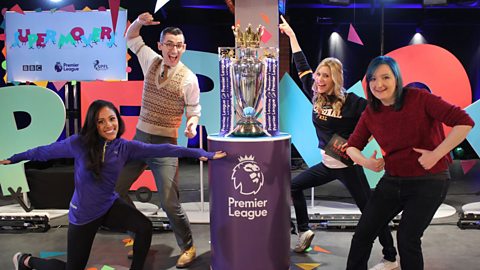
Primary BBC Live Lessons
Find out more about our Live Lessons designed for primary school students
BBC Live Lessons homepage
Return to the BBC Live Lessons homepage for more curriculum-linked Live Lessons across primary and secondary