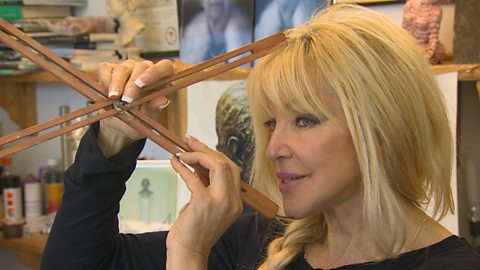
I'm influenced greatly by all the early artists, by the Greek, the Roman art. Leonardo Da Vinci, Bernini - their work is so incredible, these early sculptors.
But Michelangelo is my absolute you know, number one. Wonderful, wonderful sculptor, artist, painter - everything. He got the person out of the stone.
Michelangelo…. I think for his period, he put movement in something that's static. And that's the magic isn't it with sculpture really.
So to create movement, it’s mostly the anatomy, the way you're positioning the body. You know, the legs have got to be moving, and the arms, and the hands and the face. Nothing too static.
I realised to get this movement in the sculpture, I looked at the early pieces of art and I could see how this, it wasn't just that a piece of material was sticking out, you know, or a dress was coming out, but it was the way It wrapped round the body.
I made a large piece, 9 ft high.
And then I had to work out how these legs were going to look. And I got completely lost, and totally obsessed with the muscles in that front leg.
I mean, the way they wrap around and change shape and you know how it makes a leg more powerful.
You can accentuate those muscles coming wrapped round the knee, and the way the sculptors used to make this happen was this sort of like barley sugar effect, you know, going round and round and round. And if you continue this down the body with clothing it gives this wonderful effect of movement.
Their work is so incredible, these early sculptors. It's just sensational you know, to study that.
Video summary
Sculptor Frances Segelman explains how Italian Renaissance artist Michelangelo is her major influence.
She says he was a wonderful artist, a sculptor and a painter, who was able to ‘get the person out of the stone’.
Frances explains how sculptors have to create movement in something that is static.
She also shows us a nine-foot sculpture of Leeds United footballer, Billy Bremner, and explains how she used the barley sugar technique of the early sculptors to accentuate the muscle.
Teacher Notes
Could be used as an introduction to Renaissance artists and their figurative sculptures showing anatomy and techniques.
These clips will be relevant for teaching Art and Design at GCSE/KS4 in England, Wales and Northern Ireland and National 4/5 or Higher in Scotland.
The topics discussed will support OCR, Edexcel, AQA, WJEC GCSE in England and Wales, CCEA GCSE in Northern Ireland and SQA National 4/5 and Higher in Scotland.
Professional sculptor Frances Segelman. video
Sculptor Frances Segelman introduces her artwork and talks about her career in this resource for secondary and GCSE Key Stage 4.
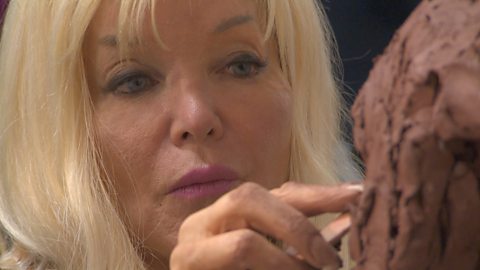
How to sculpt a bust in two hours. video
Frances Segelman sculpts a bust of Sir Derek Jacobi
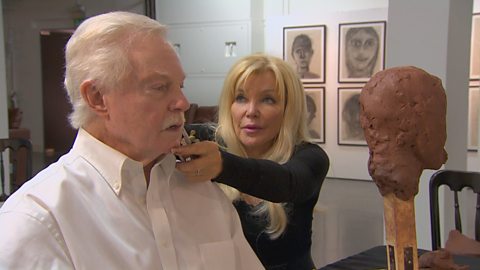
Sculpture tools and techniques. video
Frances Segelman demonstrates her sculpting technique