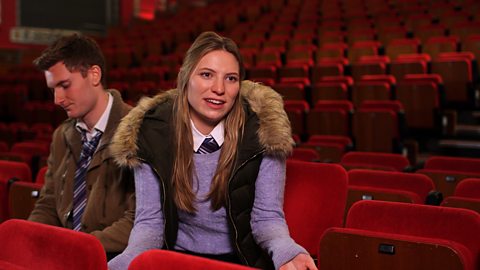
LEAH:Chimps are evil, they murder each other. Did you know that? They kill and torture each other to find a better position within the social structure.
NARRATOR:'The Characters of DNA, impossible to discuss, without talking about the theme of morality.'
LEAH:A chimp will find itself on the outside of a group, and before he knows it, he's been hounded to death by the others. Sometimes for months!
NARRATOR:'For each character seems ruled by their own individual moral code.'
LEAH:For years we thought that Chimps were our closest living relative, but… now they're saying it's Bonobo's.
NARRATOR:'Playwright Kelly gets it's character Leah, to define the terms of morality, when he compares humans to psychopathic Chimpsand social Bonobos.'
LEAH:Bonobos are the complete opposite of Chimps.
NARRATOR:'Leah herself has akin the Bonobo.'
LEAH:When a stranger Bonobo approaches the pack, the other Bonobos all come out and go "Ello mate!"
NARRATOR:'Sociable and oober chatty, Leah is insecure about her relationship with Phil and spends much of the play trying to get him to react to her.'
LEAH:What you thinking? No! don't tell me… Sorry! That’s such a stupid, that’s such a stupid… You can tell me you know, you can talk to me?
NARRATOR:'So much so, the Bonobo like Leah is prepared to violate her moral code, in an effort to get a response from Phil. Firstly killing her pet and then threatening to kill herself.'
LEAH:I sometimes think I wonder, what would you do If I killedmyself right here in front of you? Like, what do you do?! What do you do, Phil?!
NARRATOR:'Again, no response.'
LEAH:Phil?!
NARRATOR:'She doesn't do it, but ultimately she does snap. Horrified at Phil's plan to kill Adam.'
LEAH:This is insane! I mean I've never, but… this?! Because… alright whatever, but this is actually insane!
NARRATOR:'Finally Leah's morality asserts itself and she leaves him.'
LEAH:I sometimes think you're not human.
NARRATOR:'Phil is more akin to a Chimp, becoming increasingly cruel throughout the play. To begin with he's mentally cruel to Leah, not speaking a word to her. By the end, he's threatening violence.'
PHIL:We'll throw rocks at you until you drop through. You'll drop through. You'll fall into the cold. Into the dark. You'll land on Adam's corpse and you'll rot together. If he comes back, our lives are ruined. He can't come back Cathy.
NARRATOR:'And even organising Adams murder.'
PHIL:Everyone else stays calm.
NARRATOR:'Cool-headed, he's always ready with a plan In the middle of a crisis.'
PHIL:Keep your mouth shut. Tell no one, or were all go to prison.
NARRATOR:'In fact he's so calm, he's detached to the point of being sociopathic.'
PHIL:I'm in charge, everyone is happier. What's more important? One person? Or everyone?
NARRATOR:'But eventually, even he seems to be pulling back from both the consequences of his actions and the gang.'
RICHARD:Come back Phil? Phil?
NARRATOR:'Phil is eventually replaced by Cathy.'
CATHY:If you don't shut up, your be dead!
NARRATOR:'Who's the most psychopathic of them all.'
RICHARD:You wouldn't believe how things have got. Phil, she's insane!
NARRATOR:'She's the one chosen to execute Adam.'
RICHARD:She cut a first years finger off, that's what they say anyway.
NARRATOR:'And by the end of the play, is torturing fellow pupils.'
RICHARD:Doesn't that bother you? Aren’t you bothered?
NARRATOR:'From the start, she never feels showed remorse when she thinks Adam has died. Finding it, "exciting".'
CATHY:Better than ordinary life
NARRATOR:'She tried to use Adams death as an opportunity, rather than a crisis. Talking to the TV cameras, she's even prepared to frame an innocent man for their crimes.'
RICHARD:What we wanted, was to cover up what had happened… not to frame someone else!
NARRATOR:'Richard initially looked like a potential leader of the group. His gang mates were scared of him and he challenged John Tate, but he proves himself too weak.'
PHIL:Richard will take you.
RICHARD:Not me again?!
PHIL:RICHARD will take you.
NARRATOR:'He's a follower not a leader. As he shows in the end, when he takes Leah's place in the field, pleading for Phil's attention.'
RICHARD:Come back Phil? Phil?
JOHN:I really am getting a little bit cross!
NARRATOR:'John Tate was the first leader of the group.'
JOHN:Do not use that word!
RICHARD:What?
NARRATOR:'Initially menacing, he tried to ignore his conscience. Shirking from the reality of what the group have done.'
JOHN:No one says that word, OK? NO ONE!
NARRATOR:'He lacks the chimp-like ruthlessness, to hold the gang together.'
JOHN:I'm finding this all quite stressful, do you know that? I'm under a lot of stress!
NARRATOR:'And in the end, sees the light.'
NARRATOR:'Jan and Mark too showed pangs of conscience, by playing down their role in Adams demise.'
MARK:Adam was, he was laughing harder than anyone!
NARRATOR:'But their guilt comes through.'
LEAH:Did you see Jan at Adam's memorial? Floods of tears.
JOHN:That just leaves you Brian, you crying little piece of filth!
NARRATOR:'Brian's guilt is harder to supress, more immediate. He is tearful from the outset.'
BRIAN:I think we should tell someone.
NARRATOR:'Which means he gets pushed around. So much so, he's bullied into doing things he knows are wrong. And loses his sanity.'
RICHARD:They caught him staring at a wall and drooling last week.
NARRATOR:'Brian's journey matches that of Adam himself, He was bullied, told what to do, went mad and in the end is more significant in his absence than his presence.'
MARK:So we were sort of, well alright, taking the p[BLEEP]s sort of. You know what he's like, he was sort of hanging around–
JAN:Trying to be part of–
MARK:Yeah, trying to be part of… yeah, yeah. e'll do anything to be part of the group.
NARRATOR:'Adam, the first man, the first victim. Neither Bonobo, nor Chimp. Simply the loner, who's life ended… trying to be part of the group.'
Some of the key characters in DNA by Dennis Kelly are explored using a mixture of short dramatised sequences and supported by a narrative commentary on each of the characters.
The narrator examines the morality and motivations of Leah, Phil, John Tate, Cathy and other characters, as some key moments are played out, providing a voice-over commentary and exploring how the characters link to the themes of the play.
This is from the series: Making a scene
Teacher Notes
Could be used as part of an exploration of character and theme, either after an initial reading or as part of a revision activity.
Students could use this clip as the stimulus for their own presentation on a different character from the play, or as the basis for an essay-style response to one of the characters explored in this clip.
Curriculum Notes
This clip is relevant for teaching English Literature and Drama GCSE in England, Wales and Northern Ireland.
It also appears in OCR, Edexcel, AQA, WJEC and CCEA.
DNA - Plot. video
An overview of the plot of D.N.A .by Dennis Kelly.
Blood Brothers - Plot. video
An overview of the plot of Blood Brothers by Willy Russell.
Blood Brothers - The Main Themes. video
An overview of some of the main themes in Blood Brothers by Willy Russell.
Blood Brothers - The Main Characters. video
An overview of some of the main characters in Blood Brothers by Willy Russell.
The History Boys - Plot. video
An overview of the plot of The History Boys by Alan Bennett.
The History Boys - The Main Themes. video
An overview of some of the main themes in The History Boys by Alan Bennett.
The History Boys - The Main Characters. video
An overview of some of the main characters in The History Boys by Alan Bennett.
DNA - The Main Themes. video
An overview of some of the main themes in D.N.A. by Dennis Kelly.