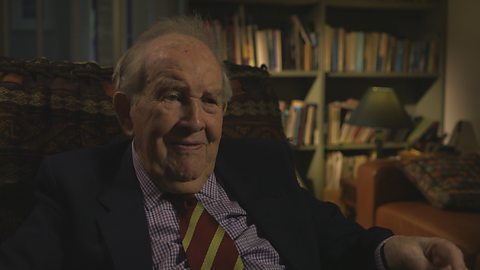
ELAINE:Hello–
ELAINE'S DAUGHTER:Hello mum
ELAINE:there's a lovely surprise, come on in.
NARRATOR:'This is Elaine Kidwell. At 91, she's the oldest member of a large extended family from Swansea, the city where she's lived all her life and where she's become a bit of a local legend all because of her life-long loveof the girl guides.'
ELAINE:'Well one of the best things I did in my life I think was to join the Girl Guides because…'
ELAINE:it taught me how to behave and how to think about other people.
ELAINE:'We made our promises you see. I will do my best to do my duty to god and the queen to help other people at all times'
ELAINE:and if you make a promise you've got to keep it.
NARRATOR:'One of the most important skills Elaine learned, was First Aid. It was a skill the emergency services were looking for in war time.'
ELAINE:'This chap, he came to our guide meeting in St. Mary's he wanted volunteers but he wanted volunteers who had passed their exams for first aid and we all had and he said "and you won't be afraid"
ELAINE:'so there was a dead silence then. "well we may be a bit nervous, you know," we said.
NARRATOR:'So at the age of just 17, Elaine became one of Britain's youngest air raid wardens.'
ELAINE:'We thought "we'll do what we can as best as we can."'
ELAINE:We were very patriotic and we loved our country.
NARRATOR:'In February, 1941, the Swansea Blitz began. When German planes dropped bombs on the city and young Elaine was soon called into action helping to treat the wounded.'
ELAINE:'I was seven and a half stone and one inch under five foot.'
ELAINE:Four foot eleven, but I made up for it because I was very busy, always and, well they didn't care if you were small or big when you were bandaging them up, you know.
NARRATOR:'In three nights of bombing, 230 people were killed and over 400 were injured but despite the bombing, the people of Swansea were determined to carry on.'
ELAINE:Do you know, I've never got over the bravery of wonderful they-- all the people of Swansea were. They were wonderful, they were.
ELAINE:'Everybody did their best. Everybody outdid themselves to be good to each other' and there was a lovely sense of comradery, you know, and help.
NARRATOR:'This sort of bravery and determination
NARRATOR:'was seen in all of Britain's bombed cities
NARRATOR:'and became known as the Blitz Spirit.'
ELAINE:'We loved our Britain,
ELAINE:'we were British and we were not going to be any different.'
NARRATOR:'Later in the war, Elaine married a local sailor called Ivor and together they had two children.
NARRATOR:'Sadly, Ivor has now passed away but Elaine remains close to her family and they love reminiscing about the past.'
ELAINE:You just say, thank you god for all that I've got because I'm very fortunate, I've got children, grand children and great grandchildren.'
ELAINE:But auntie's gorgeous, look at that little sweetie.
LAUGHS
NARRATOR:'And even though it's now many years since Elaine first joined the girl guides, she still tries to keep the promise she made to help people whenever she can.'
ELAINE:'It's inside you, you see, you do try to help and you try to be a good person and I have to do a good deed every day and some days I think
ELAINE:"well I haven't done a good deed I have to do two tomorrow" and I do, which is so funny. You still do something that is out of the ordinary but you do it specially 'because it's in you to do it.
Video summary
Please note that this video contains scenes which some viewers may find upsetting. Teacher review recommended before using in class.
Elaine Kidwell believes being a Guide taught her important values and skills, and equipped her for a vital wartime role.
Whilst she has held true to these values throughout her life, it was the first aid skills she learnt which led to her becoming one of the country’s youngest Air Raid Wardens during the war.
In spite of the devastating air raids on her hometown of Swansea, the city remained defiant and people tried to get on with their daily lives.
Once the war was over, she returned to the Guides, and continued her involvement with the movement for many years afterwards.
This short film is from the BBC series, Our Greatest Generation.
Teacher Notes
Before Viewing:
- This collection would be ideal to develop skills and knowledge supporting pupils’ understanding of the complexity of people’s lives, the process of change, the diversity of societies and relationships between different groups, as well as their own identity and the challenges of their time.
- Study World War Two in overview: key events and aspects, such as the causes of the war, the civilian experience, the role of women, and the contributions of Empire citizens.
- Study in depth, specific areas to support knowledge in the analysis of the sources. Useful areas to study include evacuation, enlisting and the home front.
- A key prior study, at least in overview, would be British society of the 1930s: its’ norms, make up, social divisions and conventional expectations.**
- You may wish to focus on the provision of knowledge the films provide at face value and their relative and collective value. Alternatively, the clips can be analysed to consider second order analytical skills. These include change and continuity, similarity and difference, and significance. Evidence can clearly be analysed in a variety of ways and your planning will determine your choices.
- An illustrative suggestion is to consider using the films to establish their utility. What do they tell us, how far are they limited in what we learn? How reliable is the evidence provided? How far might source provenance influence the utility and reliability of the content?
- Build a glossary of relevant key vocabulary, such as evacuation, enlist, Dunkirk spirit, Blitz as used in the contexts of the films. Terms such as 'social norms' and 'class differences' will need to be clarified to equip pupils with the necessary conceptual thinking base.
During viewing:
- To focus and drive active viewing, suggest a historically valid question to guide the enquiry. You might offer three alternatives, two of which are red herrings. This is to draw out from your class what actually is a valid question.
- An example of a valid question:-How far is it accurate to suggest that World War Two was a catalyst for progress in British society?This invites pupils to use their knowledge to consider what progress might have been in the historical context. Then, equipped with reasoned criteria, analysis and judgements may be pursued.
- Note that to consider progress, pupils would need to have a broad understanding of society in pre-war Britain.
- Invite pupils to develop a key enquiry question based on what they have learned so far, and see if they can answer from the new film evidence.
- A table might be useful to direct pupils’ focus. It might move from knowledge acquisition notes, through to higher level second order skills. An evidence based scoring tariff to assist in the assessment of each film, will guide analysis towards your learning objectives. Subsequently, contrast and compare the films’ values, to build an overview and summative reasoned analysis that addresses the initial key question.
- An example:
| Source film | What was their life like before WW2? | What new opportunities did they have? | How far did their lives progress according to our definition? /5 | How far might each person's change be representative of this issue in society? /5 |
|---|---|---|---|---|
| Jim Purcell: poverty | ||||
| Dorothy Hughes: women's equality | ||||
| Konnie Ho: social mobility |
Pupils make notes from viewing the films, then score the value of their research in the last two columns (1=weak to 5=excellent), as the evidence furthers their ability to answer the key question. You can adjust the column content to reflect your choice of focus. This will also help compare the areas of British society where they consider progress to be greatest.
- The films will variously introduce new knowledge or confirm/question existing knowledge or assumptions, thereby being more or less useful or limited. The circumstance of the witness may enhance or undermine the credibility (and therefore value) of the evidence.
- To further extend critical thinking, the class can be encouraged to discuss the idea that the sources may help with other enquiries even if they are considered to be limited for the current one.
- You will probably be selective in the films used to those which address your theme. Alternatively, you may compare and contrast the experiences of different interviewees when discussing the same topic.
- It can be useful to show the selected films twice. Once to take in the content, then again to take notes and analyse.
- You may choose to organise the exercise into pairs or groups to stimulate discussion and reasoning skills.
After viewing:
- Pupils summarise what they have learned from the films. This exercise can begin at the foundation level of apparent knowledge learned and then be developed through stages of higher level analysis, reflecting the design of the table used during viewing.
- _All reasoning should use examples from the films and ideally, existing prior knowledge, to assess the value of the new evidence towards the enquiry.
- Contrasting sources such as contemporary accounts, official government accounts, reports from the press and newsreels, visual versus written evidence, could be analysed in a similar way to broaden and deepen the analysis of different voices or indeed alternative types of evidence.
- Another opportunity is for the class to compare other similar sources such as Anne Frank’s diaries, or the film 'Hope and Glory', a fictional account of filmmaker John Boorman’s childhood memories during WW2. Such activities can deepen and secure, knowledge and understanding of content and source type.
SEN and Supported learning:
- Differentiate your grid with one focus of knowledge learned from the films. This can then be extended to perhaps consider how the new learning compares with earlier knowledge. Does it confirm or question what we knew?
- The group ideas previously mentioned can promote all abilities to contribute and build confidence. They can also expose the class to different perspectives of analysis.
- Writing frames or cue cards linked to the analysis frame used during viewing of the films may also support the construction of balance and reasoned discussion and summaries.
- Consider selecting fewer or more sources from the collection, depending on pupil abilities and aptitudes.
Further development:
- BBC Teach resources offer a wide range of collections facilitating opportunities to focus more specifically on particular disciplines of history. This might be substantive knowledge or second order concepts such as continuity and change. Both the World War 2 Stories and The Last Survivors collections would ideally support a consolidation and development of the historical enquiry methodology used, but emphasising certain skills concepts over others to explicitly build up these discrete skills.
- Clearly, second order skills cannot be taught separately from the knowledge of history, but creative and rigorous planning must include and allow them all to be visited. Depending on your planning you can select where and when you place emphasis.
- Your class might be offered the chance to create their own snapshots of life today, focussing on recent social changes of their local community or wider UK society. This can lead to debating skills enhancement, as various conclusions are proffered and weighed up by the group.
Video questions:
Pupils could talk about the clubs they are involved in and compare their experiences to the ones that Elaine had, are there any similarities or differences?
Through this pupils could look at the importance of pastoral care that occurs in these clubs and societies, which could show them the motives as to why Elaine helped take care of her city during World War Two.
Below are prompts to guide and direct pupils to ask relevant questions for an enquiry into whether World War Two was a catalyst for progress in British society.
- How did the war present Elaine with new opportunities?
- How might Elaine’s involvement affect both her and the wider society of the time?
This short film will be relevant for teaching history at Key Stage 3 in England, Wales and Northern Ireland and third and fourth level in Scotland.
Jim Purcell: The boy with no shoes. video
For Jim Purcell, life after the war was far more comfortable than the years preceding it.
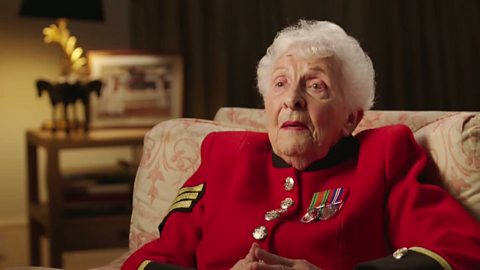
Dorothy Hughes: The girl who broke the rules. video
The story of how Dorothy Hughes came to be one of the first female Chelsea pensioners.
Gus Bialick: The boy who loved Britain. video
Throughout his life, Gus remained fiercely committed to the values for which Britain fought.
Konnie Ho: The girl from Chinatown. video
Evacuation and marriage gave Konnie a different life to the one she had before the war.
Freddie Hunn: The boy who loved poetry. video
Freddie’s love of poetry drove him to join the army and helped maintain morale during the war.