MUSIC PLAYING
Hi! I'm Mwaksy. Hey, I'm Greg.Greg, a question for you. Yes?How do you get from this… Mm? …to this?Skills! How'd you do that? I'm very glad you asked,because that means we can talk about something very helpful - circuits.A circuit is a closed loop that electricity can flow around.Let's start by building a simple circuit.First, a battery -a store of energy that can be converted into electricity.Now let's add a wire for the electricity to flow around.And let's try adding some different "components" to the circuit -a bulb, a buzzer, and a motor.They each use the electricity flowing around the circuitand through them to make light, sound, or movement.And the circuit only works if it is complete.Electricity can't usually jump across a gap.We can use a switch to complete the circuit and turn our components on,or break the circuit and turn it back off again.
Great, so the electricity flows as long as there's a source ofelectricity and an unbroken circuit?That is it. I've actually got a really helpful wayto visualise this, if you're up for it?Really? OK! Show me the science!We are going to imagine that we're part of a supersized circuit,we are going to be circuit components.OK, that sounds great, but are we actually going to use wires?No, our supersized wires will be represented by this red rope. OK.I'll be a battery, so I'm packed full of chemical energy,ready to be converted into electricity.Mwaksy, what will you be? Er… Pick a component.A motor? Perfect. Yeah? OK.All right, so I'll send electricity round the rope,and when it passes through your motor, what happens?I spin! Whee!
HE LAUGHS
So, Greg, that circuit that we made, would that work in real life?Yeah, absolutely. That was actually just a simple version of a circuityou might find in an electric car.A battery, a motor, and lots of other components like headlights,and, of course, a switch to turn the car on and off.Circuits are everywhere, and we use them all the time.Mm, and I guess they can be any size, right? Yeah!Just think about the power lines that carry electricityall the way across the country,or even across the bottom of the sea.OK, so just to recap - a circuit is electricity flowingthrough a big circle, through lots of different components.And if we break that circuit through a switch,then electricity stops flowing?Yeah, spot-on.Right, so if we complete the circuit, then electricitystarts flowing again? Yeah.You've got your thinking face on.Yeah, I've got an idea. All right.I've got a little electricity demo for you!Are you ready, Greg? Yeah, what's going on?OK, take a seat.
LOUD BUZZING
Yes!
SLOWED-DOWN: Ye-e-es!
Did you like that? That's cool!So, I've made a very simple circuit - I've got a buzzer,a very safe low-voltage battery…And some cool fan thing!All right, so when I sit down, I closed a switch. Yeah.And the electricity flowed, got your buzzer going,got your spinney thing going - I'm impressed. Exactly!And I couldn't have said it better myself.So, now we know how circuits work - so I feel like we shouldask them a question. OK, here's the question.Where else have you seen circuits?Whoa, that's a good one. See you soon! Bye! Bye!
LOUD BUZZING
Ah, got me again!
Video summary
Mwaksy and Greg construct a simple circuit that uses cells, wires, bulbs and wires and investigate how a switch opens and closes a circuit.
After making an imaginary super-sized circuit using a rope, Mwaksy uses her electricity know-how to play a noisy prank on Greg.
Show Me the Science is a series of short films and teacher resources for primary schools, following presenters Mwaksy Mudenda and Greg Foot as they use demonstrations, experiments and animations to learn about forces and electricity.
Teacher Notes
Before watching the film:
Prior to this lesson you may wish to introduce students to other relevant topics, for example:
During the film:
Depending on your lesson’s focus, you may wish to pause the video at certain points to check for understanding, asking questions such as:
- What do you use to turn the lights on and off? Where else could you find a switch?
- Upper KS2: Which circuit symbols can you see in the animation? (motor, buzzer, lightbulb, switch, cell*)
- What do you have in the classroom or at home that uses a battery? Does it light up, make a noise, or move? Does it do something else?
- What other circuit components could Mwaksy be in the super-sized ‘rope’ circuit?
- How else can we have fun using electricity?
Note: In physics, what we normally think of as a single battery is actually called a cell. The term battery is used to describe a container of one or more cells. Notice that the symbol for a battery is made from joining two cell symbols together.
Final question:
Where else have you seen circuits in action?
Discussion points for the final question:
- Do you have any circuits in the classroom? What about the lights?
- Do you have any circuits at home?
- How do you think circuits have changed our lives? What would our homes have looked like before electricity was discovered? What would schools have looked like?
- Where else could you see a circuit? What about in a shop, or a bus?
- How can circuits help keep us safe? (E.g. smoke/burglar alarms, traffic lights, headlights on cars.)
Following on from the film:
- Ask your students to make their own super-sized circuit, by passing a ball around to represent the electricity flowing between them.
- Before they start, decide which student will be which circuit component. What should each component do? What will that look like in their circuit?
- You could also try using a rope loop to represent the electricity flowing around the circuit.
This short film is suitable for teaching science at KS2 in England, Wales and Northern Ireland and 2nd Level in Scotland.
What is electricity? video
Mwaksy and Greg learn about what electricity is and how we generate it using movement.

What are conductors and insulators? video
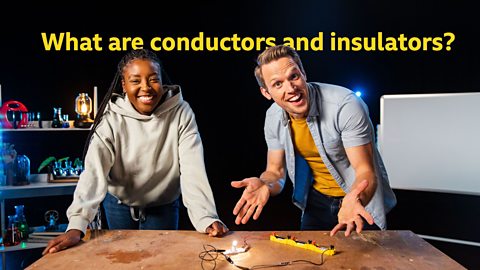
Mwaksy and Greg create circuits using spoons and dough, to learn about conductors and insulators, why they’re useful and how they keep us safe.
Electricity in the world around us. video
Mwaksy and Greg explore the different reasons why electricity is useful and convert the chemical energy in a battery into different forms of energy.