I'm Puja Varsani, and I do Product Design and Robotics at Middlesex University.
When I was in school, I had big dreams. I wanted to be a lawyer, I wanted to be an architect, then I sort of went on this path because I was really good at design technology and I'd found product design, and I've not looked back, really. It's just one of those things that I've just sort of fallen into and I've just loved from day one.
What I love about robotics is the fact that you can make something and you can give it life and you can give it movement. Straightaway, you can see the achievements you've made. In the future, there's the possibility of having a lot more robots in the household, and they could be doing a number of things, from just being a companion to washing dishes or cleaning your room. But you'd want to be comfortable with it and you'd want to trust it to be able to live with it in your house, and that's what my research is based on.
You have to be very practical, hands-on, you want to get your hands dirty and want to go into the workshop and create all these crazy things. Even if it doesn't work, just for fun, just go in there and just have fun, basically. Depending on what project I do, I'd start off sketching. As long as you've got the basics, the raw basics of sketching, and you have the ability to quickly sketch out your idea so someone else can understand it. And then I begin to design it on the computer. So, first what you need to do is make sure that you know roughly what size you're working to and then the shapes that you need as well, and then put it all together, and then you get to see what exactly it'll look like as a whole.
Once I've done that, I'd go into the workshops and start manufacturing it. I'm going to hit play and it will cut out my template for me. And then assembling. You sit here and look at it for a good ten seconds before you figure out if it's this way or if it's this way. And it's this way.
I got told by my mum that when I was a kid, I used to love playing with Lego and just making things with Lego and stuff like that. And I used to want to take things apart. Like, I used to take torches apart just to see what was inside it. I wouldn't take apart anything expensive, like a toaster or anything.
Tomorrow is the first day of my degree show, and that's a big thing because that's what we've been focused towards, that's what we've been working towards. This is very cool. It's not what I expected it to be. I expected it to be like this, like as grand as this but just in a smaller scale. It's a good chance to sort of mingle with industry people as well, because we can invite them to see what skills we have. And it just showcases our work.
I'm a bit apprehensive about the show because it's a very big space we have, and loads of people are going to come see it. The feedback of people's reactions has been quite good. They're really engaging and talking to me and understanding exactly how I started off with my robots. So, yeah, it's positive feedback so far. Explaining it to other people and getting them to have the same passion as I do for what I am doing, that's a bit scary.
So basically, what I'm doing is social robotics. If you look at how people react and their body language and stuff like that and convey it to robot language, it could be, you know, people could understand it. It's mind-blowing, thinking about people that are talking to me could potentially be like, "Oh, yeah, jot down your e-mail address," and next week, I might get an e-mail saying, "We want you to do this because we saw you at the degree show and we found that you had such amazing skills." So yeah, a bit crazy.
Video summary
Puja Varsani is a product designer with a fascinating passion for social robotics.
Puja explains that these robots may, one day, be a companion or even do the washing and cleaning up!
These are robots that help people and in the future they may have a role anywhere from the home to the NHS.
The designer shows us how she comes up with her ideas and reveals some of the tricks of the trade before a display of her robots is unveiled to a curious audience at an exhibition.
Teacher Notes
Students could brainstorm what made Puja become a robot designer whilst watching the clip.
This could be followed by a discussion on why we should choose certain career paths.
Students could list the hobbies and pastimes that interest them and research what future careers they might possibly lead to.
This clip will be relevant for teaching Modern Studies.
This topic will be relevant for KS2 and KS3 in England and Wales, and 2nd, 3rd, 4th levels and National 4, 5 and Higher in Scotland.
A career in fashion. video
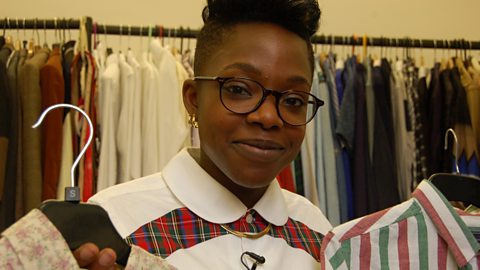
Stylist Ayishat Akanbi takes us inside her work in fashion.
A career as a games artist. video
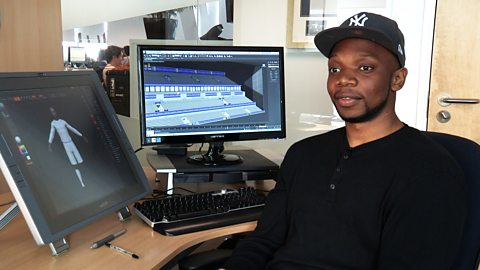
Ronnie Ochero turned his childhood obsession of playing video games into a career, by making them!
A career as a space scientist. video
Space scientist Maggie Aderin-Pocock explains why being different is no barrier to success if you are passionate about something.

