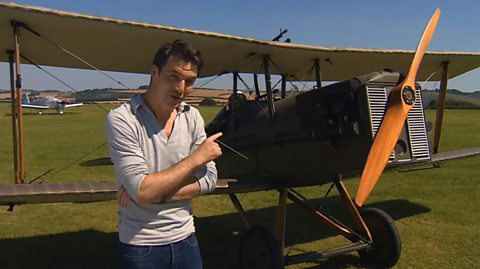
Dan Snow:Hello, I'm Dan Snow. Amongst the many, often terrible things that WW1 is noted for, is the fact that it was the first conflict in which air power, and who ruled the skies, was a significant factor.
Dan Snow:Fixed wing planes had been used in a military role before 1914, but WW1 was really when the fighter pilot came into being. And the war was still being fought when, in April 1918, the Royal Flying Corps and the Royal Naval Air Service merged to form what is still going strong a century later, the Royal Air Force, aka the RAF.
Dan Snow:For a bit of insight into what it was like for those early pilots here's James May, a man who knows a thing or two about engines.
James May:The first flight in a powered aeroplane was in 1903. It had barely left the ground before military sorts began to wonder if this contraption would be of any use to them.
James May:In the early days of the aeroplane, it's value was not truly appreciated by the war-makers. It was generally used for spying on the enemy's cavalry, or for making sure our boys were firing in the right direction.
James May:But this reconnaissance proved so important that in 1915 pilots started taking pot shots at each other, and dog fighting began. They also began lobbing things over the side. And a form of warfare that came to overshadow the 20th Century was born: aerial bombing.
James May:These were the weapons of choice for the early aerial warriors, not that they actually had a great deal of choice, they're Flechettes, small darts made out of steel. But not all pilots were terribly keen on this sort of thing.
James May:In Britain's Royal Flying corps, for example, some officers said, "It's a dirty way of fighting". "The enemy can't hear the things coming and they make such nasty wounds."
James May:But such scruples were short lived. It's hard to believe they could hit anything, especially when they were dodging fire from the ground.
1000:02:14:02 00:02:22:24James May:So, to see how accurate they could be, I'm going to take myself back to the early days of the aeroplane and the first air warriors.
James May:Now for the purposes of this aerial bombing demonstration we're going to use flour. Partly so that you can see where the bombs land and partly because there is something intrinsically amusing about flour bombs.
James May:We've actually had to get permission from the Civil Aviation Authority to do this and the bomb is allowed to be no more than 500 grams of highly explosive, self-raising flour.
James May:Early flying wasn't for the faint hearted. Aeroplanes were prone to breaking up and there was a constant risk of fire. But the pilots rarely wore parachutes.
James May:My first run will be at 600 feet. This should give me a chance of hitting the target. Back in WW1, I would also have been at risk of being hit by enemy gunfire.
James May:Bomb door open.
James May:From up here the target looks pretty small. In fact it's seven by seven metres.
James May:Steady as she goes.
James May:Bombs away.
James May:Oh yeah, miles off.
James May:I decided to drop down to 400 feet.
James May:Bomb gone.
James May:Hmm that wouldn't have bothered Jerry. Picking the right moment to drop the bombs is tricky. I'm having to take into account the aeroplane's speed, the wind speed and the bomb's aerodynamics. So let's try 200 feet.
James May:Bombs away.
James May:At last, on target.
James May:[LAUGHS]
James May:Let's just see that again. So, from 200 feet you'd have a chance of hitting the enemy. Sadly, they'd have a better chance of hitting you first. And that drove the pilots to fly higher.
James May:Sometimes they did it from 1,500 or 2,000 feet so how they even hit the right country, frankly, is beyond me.
Video summary
James May looks at the role of aeroplanes in World War One.
From the early years of the war when they were mainly used for reconnaissance, to dog fights between enemy aircraft, and ultimately aerial bombing.
Early pilots used metal darts to drop over enemy lines, despite objections from some in the Royal Flying Corps.
James demonstrates just how difficult a task this was.
Pilots lives were dangerous, with unreliable planes, enemy fire and no parachutes!
Teacher Notes
The presenter in this clip uses language that could be offensive when describing the Germans. It may be worth acknowledging this and discussing why this language was used at the time with your students.
Key Stage 3:
Students could be shown a picture of a World War One plane and be asked to come up with ideas about what it might be used for, and to identify similarities and differences between a modern RAF plane.
They could then watch the clip and list all the uses of places in World War One and then the dangers and challenges pilots place.
Next they could compare the life of a pilot with the life of a soldier in the trenches to come up with a conclusion about whose life was more dangerous.
Key Stage 4:
Students could use this clip as part of a wider study on new technology in World War One.
They could use the clip as a starting point to explain how aeroplanes could contribute to the wider war effort- with reconnaissance, aerial bombing and dog fights.
This could then be used to evaluate aeroplanes importance in overall victory.
This clip will be relevant for teaching History at KS3 and KS4/GCSE in England Wales and Northern Ireland.
Also at 3rd Level, 4th Level, National 4/National 5 and Higher in Scotland.
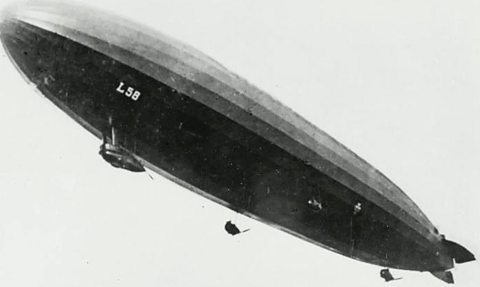
How did Britain deal with the Zeppelin threat during World War One? video
Ben Robinson examines the Zeppelin threat to Britain during World War One.
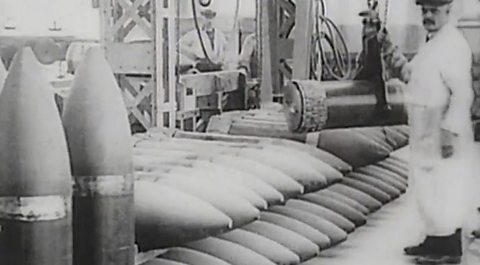
How did Britain meet demands for weapon production in World War One? video
Saul David on how Britain struggled to produce the weapons to supply the army in World War One.
How did the Royal Flying Corps contribute to World War One? video
Joe Crowley looks at the history of the Royal Flying Corps and the role it played in World War One, leading to the creation of the RAF in 1918.