NARRATOR: Welcome to Religions of the World. Christianity: The Religion of Christians.
Jesus is the most important person for Christians. Christian believe Jesus was the son of God. Jesus was a teacher and told everyone stories to make them think about God and about how you should treat other people with kindness. One of his most important messages, something he said to people a lot was that you should love your neighbour.
One day, while Jesus was talking to a crowd of people, someone asked him, “Who is my neighbour?” And Jesus told him this story. The Christian Story of the Good Samaritan.
Once, there was a Jewish man who was travelling from Jerusalem to his home in Jericho. The road was rocky and ran through the hills. Suddenly, a group of bandits jumped from their hiding place. They took all his belongings and ripped off his clothes. They robbed him and then left him lying, hurt, by the side of the road so that he wouldn’t chase after them.
A little while later, a priest was walking along the same road. The injured man called out to the priest for help.
INJURED MAN: Help me.
NARRATOR: Would the priest love his neighbour? The priest was scared. He thought that the bandits might still be nearby so he hurried past on the other side of the road, ignoring the injured man’s calls for help.
PRIEST: I am sorry.
NARRATOR: Later, a priest’s helper came along the same road. Again, the injured man called out to him.
INJURED MAN: Help me.
NARRATOR: Would the priest’s assistant love his neighbour? The priest’s assistant looked down at the injured man to check if he knew him. But he realised he didn’t know the man and hurried off down the road.
PRIEST’S ASSISTANT: I can’t do that.
NARRATOR: A little while later, a third man walked past. He was from Samaria, a neighbouring country. Samaritans were enemies to the Jewish people. They had never liked each other. Would the Samaritan help his neighbour, even though his people did not like the Jewish people?
INJURED MAN: Please. Help me.
NARRATOR: The Samaritan saw the Jewish man lying by the side of the road and immediately felt sorry for him. He knelt down next to the injured man, wrapped his wounds and gave him some water. He then helped the injured man onto his donkey and carried him all the way to the nearest town.
He even paid for the man to stay in an inn until he was better. After Jesus had told this story, he asked all the people listening a question. “Who was a loving neighbour in the story?” The man who had asked the question, answered. It was the Samaritan. Jesus said, “You go and do the same.”
While Jesus was travelling around, spreading the word of God, his Father, he made sure that he spoke to everyone and treated everyone equally. The priests and other religious leaders were very angry that Jesus was often seen talking to people they thought were bad or mean.
Jesus told them the story to help them understand why he spoke to these people in the same way he spoke to everyone else.
The Christian Story of the Lost Sheep.
Once, there was a shepherd who looked after 100 sheep. One evening, when he was counting his sheep into their shelter for the night, he only counted 99. There was one sheep missing. The shepherd made sure the 99 sheep were safe.
Then he set out to find the one lost sheep. He travelled across rivers and hills, through fields and forests until he eventually found the sheep. He was very happy to have found the sheep so he carried it all the way home on his shoulders. When he arrived back, he happily told all his friends that he’d managed to find and save the one lost sheep.
Jesus’ story showed the people listening that God cares about everyone. Even if people get lost or wander away from God, he still loves them. In fact, finding the lost sheep made the shepherd even happier than the 99 sheep who had not got lost. Jesus used lots of stories like this to teach people to think about how God treats people and how we should treat everyone else.
Video summary
Part of a series of animated films teaching pupils about religions of the world.
This film focuses on Christianity, and narrates the story of the Good Samaritan & the Lost Sheep.
This film tells the story of man robbed and left by the road and the kind Samaritan who looked after him, and the lost sheep who was found and recovered to the flock.
The film is bright and colourful and immerses the pupils in the story through a clear, friendly narrative.
This clip is from the series Religions of the World.
Teacher Notes
This could be used to discuss how it feels when you lose something special.
How long would you spend looking for a lost toy?
Teachers could create puppets for the characters in the stories and ask the pupils to retell the stories in groups.
They could discuss the idea of loving our neighbour. Who is our neighbour?
Pupils could draw some ideas of people who are our 'neighbours', who we might be able to help, in a local and global sense (e.g. refugees, homeless people).
This short film will be relevant for teaching KS1 religious education in England and Northern Ireland, Foundation Phase in Wales, and Early and 1st Level Religious and Moral Education in Scotland.
The Buddhist Story of Siddhartha and the Swan and The Monkey King. video
A short animated film narrating two Buddhist stories.

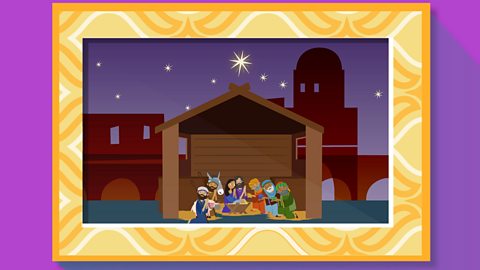
The Christian Story of the First Christmas. video
A short animated film for primary schools narrating the story of the first Christmas.
The Christian Story of Easter. video
A short animated film narrating the Christian story of Easter.

The Hindu Story of Rama and Sita. video
A short animated film narrating one of the main stories of Diwali.

The Islamic Story of The Prophet and the Ants and 'The Crying Camel' video
A short animated film narrating two Islamic stories.

The Five Pillars of Islam. video
A short animated film explaining the Five Pillars of Islam.

The Jewish Story of Moses. video
A short animated film narrating the Jewish story of Moses.

The Jewish Story of Hanukkah. video
A short animated film narrating the Jewish story of Hanukkah.

Sikh Stories. video
A short animated film narrating the Sikh Story of the Milk and the Jasmine Flower and Duni Chand and the Silver Needle.