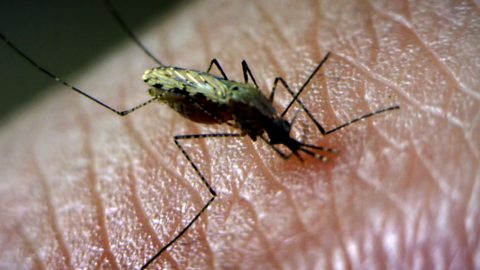
In this short film Dr Michael Mosley visits a 'delousing salon' in London to collect live head lice.
Delousing salons use a vacuum cleaner with a specialised attachment to collect the ten to twenty lice that an infected person typically has.
Michael Mosley infects himself and visits the London School of Hygiene & Tropical Medicine.
Here, he looks at the lice sucking his blood using a handheld microscope.
The speed of the lice moving over his arms is amazing.
The co-evolution of these organisms with humans is also described.
This short film is from the BBC series, Michael Mosley: Infested! Living with parasites.
PLEASE NOTE: THIS SHORT FILM CONTAINS DISTURBING SCENES AND TEACHER REVIEW IS RECOMMENDED PRIOR TO USE IN CLASS.
Teacher Notes
This short film could provide an interesting introduction to the topic of parasitism (and mutualism).
This could lead to studying the effects of parasites on humans or other organisms (including plants).
This could also introduce the topic of co-evolution (humans and body lice).
Curriculum Notes
This short film is suitable for teaching biology at KS4/GCSE in England, Wales and Northern Ireland and National 4/5 in Scotland.

More from Michael Mosley: Infested! Living with Parasites:
Infested by hookworm. video
In this short film Dr Michael Mosley investigates hookworms - large parasites which invade our immune system. He meets a sufferer of Crohn’s disease who infected himself with hookworms to reduce his symptoms.
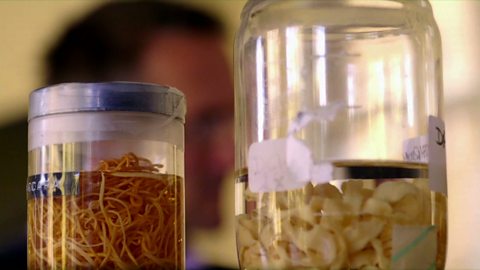
Infested by leeches. video
In this short film Dr Michael Mosley interviews a surgeon who is pioneering the use of leeches in medical research.
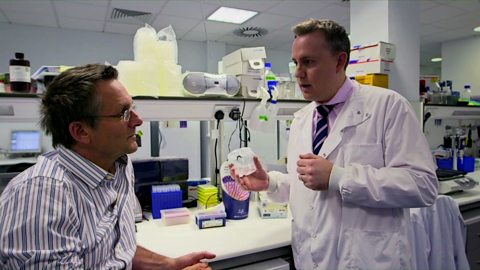
Infested by tapeworms. video
In this short film Dr Michael Mosley visits Kenya to see how the beef tapeworm needs to infect both beef cattle and humans to complete its life-cycle.
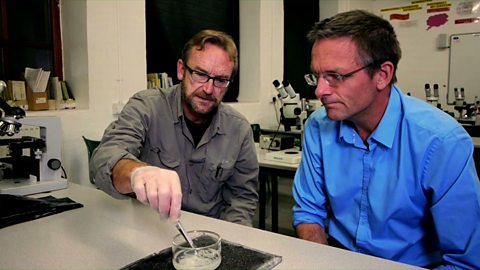
Infested by Toxoplasma gondii. video
In this short film Dr Michael Mosley describes the infection of household cats with Toxoplasma gondii.

Infested with malaria. video
In this short film Dr Michael Mosley investigates the parasite Plasmodium that carries malaria. This disease kills more than half a million people per year.