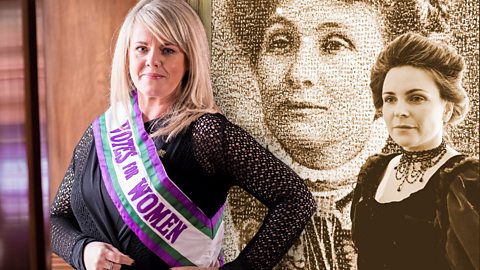
FORGOTTEN SUFFRAGETTES
On Friday 18 November 1910, over 300 suffragettes marched in protest through Westminster to Parliament, angry the government had abandoned a Bill that proposed granting women the right to vote.
Amongst the protesters that day were three courageous women from three very different backgrounds who, despite their differences, joined together to fight for a shared cause.
Princess Sophia Duleep Singh (1876 - 1948)
Princess Sophia was the daughter of Duleep Singh, the last Maharaja of the Sikh Empire, whose lands in India had been seized by the British when he was just 10 years old.
The Maharaja and his family became favourites of Queen Victoria when they were forced into exile in England. A house at Hampton Court Palace was given to Sophia as one of the Queen’s goddaughters.
After witnessing society’s deep inequalities, both in England and in India, this glamorous society figure became a leading women’s rights activist. She threw herself at the Prime Minister’s car carrying a sign that read ‘Give Women the Vote’.
Sophia refused to provide her details for the national census and pay her taxes. She was taken to court for this but demanded to know why she should pay tax when she was not considered fit to vote.
The Princess donated large sums of money to further fight for the vote, and could often be seen outside the gates of Hampton Court Palace selling the suffragette newspaper.
This promotion of a cause seen by some as radical and controversial, by a princess on royals grounds, was shocking to society and the newspapers of the time.
However, Sophia’s actions inspired women to continue their fight for the right to vote, both in Great Britain and in her father’s homeland of India.
Annie Kenney (1879 - 1953)
Annie Kenney was born into a large working-class family in Lancashire. From the age of 10 she had to work long hours at a local cotton mill.
Annie’s life changed in her twenties when she went to see the inspirational Christabel Pankhurst talk about women’s right to vote. She became passionately devoted to the cause.
The two women became friends, campaigning and protesting together. They disrupted an important political meeting in Manchester, where they heckled politicians - including Winston Churchill - demanding to know if they would give women the vote.
The women were arrested and fined; when they refused to pay they were sent to prison. Annie would be arrested a further 12 times before women were granted the vote.
Annie travelled up and down the country giving passionate speeches, popularising the cause among working-class women and recruiting them, and gaining the support of wealthy donors.
Annie was a militant, believing ‘deeds not words’ were necessary to win women the right to vote. During several of her prison stays for such protests,Annie was one of many suffragettes who went on hunger strike.
A new law, designed to prevent deaths in custody, gave Annie a temporary release from prison when she became too weak or unwell, but required her to return to prison again when she was well enough.
Annie repeatedly avoided the return to prison, evading police who were waiting for her outside rallies, and using elaborate tricks or disguises to sneak inside, where she would be greeted with wild applause.
(Rosa) May Billinghurst (1875 - 1953)
May Billinghurst contracted polio as a baby, leaving her paralysed from the waist down. In spite of her disability, she dedicated herself to helping others who were less fortunate, working in London's slums and workhouses.
Her first-hand experience working with London’s poor and vulnerable - particularly women - led her to join the suffragettes. She soon became a well-known figure at rallies, on her distinctive tricycle decorated in suffragette colours.
May, like Annie Kenney, believed in militant action: smashing windows and destroying the contents of post boxes as a way of protesting.
After her third arrest May was sentenced to eight months in prison. She went on hunger strike and suffered violent force feeding.
Suffragettes were outraged at this treatment of a woman with disabilities. Emmeline Pankhurst led a campaign that increased awareness of the situation. Eventually May was released.
Sophia, Annie and May were all at the march to Westminster in 1910. As they reached Parliament, police met the protesters with unexpected violence. Women were beaten and pushed to the ground, earning this day the name ‘Black Friday’.
In Westminster today, a large statue celebrates the suffragettes and their campaign. Without the action of these women, and thousands like them, women might never have won the right to vote.
Video summary
This animation explores the actions and experiences of three lesser-known - but nonetheless historically significant - suffragettes from diverse backgrounds: Princess Sophia Duleep Singh, Annie Kenney and (Rosa) May Billinghurst. Each of them was present at the protest march in Westminster on 18 November 1910 that subsequently became known as 'Black Friday'.
Narratives about the suffragette movement have historically focused on prominent activists such as the Pankhurst family and Emily Wilding Davison. Acknowledging the important work of these leading suffragettes ought not to hide the stories of other campaigners: women from diverse backgrounds who also played a significant role in campaigning for women’s suffrage.
This animation shares the stories of three of these ‘forgotten’ suffragettes, demonstrating how much is owed today to a group of activists that included women of colour, women from all social classes and women with disabilities:
- Princess Sophia Duleep Singh (1876 - 1948): the daughter of Maharaja Duleep Singh and Queen Victoria’s goddaughter, who brought the fight for women’s votes to the gates of Hampton Court Palace
- Annie Kenney (1879 - 1953): the working-class suffragette arrested alongside Christabel Pankhurst after heckling Winston Churchill about voting rights in 1905
- May Billinghurst (1875 - 1953): the disabled suffragette who attended rallies in her customised tricycle and founded the Greenwich branch of the Women’s Social and Political Union (WSPU).
Showcasing the important contribution made to Britain by those from diverse backgrounds promotes a sense of inclusivity, regardless of gender, background or ability: the story of women’s suffrage is part of our shared history.
Teacher notes
Before the video:
Before watching the video, students could discuss suffragettes with whom they might be familiar - eg Emmeline, Christabel and/or Sylvia Pankhurst. They might then be invited to consider what these women have in common and whether there are any voices that don’t appear in prevailing accounts of suffragette history.
While watching the video:
Students could consider the following:
- What sort of women became suffragettes?
- What were their motivations?
- Was it harder for some women to fight for the vote than others? Why?
- What obstacles did the suffragettes face in their fight to obtain the vote?
- What types of action did the suffragettes take?
- Why did some people find the suffragettes and their cause controversial?
At the end of the video:
- Students could undertake group projects in which they discover more information about one of the suffragettes covered in the film, or other similarly 'forgotten' suffragettes.
- Students could be invited to consider whether or not they would have supported the suffragettes’ cause. How far would they have been willing to go to win the vote for women? Do they think that 'the ends justify the means'?
- Students could produce a piece of writing about why they think these particular suffragettes aren’t talked about as frequently as others, such as the Pankhursts. What does this suggest about the way historical accounts are constructed?
Terms and concepts for discussion:
- 'Suffragettes' vs 'suffragists'
- Militant
- Census
- Force feeding / Cat and Mouse Act 1913
Suitable for teaching History at KS3 Level in England, Wales and Northern Ireland and Third Level in Scotland.

See also...
Emmeline Pankhurst and the Suffragettes. collection
In this series of short films, Sally Lindsay takes a look at the personal loves, losses and political passions that transformed Emmeline Pankhurst from a working mum from Manchester into a militant activist.