Karim: Design isn’t just about making things look good, it’s also about making sure that the thing works.
Karim: Take this chair. If it hasn’t been properly designed and tested then it will just collapse when I sit down on it.
Karim: Thank goodness for that!
Karim: When designing a new product, designers make a thing called a prototype.
Karim: Come on, I'll show you.
Karim: A prototype is like a model that designers make to take their idea from a flat illustration on a page to a 3D item that you can look at from all angles.
Karim: It’s the best way to get a feel for if the design really works and more importantly if it doesn't work and what needs to be changed.
Karim: Remember, prototypes are temporary models. They're not strong enough to hold a person… even a little person like me.
Karim: So who made this then?
Karim: MEET THE MASTER!
Karim: David Irwin is a furniture designer living and working in Newcastle.
David: The key to good design for me is trying to keep things as simple as possible. Whenever I start a new project I try to consider three things.
David: First of all, where the product is going to used, how it's going to be used and also what it's going to be made from.
David: So the first thing to do is start sketching. You can be as rough as you like, its just to get that idea out of your head and down onto paper.
David: And don't worry about making mistakes.
David: I try to imagine it in three dimensions, so what it looks like from all angles.
David: If we think about a cube with all those different faces and then try and imagine what the product that you're designing looks like from all these different angles.
David: So you can work from that to create a prototype, and from that prototype you can create the final, finished piece of furniture.
David: So your challenge today is to design and make a prototype of a chair. Here are some examples…
David: Remember to think about where your design is going to be used and make sure it's suitable for that space.
David: So what are you waiting for? Go get creative!
Karim: Nice! So who's going to be taking on this challenge then?
Karim: This is Molly, and she can make a pencil appear whenever she needs it!
Karim: Next up its Sam, who can appear and disappear whenever he likes!
Karim: Hey! Where did he go?
Karim: And finally, we've got Rudi, and her creative super power is super shading!
Karim: Right team, are we ready to design a chair?
Children: YEAH!
Karim: Wicked! You will need…
Karim: A pencil, paper and a rubber…
Karim: A range of different materials…
Karim: Safety scissors, glue and tape.
Karim: First things first, let’s try and sketch out some of the ideas we might have, so grab some pencils and pens…
Karim: What are you going to do? I'm going to go for a relaxing chair. You know the ones where you sit down and it reclines back?
Rudi: I'm going to do a really comfy thinking chair.
Molly: A rainbow reading chair.
Karim: Sam the man with the plan! Talk to me about your chair.
Sam: I'm going to do a game chair.
Karim: Right, let's get sketching!
Karim: Wow, these are looking brilliant. Let me see your designs, hold them up!
Karim: Wow, so many colourful ones there. Looking extra comfy, we've got the gaming chair.
Karim: Awesome, well done guys! Now that we’ve sketched out our ideas it’s time to make the prototypes!
Karim: So there's loads of materials in the middle, get stuck in, let's see what we can make, yeah?
Karim: Remember with a prototype like this its all about making your drawing into a 3D model.
Karim: You don’t need to be able to sit on it and it can be any size you like.
Karim: Right, now it’s over to you! Get creating and remember don’t sit on your prototypes!
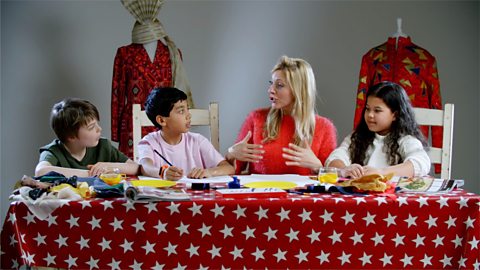
Karim: Hey guys, should we make one big prototype together?
Rudi: Yes, should we make a couch?
Karim: A couch? Sounds good. Let's go for materials!
Karim: If you enjoyed this creative challenge there are loads more over on the BBC Teach website.
Karim: You can create a cake sculpture, tell a story or design a costume. So go on get creative!
Video summary
Presenter Karim Zeroual is in a furniture store. Art and creativity are all around us, but have you ever thought of furniture design as art?
Isn’t it amazing to think that every bit of furniture that we use began life as an idea and probably a sketch of some sort?
We meet David Irwin, master furniture designer, he has invited us to his industrial design studio to learn how to design and make a chair.
David demonstrates how he begins sketching design ideas and then makes a prototype to test the success of his design in three-dimensions.
Karim and a group of children take on the challenge to design a prototype for a chair of their own.
We see them enjoying the challenge and get a look at their final prototypes.
This short film is from the BBC series, Get Creative.
Teacher Notes
Before Watching
Look at furniture around the classroom and ask your pupils to think of furniture they use at home, discuss how all items of furniture began as a designer’s idea.
Ask the children what sort of things designers might consider when designing and making a chair.
Ask pupils to reflect on how they think ideas are best recorded (i.e. with 2D sketches), and encourage the children to reflect upon the limitations of a 2D sketch.
You could spend some time practicing sketching items of furniture from around the classroom or from images.
Timed sketches work well as an exercise; you could begin with five minute sketches and work down to 30 second sketches.
After Watching
Ask pupils to have a think about the purpose and setting for their chair and how these points will impact their design.
Let the children sketch a few possible designs, they can then use peer discussions to establish which design will work best as an actual chair.
Ensure that the children know which materials are available to them and encourage them to think practically about how they will use the materials provided to construct their prototype of the chair.
You may need to demonstrate some simple joining techniques (e.g. how to use masking tape to connect two pieces of card to each other).
Master Skills
Sketching a design to inform model making.
Using a design to inform sculpting using a variety of materials.
Thinking Questions
- What is the purpose of your chair?
- Who will be sitting on your chair?
- Where will your chair be used?
- Does your design show the chair from a variety of angles?
Supported Learning and SEN
Depending on the ability of the children in your cohort, you may chose to begin by looking at different chairs and talking through the features of a chair.
Provide examples of simple chair designs in 2D, these can be found with a simple internet search.
This will give the children a starting point and help them understand the elements they need to include (e.g. legs and body of the chair), with drawings from different angles.
It might be helpful to prepare or demonstrate how to join materials to each other (e.g. how to use masking tape and simple tabs, slits, slots and folds).
Offer children the option of working in a group or provide support from an adult or more able peer.
Extend this Project
You could extend this challenge by having the children work in small groups to create a life-sized version of one of their chair designs, using junk modelling techniques.
Perhaps even have the children ‘pitch’ their design to an imagined furniture store or homeowner.
At the end of the project, ask the children to write or speak about how they will know if their design was a success (maybe test the seat with a cuddly toy).
Have the children evaluate their work according to the set of specifications they develop and discuss how they could improve on the design.
Curriculum Notes
This short film meets and extends the current national curriculum requirements for art and design at KS1 and KS2 in England, Wales and Northern Ireland and at 2nd Level in Scotland.
The film and lesson ideas will engage, inspire and challenge your pupils to explore their own ideas and produce creative work.
The short film introduces children to high quality skills and knowledge in art and design.
The challenge set supports children in becoming proficient in techniques including, but not limited to, drawing, painting and sculpture.
Through this series of short films, pupils will be introduced to and inspired by a range of artists, craftspeople and designers, they will experiment, invent and create work that links to the work of professional creatives.
Stop-motion Animation. video
Naomi Wilkinson visits an animation studio and shows us how to create our own stop-motion animation.
Cake Sculptures. video
Karim Zeroual introduces cake sculpting and sets a challenge to make your own cake topper.
Costume Design. video
Naomi Wilkinson goes exploring in the costume department and challenges us to design our own costume.