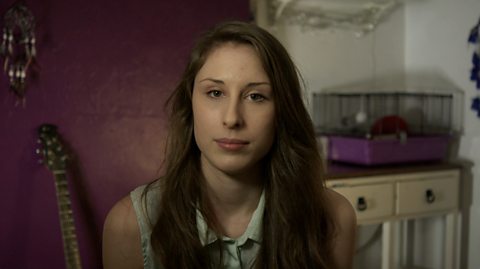
I dropped out of university. I was nearly kicked out of my family home and nobody trusted me.
I’m Sam. I’m from London. I’m quite a chilled out, open-minded kind of guy. I’m in to my hip-hop and my drum and bass. I come from quite a big family. I’ve got three brothers.
My first experience with weed, with any kind of drug, was when I was twelve years old.
The pattern was I’d go to school. I’d come home. I’d watch a bit of TV, then I’d smoke a spliff.
That went on for about 6 months or a year before I started actually doing it during school, and after school, and just every waking moment.
When I was 15 I went to my first music festival. At that festival, I came across ketamine and tried it and I took to it, I really took to it. It was a whole new thing for me.
Voice over:
Ketamine is a clear liquid or powder. It is a powerful anaesthetic, which is misused by drug users who snort it, inject it or swallow it. It can alter levels of neurotransmitters in the brain, creating the feeling that the brain is shutting off from the body. Under it’s influence, the mind can also begin to perceive things that aren’t really there, known as hallucinations. All this causes a sense of mind-body separation, with loss of control and a feeling of floating.
Sam:
It was the same as the weed. I started doing it in the evenings, on the weekends, you know. I’d get a bit and it would last me a few days and then slowly I’d start doing it every day and then I’d do a line in the morning before I went to school. Yeah, it became completely out of control.
I barely scraped by through my GSCE’s and A Levels but I became motivated to try and go to university, which I managed to get in to. I went to Brighton University. When I was at uni in Brighton, my life was completely controlled by my drug taking and so I wasn’t able to focus on anything.
Voice over:
The anaesthetic effect of Ketamine reduces the brain’s alertness, leading to difficulties of movement and concentration. Users need more and more Ketamine to counteract these side effects, which can lead to addiction. The combination of altered mental function, and addiction can reduce the user’s ability to focus on anything except the next dose.
Sam:
I, er, was completely wasted every day, walking around like a zombie.
I failed the courses that I was on… er… it ended up with me moving back to London, back to my parents. I’d built up a reputation within my family as somebody that you couldn’t trust. I mean sometimes when I was on the ketamine and I’d come down to the dinner table, I’d think that I was alright but then I’d try and talk and I couldn’t speak and it would just be a very ugly thing for my parents to have to see. You know, constantly being told, you know, that I’m not making any sense… yeah…
My parents reached out to me. They tried to help and I refused the help. They threatened to kick me out of the house but they couldn’t because they were scared that I would end up dead or in jail.
It eventually all caught up with me.
I started getting stomach cramps and these were very extreme, probably the most painful thing that I’ve ever experienced. I started getting kidney pains which I didn’t know were kidney pains, I just thought it was a pain in my lower back. I used to get terrible problems with my bladder. So I would have to go to the toilet constantly. I was passing blood in my urine regularly, erm, every time went to the toilet.
Voice over:
Long-term use of Ketamine can damage the bladder, impairing its ability to stretch sufficiently as it fills. It’s thought the urine effectively backs up, swelling the kidneys, causing pain and possibly even kidney failure. The lining of the bladder can also be damaged, producing blood in the urine.
Sam:
It doesn’t matter how bad the pain is, how serious the symptoms are, you know, I wasn’t going to be stopping taking that drug because I was addicted to it, completely and totally.
I stopped really mixing with people. I didn’t spend time with my friends or with my brothers. I was on my own most of the time. I didn’t really want people to know how bad things were. And it was a miserable point in my life.
My dad kind of blew a fuse and he gave me the choice that I can either leave the house, you know, and basically never come back. Or he would help to put me in to rehab and try and sort out my problem. And, erm… so I accepted the help that he offered me. And, erm, within a week I was in a residential treatment centre for drug addiction.
Just feels so far apart from that whole world of hard drugs, when you are young, that you tend to not, well I tended to not listen a great deal to, when stuff was being said about it.
Video summary
Sam describes how his life dramatically changed through his involvement with illegal drugs.
He reflects honestly about his experience and explains how what started out as fun eventually led to reliance, with severe physical and psychological consequences.
Sam, now in his early twenties, reflects on how a cocktail of drugs devastated his teenage years.
An addiction to ketamine, a powerful general anaesthetic, severely damaged his kidneys, and caused him to pass blood in his urine, as the lining of his bladder was destroyed.
He recalls the downward spiral in which he took more and more of the drug to try to combat the pain.
Eventually Sam was thrown out of university and went into rehab.
Sam's story is interspersed with graphics, which explain in detail the chemical and biological processes that were taking place in his body as he was taking drugs.
The film also highlights key statistics in relation to young people's drug taking, confirming that only a very small minority of young people have ever tried them.
These films feature sensitive topics and behaviour which could be imitated. Teacher review is recommended prior to use in class
This clip is from the series Drugs: My Story.
Teacher Notes
The clip could spark discussions in class on drug use and its dangers.
Sam's story is one of significant risky behaviours, but there is one in particular, what do you think it is?
Teachers could note that he was using ketamine alone. Students could be tasked with drawing the effects of ketamine - an anaesthetic - on a map of the brain and body.
Extensive use of ketamine can damage the body significantly, particularly the bladder and kidneys. As a result of the pain, users of ketamine often use more of it as it's an anaesthetic, beginning a vicious cycle.
Ask students why they think people use drugs.
This could lead to discussions about peer pressure, feeling lonely as in Sam's case and coping with life in general.
What are healthier ways of coping with the challenges of growing up and other life challenges?
Sam's family lost trust in him, what do you think that must be like? What was it like for Sam and what was it like for the people who love him?
This clip will be relevant for teaching the dangers of drug use in PSHE and Citizenship. This topic appears in OCR, Edexcel, AQA, WJEC KS4/GCSE in England and Wales, CCEA GCSE in Northern Ireland and SQA National 4/5 in Scotland._
Jade's experience of taking mephedrone. video
Jade gives a highly personal account of how taking a variety of illegal drugs devastated her life.
Lorne's experience of smoking cannabis. video
Lorne, 17, describes how becoming addicted to cannabis devastated his life and damaged his hopes of becoming a professional footballer.
Rose's experience of taking legal high drugs. video
Rose describes how she collapsed after smoking a 'legal high' at a music festival.