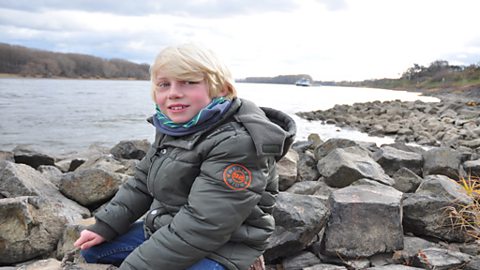
A child-led introduction to Füssen, Germany, suitable to support study of a European location at KS2.
The video
Phillip: My name is Phillip. I live in Halblech, in Bavaria.
Phillip: SPEAKING BAVARIAN-GERMAN
Phillip - TRANSLATED: Halblech is a few kilometers away from Schwangau and Füssen. This region is called Allgäu. My father is a soldier and works, in Dresden, training officers.
Phillip's mother & father: SPEAKING BAVARIAN-GERMAN
Phillip - TRANSLATED: Once, he was stationed in Afghanistan.
Phillip's mother: SPEAKING BAVARIAN-GERMAN
Phillip - TRANSLATED: That was quite hard for my mom, because she was all alone.
Phillip & family: SPEAKING BAVARIAN-GERMAN
Phillip - TRANSLATED: My house is made from wood and concrete. The concrete comes from our family business, which was started by my grandpa and grandma.
Phillip's grandpa: SPEAKING BAVARIAN-GERMAN
Phillip - TRANSLATED: My mother, grandpa and uncles all work at the gravel pit. Grandpa and I often drive the bulldozer together in the gravel pit, and we dig from the huge mounds of gravel and sand. Once, we found a mammoth tooth in the sand.
Phillip's grandpa: SPEAKING BAVARIAN-GERMAN
Phillip - TRANSLATED: It's a lot of fun driving the bulldozer with my grandpa. This is the land of kings and castles. Neuschwanstein is the most famous castle.
Caption: Konigsschlosser.
Phillip - TRANSLATED: King Ludwig built it. Some people say he was mad, but he's often called the Swan King, or Fairytale King. This castle has been a location for lots of films, like Chitty Chitty Bang Bang and Sleeping Beauty. I can see the castles from my house and from my school. This is my classroom, and from here I can see Neuschwanstein Castle.
In Bavaria, we have many old customs. For example, we have a traditional costume club. Each club has its own costume with its own colours. My feather is a real eagle's feather, but eagles are now protected.
Our mountains and lakes are really beautiful. Our mountains are called the Alps. Lots of tourists come up here to see the beautiful views and enjoy the tasty food. From the top of the mountain, you can see all the lakes, rivers, and woods.
The most famous lakes in our area are called the Forggensee, the Bannwaldsee, and the Alpsee. The Forggensee is the largest. It's man-made, and it was built to help generate electricity. At the power plant, there's a section that looks just like a pair of trousers. In Bavaria, we've got about 4,200 hydroelectric power plants.
What I really love is fishing by the river. The river is called the Lech. I fish for trout all year round, except in winter, when we're not allowed to. The river's important, because we use its water for drinking. It's pure, clear, and flowing water from the mountains. We don't need to clean the water with chlorine because it's so clean.
In the summer, lots of children come here to build stone men by the river. It's quite tricky, because you need to be careful that the stones are balanced.
Phillip: No, that's not good idea.
Phillip - TRANSLATED: I love where I live, and if you were to visit Allgäu, you would love it too.
Video summary
Download/print a transcript of the video.
Füssen lies in the Allgäu region of Bavaria in Germany, famous for its mountain lakes, the Alps and castles including Neuschwanstein, which has been featured in a number of films.
Philipp is 12-years-old and is a member of a traditional dancing and cultural group.
He dresses in lederhosen and dances traditional German dances. His family own a concrete factory and their business depends on the mountains for the mined stone.
The area has many lakes and fast running rivers that help power the local hydroelectric plants.
There are about 14 plants in the Füssen area alone, and around 1400 in Bavaria. Lots of tourists come to ski in the winter and paraglide in the summer.
Teacher Notes
Download/print the Teacher Notes for this episode (pdf).
Teacher Notes prepared in partnership with the Geographical Association.
Central idea
- Places have a unique range of physical and human features.
Think, work and apply like a geographer
- Compare
- Sustainability
- Sense of place
- Reason & justify
Questions to explore
- Where is Füssen?
- How is life different in rural and urban areas?
- What materials are used to make houses and where do they come from?
- Do different cultures have different traditions?
- What are the Alps and where are they?
- Are all lakes natural?
- What is a hydroelectric power plant and how does it work?
- Why do people visit the Alps?
- How are rivers important in places like Füssen?
Key learning outcomes
- To know how to find Allgäu, Füssen and Bavaria on a map.
- To know what life can be like in a rural Bavarian location.
- To know that places have similarities and differences.
- To know how to survey people for their thoughts and opinions.
Suggested learning opportunities
Similarities and differences
- Pupils create a Venn diagram for the Füssen region and their own local area to compare what kinds of human and physical features are found there. Physical, satellite, political and weather maps of the areas can be used to support the information in the video.
- Pupils could create cards for all of the human and physical features found in the two locations, add descriptions to each and provide a score out of 10 for how essential they are to everyday life.
Fun-filled Fussen!
- Pupils use the video to list the positives about life in Füssen and use these to create a survey to find out whether people would also love Allgäu if they were to visit. The questionnaire could find out what people like doing on their holiday.
- Pupils write a blog post as if they had spent a fortnight in the region. They should share all of the elements that make the place special.
Ideas for going further and links
Explore hydro-electricity
- Pupils investigate sustainable and unsustainable power sources to enable them to explain to a parent meeting why we should be supporting sustainable power generation.
KS1/KS2 Primary Geography: Cities, towns and villages
KS2 Geography: Urban settlements - living in a city or megacity
KS2 Geography: Tourism
This clip is relevant for teaching Key Stage 2 in English, Progression Step 3 in Wales and 2nd Level (Scotland) students about life in other countries. The National Curriculum for Geography at Key Stage 2 emphasises study of a European location and making comparisons with a location in the United Kingdom.
A location in Europe - Haarlem, Netherlands. video
10-year-old Mika describes the traditional Dutch architecture of her hometown of Haarlem, Netherlands.
A location in Europe - Rotterdam, Netherlands
11-year-old Martina introduces the busy port of Rotterdam, Netherlands, where her parents work.
A location in Europe - Veere in the province of Zeeland, Netherlands. video
Nine-year-old Robbert introduces his hometown of Veere in the province of Zeeland, Netherlands.
A location in Europe - Kinderdijk, Netherlands. video
Nine-year-old Donna introduces Kinderdijk - a region famous for its canals and windmills.
A location in Europe - the North Frisian island of Sylt, Germany. video
11-year-old Helen explains what life is like on the German island of Sylt.
A location in Europe - Inzell, Germany. video
11-year-old Josephine introduces the physical and human geography of Inzell, in Bavaria.
A location in Europe - Hamburg, Germany. video
Nine-year-old Zoe introduces the physical and human geography of Hamburg, Germany.
A location in Europe - Cologne, Germany. video
Nine-year-old Niklas shows what life is like in the city of Cologne.